
Have you ever wondered how scientists estimate the mass of the Earth without a giant weighing scale, or how doctors measure blood volume inside the body without removing any blood? These questions were solved by converting real-world physical situations into mathematics — a process called mathematical modelling. NCERT Class 12 Mathematics introduces this concept in Appendix 2, and it connects everything you have studied — matrices, calculus, and linear programming — into a unified problem-solving framework.
What Is Mathematical Modelling?
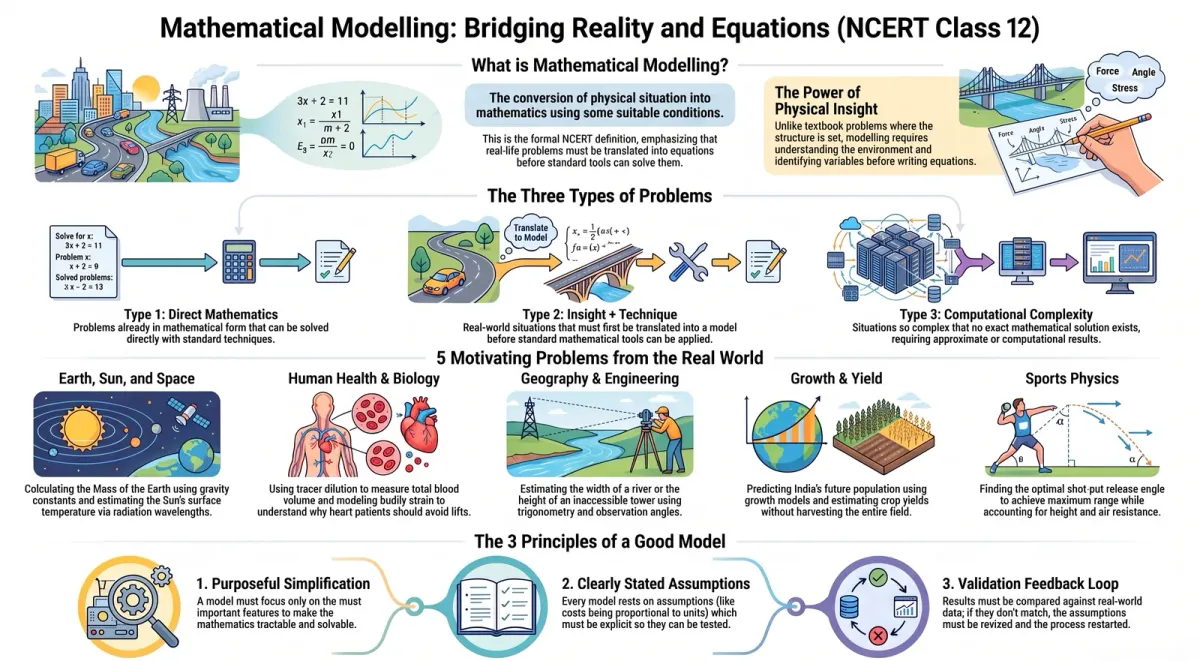
NCERT defines mathematical modelling as “the conversion of physical situation into mathematics using some suitable conditions.” In practical terms, this means taking a real-life situation — one that does not come pre-packaged as an equation — and expressing it in mathematical language so that standard tools can solve it.
What distinguishes mathematical modelling from a typical textbook problem is the physical insight required at the start. In a textbook exercise, the mathematical structure is already set up for you. In the real world, you must first understand the situation deeply, identify the governing relationships, and decide which mathematical tools apply — before writing a single equation.
Three Types of Problems in NCERT Class 12
To explain why mathematical modelling is necessary, NCERT distinguishes between three categories of problems:
-
Type 1: Solvable directly with standard mathematical techniques. All information is already in mathematical form.
-
Type 2: Require physical insight plus standard techniques. The real-world situation must first be translated into a model.
-
Type 3: So complex that no exact mathematical solution exists. Only approximate or computational solutions are possible.
Most problems students encounter in engineering, medicine, or economics are Type 2 or Type 3. Modelling is the skill that handles both — and the reason NCERT dedicates an entire appendix to it.
Nine Motivating Problems from Section A.2.2
NCERT opens Appendix 2 with nine real-world problems to show that mathematical modelling is not abstract theory — it is how practical questions in science and life are actually answered. Here are all nine:
-
Width of a river — estimated using angles of observation from the bank, without crossing it.
-
Optimal shot-put angle — finding the release angle for maximum range, accounting for height, resistance, and gravity.
-
Height of an inaccessible tower — computed from two angles of elevation when the base cannot be reached.
-
Temperature of the Sun’s surface — estimated from the wavelength of maximum radiation emitted.
-
Heart patients and lifts — understanding why cardiac patients are advised against using lifts requires a physical model of bodily strain.
-
Mass of the Earth — calculated using the known gravitational constant and acceleration due to gravity.
-
Yield of pulse crops — estimating total yield from a standing crop without harvesting the entire field.
-
Blood volume in the body — using a tracer dilution technique to estimate total volume without removing all the blood.
-
Population of India in 2020 — projecting forward from census data using a growth model, without waiting until then.
Each of these draws on a different mathematical tool — trigonometry for the tower, differential equations for population growth, matrices for production planning. The seven examples in Appendix 2 work through several of these systematically.
What Makes a Good Mathematical Model?
Three principles define a useful model in NCERT:
Simplification with purpose. A model focuses on the most important features of a situation and ignores the rest. This is not a flaw — it is what makes the mathematics tractable.
Clearly stated assumptions. Every model rests on assumptions. For instance, in the profit model covered in Example 6, variable costs are assumed to be directly proportional to units produced. Stating this assumption explicitly lets others test whether it holds in reality.
Validation against observation. Once the mathematical equations are solved, the results must be compared to real-world data. If they agree well, the model is accepted. If not, the assumptions are revised and the process begins again. This feedback loop is formalised in the five-step framework introduced in Section A.2.3, covered in detail in the next blog in this series.
How This Topic Is Examined in Board Exams and CUET
Questions from the Mathematical Modelling appendix in Class 12 board exams typically include:
-
Define mathematical modelling and explain why it is necessary.
-
State the types of problems for which modelling is required.
-
Name any four motivating problems from NCERT and briefly describe them.
-
Explain what it means to say a mathematical model is always an approximation.
For CUET, which tests reasoning and concept application over rote computation, this chapter gives you a strong analytical foundation. Being able to explain what modelling is, why assumptions matter, and when a model needs revision demonstrates exactly the kind of thinking entrance exams reward.
Master Mathematical Modelling with ChampionsPrep
At ChampionsPrep , you can practise topic-wise questions on NCERT Class 12 Mathematical Modelling — including definition-based MCQs, example-based long-form questions, and conceptual reasoning problems aligned with the board exam pattern. Get instant AI-powered doubt resolution for just ₹10 per session.
👉 Visit https://app.championsprep.in to start practising today.
*
Test Your Knowledge
What Is Mathematical Modelling? A Complete Introduction for NCERT Class 12
Frequently Asked Questions
What is the exact NCERT definition of mathematical modelling? +
NCERT Class 12 Appendix 2 defines mathematical modelling as "the conversion of physical situation into mathematics using some suitable conditions." The process involves identifying variables, applying physical laws, setting up equations, and interpreting the mathematical solution back in the real-world context.
Is mathematical modelling in the CBSE Class 12 board exam syllabus? +
Mathematical modelling appears as Appendix 2 of NCERT Class 12 Mathematics. Many boards include short-answer and definition-based questions from this appendix, asking students to define the concept, list the types of problems, or name the motivating examples.
How many motivating problems does NCERT list in Appendix 2? +
NCERT lists nine motivating problems in Section A.2.2, ranging from finding the width of a river and the height of a tower to estimating the Sun's temperature, Earth's mass, blood volume, and India's future population.
What is the difference between physical insight and a standard mathematical technique? +
A standard mathematical technique is a known formula applied to a problem already set up in mathematical form. Physical insight is the understanding of a real-world situation that allows you to identify which variables matter and how to convert the situation into a solvable mathematical problem.
How does mathematical modelling connect to other Class 12 topics like matrices and calculus? +
Matrices, calculus, and linear programming are the tools used within a modelling framework. The seven worked examples in NCERT Appendix 2 show each tool applied to a different real-world problem — matrices for production planning, calculus for profit and concentration changes, and linear programming for resource optimisation.
AI-powered practice — free to start