
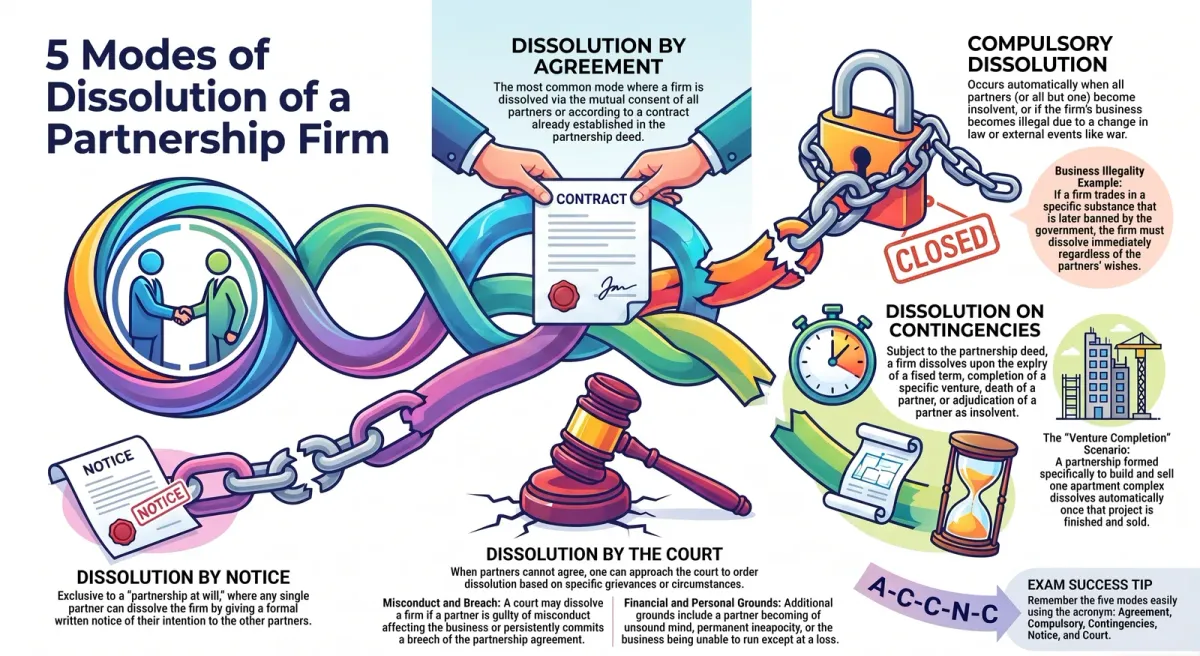
A partnership firm does not dissolve on its own — it dissolves through one of five legally recognised modes under the Indian Partnership Act, 1932. For CBSE Class 12 Accountancy students, this is one of the most frequently tested theory areas in Chapter 4, “Dissolution of Partnership Firm,” often appearing as short-answer questions, true-or-false statements, or scenario-based MCQs. This guide walks through all five modes with clear examples, so you never lose marks on this section again.
Overview: The Five Modes of Dissolution of a Firm
A firm can be dissolved in any of the following five ways:
-
Dissolution by Agreement
-
Compulsory Dissolution
-
Dissolution on the Happening of Certain Contingencies
-
Dissolution by Notice
-
Dissolution by Court
Let’s look at each one in detail.
1. Dissolution by Agreement
The simplest and most common mode of dissolution is dissolution by agreement. A firm is dissolved in this manner when:
-
All the partners give their mutual consent, or
-
The dissolution happens in accordance with a contract already agreed upon between the partners (for example, a clause in the partnership deed).
Example: Three partners running a consultancy firm mutually decide to close the business and divide the proceeds. Since all three agree, this is dissolution by agreement — no external trigger is needed.
2. Compulsory Dissolution
Sometimes, circumstances leave a firm with no choice but to dissolve. This is called compulsory dissolution, and it happens in two main situations:
-
Insolvency of partners: When all the partners, or all but one, become insolvent, they lose the legal capacity to enter into a contract, making it impossible for the firm to continue.
-
Illegality of business: When the firm’s business becomes illegal, or some event makes it unlawful for partners to continue — for instance, if a partner becomes an “alien enemy” following a war declaration between their country and India.
Example: If a firm’s core business (say, trading in a substance later banned by law) becomes illegal overnight, the firm must dissolve compulsorily — regardless of what partners personally want.
3. Dissolution on the Happening of Certain Contingencies
Subject to any contrary agreement between partners, a firm is automatically dissolved when certain pre-defined contingencies occur:
-
Expiry of a fixed term: If the firm was constituted for a specific period, it dissolves when that period ends.
-
Completion of the venture: If formed for one or more specific ventures, it dissolves once those ventures are completed.
-
Death of a partner: Unless the deed states otherwise, the firm dissolves on the death of any partner.
-
Insolvency of a partner: If a partner is adjudicated insolvent, the firm dissolves unless the agreement provides otherwise.
Example: A firm formed specifically to construct and sell one residential project dissolves automatically once that project is completed and sold — this falls under “completion of venture.”
4. Dissolution by Notice
This mode applies specifically to a “partnership at will” — a partnership with no fixed duration or venture attached to it. In such a case, any one partner can dissolve the firm simply by giving a written notice to the other partners, clearly stating their intention to dissolve the partnership.
Example: In a two-partner partnership-at-will running a retail store, if one partner wants to exit and sends a formal written notice expressing this intention, the firm stands dissolved from the date mentioned in the notice (or the date of communication, if none is mentioned).
5. Dissolution by Court
When partners cannot agree among themselves, any one partner can approach the court, which may order dissolution of the firm on several specific grounds, including:
-
A partner becomes of unsound mind (insane).
-
A partner becomes permanently incapable of performing their duties.
-
A partner is guilty of misconduct likely to adversely affect the business.
-
A partner persistently commits breach of the partnership agreement.
-
A partner transfers his entire interest in the firm to a third party.
-
The business cannot be carried on except at a loss.
-
The court considers dissolution to be “just and equitable” on any other ground.
Example: If a partner repeatedly diverts firm funds for personal use in breach of the partnership deed, the other partners can approach the court, which may order dissolution on the ground of persistent breach of agreement.
How to Remember These Modes for Exams
A simple way to remember these five modes is A-C-C-N-C: Agreement, Compulsory, Contingencies, Notice, Court. When a scenario-based question comes up, ask yourself:
-
Did all partners agree? → Dissolution by agreement
-
Did insolvency or illegality force it? → Compulsory dissolution
-
Did a pre-set condition (term, venture, death) trigger it? → Contingency-based dissolution
-
Was it a partnership at will, ended by one partner’s notice? → Dissolution by notice
-
Did a partner have to approach the court? → Dissolution by court
Practice These Concepts with ChampionsPrep
Reading about the modes of dissolution is easy — spotting them correctly in an exam scenario takes practice. ChampionsPrep offers AI-powered, pay-per-use MCQ and long-answer practice banks built specifically for CBSE Class 12 Commerce students, so you can test yourself on exactly this topic for as little as ₹10 per use. Head to https://app.championsprep.in and start practising today.
Test Your Knowledge

Modes of Dissolution of a Partnership Firm: Complete Guide with Examples
Frequently Asked Questions
How many modes of dissolution of a firm are there under the Partnership Act, 1932? +
There are five modes: dissolution by agreement, compulsory dissolution, dissolution on the happening of certain contingencies, dissolution by notice, and dissolution by court.
What is compulsory dissolution? +
Compulsory dissolution occurs when all partners (or all but one) become insolvent, or when the firm's business becomes illegal, leaving the firm with no legal option but to dissolve.
Can a single partner dissolve a partnership at will? +
Yes. In a partnership at will, any one partner can dissolve the firm by giving a written notice to the other partners stating their intention to do so.
On what grounds can a court order dissolution of a firm? +
A court may order dissolution on grounds such as a partner's insanity, permanent incapacity, misconduct, persistent breach of agreement, transfer of entire interest to a third party, the business being able to run only at a loss, or any other ground the court considers just and equitable.
Does the death of a partner always dissolve the firm? +
Not always. Subject to the partnership agreement, the firm is dissolved by the death of a partner unless the partnership deed specifically provides for the business to continue with the remaining partners.
AI-powered practice — free to start