
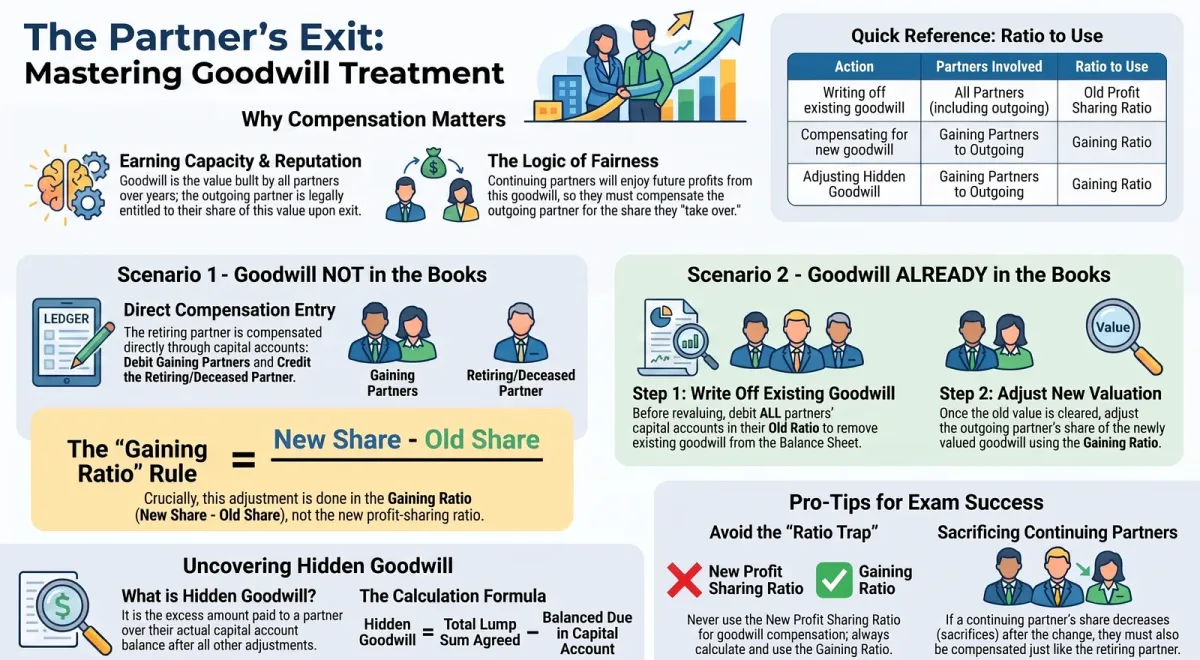
Goodwill represents the reputation and earning capacity a firm has built up over time — and every partner, including one who is retiring or has passed away, has contributed to creating it. That’s why, at the time of retirement or death, the outgoing partner (or their legal representative) is entitled to be compensated for their share of goodwill. This post explains exactly how that compensation is worked out and recorded in the books.
Why Does an Outgoing Partner Get a Share of Goodwill?
Goodwill isn’t created overnight — it builds up through years of combined effort by all partners. When a partner exits the firm, the continuing partners will keep benefiting from that goodwill in the future, while the outgoing partner will not. Fairness demands that the continuing partners compensate the outgoing partner for the share of goodwill they are effectively “taking over.”
The accounting treatment differs depending on whether goodwill already appears in the firm’s books.
Case 1: When Goodwill Does Not Appear in the Books
This is the most common scenario in exam questions. Since there’s no existing Goodwill account to adjust, the retiring/deceased partner is compensated directly through the partners’ capital accounts.
Journal Entry: Gaining Partners’ Capital A/c Dr. (individually, in gaining ratio) To Retiring/Deceased Partner’s Capital A/c
Example: A, B and C share profits 3:2:1. B retires; firm’s goodwill is valued at Rs. 60,000. A and C continue sharing profits 3:1.
B’s share of goodwill = 2/6 × 60,000 = Rs. 20,000. This is debited to A and C’s capital accounts in their gaining ratio, not their new profit sharing ratio. Since A’s old share was 3/6 and new share is 3/4, and C’s old share was 1/6 and new share is 1/4, the gaining ratio works out to 3:1 — so A’s capital is debited Rs. 15,000 and C’s Rs. 5,000, both credited to B.
Case 2: When Goodwill Already Appears in the Books
If the Balance Sheet already shows goodwill (say, from a previous admission), it must first be written off by debiting all partners’ capital accounts — including the outgoing partner’s — in their old profit sharing ratio.
Journal Entry: All Partners’ Capital A/c Dr. (old ratio) To Goodwill A/c
If the firm’s goodwill is then revalued at the time of retirement/death, the outgoing partner’s share of this new valuation is adjusted through the gaining partners’ capital accounts, exactly as in Case 1.
Solved Example
Hanny, Pammy and Sunny share profits 3:2:1. Goodwill already appears in the books at Rs. 60,000. Pammy retires, and goodwill is now revalued at Rs. 84,000. Hanny and Sunny will share future profits 2:1.
Step 1 — Write off old goodwill: Hanny’s, Pammy’s and Sunny’s capital accounts are debited Rs. 30,000, Rs. 20,000 and Rs. 10,000 respectively (old ratio 3:2:1), and Goodwill A/c is credited Rs. 60,000.
Step 2 — Adjust Pammy’s share of the new valuation: Pammy’s share = 1/3 × 84,000 = Rs. 28,000. Hanny’s and Sunny’s gaining ratio works out to 1:1, so each is debited Rs. 14,000, and Pammy’s capital is credited Rs. 28,000.
Hidden Goodwill
Sometimes a question doesn’t give you the value of goodwill directly. Instead, it tells you that the retiring/deceased partner is paid a lump sum that is more than the balance standing in their capital account after all other adjustments. That excess is the retiring partner’s share of the firm’s hidden goodwill; divide the excess by the partner’s profit share to get the firm’s total.
Example: P, Q and R share profits 3:2:1. R retires; after all adjustments, the balance in his capital account is Rs. 60,000. P and Q agree to pay him Rs. 75,000 in full settlement. The excess, Rs. 75,000 − Rs. 60,000 = Rs. 15,000, is R’s share of the goodwill (he holds 1/6 of the profits), so the firm’s hidden goodwill is Rs. 15,000 × 6 = Rs. 90,000. R’s share of Rs. 15,000 is debited to P and Q’s capital accounts in their gaining ratio (3:2), i.e., Rs. 9,000 and Rs. 6,000 respectively, and credited to R.
Key Points to Remember
-
Goodwill is always adjusted through capital accounts, not through a separate Goodwill account, unless goodwill already exists in the books and needs writing off.
-
Existing goodwill is written off in the old ratio; new goodwill compensation is adjusted in the gaining ratio.
-
A partner who has sacrificed part of their future share (even while continuing in the firm) must also be compensated, just like the outgoing partner.
-
Hidden goodwill is identified by comparing the amount actually paid with the balance due as per the capital account.
Common Exam Mistakes
-
Adjusting the outgoing partner’s goodwill share in the new profit sharing ratio instead of the gaining ratio.
-
Forgetting to first write off existing goodwill before adjusting for a revalued amount.
-
Not recognising a hidden goodwill situation when the question mentions a lump-sum settlement different from the capital balance.
Related Reading
-
New Profit Sharing Ratio and Gaining Ratio on Retirement or Death of a Partner
-
Treatment of Goodwill on Admission of a Partner (Journal Entries)
-
Reconstitution of a Partnership Firm: Meaning & Modes (2026 Guide)
Practise This Topic
Goodwill adjustment questions are a favourite in CBSE board papers, and small ratio mix-ups cost easy marks. Practise unlimited goodwill numericals with instant step-by-step solutions on ChampionsPrep .
Test Your Knowledge
Treatment of Goodwill on Retirement or Death of a Partner
Frequently Asked Questions
Why is goodwill adjusted through partners' capital accounts and not a goodwill account? +
Because opening a full Goodwill account for an internally generated asset isn't in line with accounting standards; only the compensation is passed through capital accounts.
In what ratio is an outgoing partner's share of goodwill adjusted? +
It is always adjusted in the gaining ratio of the continuing partners, since they benefit from the increased profit share.
What happens if goodwill already appears in the books at the time of retirement? +
It is first written off by debiting all partners' capital accounts in the old profit sharing ratio, then any revised goodwill value is adjusted separately.
What is hidden goodwill? +
It is goodwill implied by the settlement rather than stated as a value: the excess a retiring or deceased partner is paid over the balance in their capital account after all other adjustments is that partner's share of the firm's hidden goodwill. The firm's total is this excess divided by the partner's profit share.
Can a continuing partner also receive credit for goodwill? +
Yes, if a continuing partner sacrifices part of their future profit share due to a change in the profit sharing ratio, they too are compensated.
AI-powered practice — free to start