
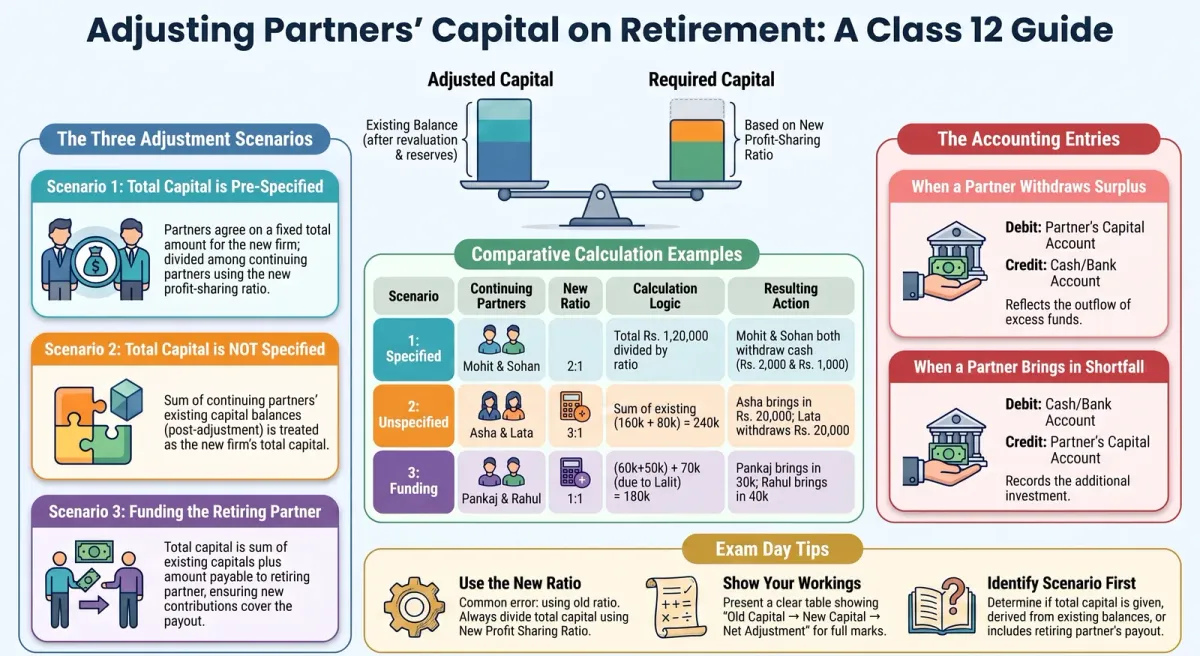
After a partner retires and all adjustments — goodwill, revaluation, reserves — have been passed through the capital accounts, the continuing partners often want their capitals to be in proportion to their new profit sharing ratio. This final step, called capital adjustment, ensures the reconstituted firm starts on a clean, proportionate footing. This post walks through the three common scenarios you’ll encounter in exam questions.
Why Capitals Need to Be Adjusted
It’s common sense in partnership accounting that capital contribution should roughly reflect a partner’s share in profits. When a partner retires and the remaining partners’ profit shares change, their capital balances — shaped by years of past adjustments — rarely align neatly with the new ratio anymore. Partners may therefore decide to bring in additional capital or withdraw the excess, so that capitals match the new profit sharing ratio.
Scenario 1: Total Capital of the New Firm Is Specified
Here, the partners agree on a fixed total capital for the reconstituted firm. This amount is divided among the continuing partners in their new profit sharing ratio, and each partner’s resulting capital is compared with their existing (post-adjustment) balance.
Example: Mohit, Neeraj and Sohan share profits 2:1:1. Neeraj retires, and Mohit and Sohan agree to fix the new firm’s capital at Rs. 1,20,000, shared in their new ratio of 2:1. Their existing capitals (after adjustments) are Rs. 82,000 and Rs. 41,000 respectively.
-
Mohit’s new capital = 1,20,000 × 2/3 = Rs. 80,000 → he must withdraw Rs. 2,000
-
Sohan’s new capital = 1,20,000 × 1/3 = Rs. 40,000 → he must withdraw Rs. 1,000
Scenario 2: Total Capital of the New Firm Is Not Specified
If no fixed total is mentioned, the sum of the continuing partners’ existing (adjusted) capital balances is treated as the new firm’s total capital. This total is then redivided among them in the new profit sharing ratio.
Example: Asha, Deepa and Lata share profits 3:2:1. Deepa retires. After adjustments, Asha’s and Lata’s capitals stand at Rs. 1,60,000 and Rs. 80,000 — a total of Rs. 2,40,000. Their new ratio is 3:1.
-
Asha’s new capital = 2,40,000 × 3/4 = Rs. 1,80,000 → she must bring in Rs. 20,000
-
Lata’s new capital = 2,40,000 × 1/4 = Rs. 60,000 → she must withdraw Rs. 20,000
Scenario 3: Continuing Partners Contribute to Pay the Retiring Partner
Sometimes, the question specifies that the amount payable to the retiring partner will be brought in by the continuing partners themselves, in such a way that their own capitals end up proportionate to their new profit sharing ratio.
Here, the total new capital of the firm = existing (adjusted) capitals of continuing partners + amount payable to the retiring partner. This total is divided in the new ratio, and each continuing partner’s required contribution is worked out by comparing this new capital with their existing balance.
Example: Lalit, Pankaj and Rahul share profits 4:3:3. Lalit retires; the balances of Pankaj and Rahul (after adjustments) are Rs. 60,000 and Rs. 50,000, and the amount payable to Lalit is Rs. 70,000. Total capital of the new firm = Rs. 1,80,000, shared equally (new ratio 1:1) since Pankaj and Rahul’s new shares both work out to 3/6.
-
Pankaj’s new capital = Rs. 90,000 → brings in Rs. 30,000
-
Rahul’s new capital = Rs. 90,000 → brings in Rs. 40,000
The combined Rs. 70,000 brought in is then paid out to Lalit.
Journal Entries for Capital Adjustment
When a partner withdraws excess capital:
| Particulars | Dr (₹) | Cr (₹) |
|---|---|---|
| Partner’s Capital A/c Dr. | ||
| To Cash/Bank A/c |
When a partner brings in additional capital:
| Particulars | Dr (₹) | Cr (₹) |
|---|---|---|
| Cash/Bank A/c Dr. | ||
| To Partner’s Capital A/c |
Solved Example: Putting It All Together
Continuing with Scenario 2 above (Asha, Deepa, Lata), once the adjusted amounts are known:
| Particulars | Dr (₹) | Cr (₹) |
|---|---|---|
| Bank A/c Dr. | 20,000 | |
| To Asha’s Capital A/c | 20,000 | |
| (Cash brought in by Asha) |
| Particulars | Dr (₹) | Cr (₹) |
|---|---|---|
| Lata’s Capital A/c Dr. | 20,000 | |
| To Bank A/c | 20,000 | |
| (Surplus capital withdrawn by Lata) |
Notice how the total cash flow nets out — one partner’s contribution effectively funds another’s withdrawal, keeping the firm’s overall cash position broadly stable in simple cases.
Exam Tips
-
Always identify which scenario applies first — is a total capital given, or must it be derived from existing balances or from the amount payable to the retiring partner?
-
Use the new profit sharing ratio, not the old one, when dividing the total capital among continuing partners.
-
Present your workings as a clear table: Old Capital → New Capital → Amount to Bring In/Withdraw. Examiners reward clear, step-by-step presentation.
-
Don’t forget to record the actual journal entries after your workings — many students calculate the figures correctly but skip the entries and lose easy marks.
Practise This Topic
Capital adjustment questions test whether you can combine multiple concepts into one clean answer. Sharpen this skill with structured practice sets and instant, step-by-step solutions on ChampionsPrep .
Test Your Knowledge

Adjustment of Partners' Capital on Retirement of a Partner
Frequently Asked Questions
Why is capital adjustment necessary after a partner retires? +
So that the continuing partners' capital balances are proportionate to their new profit sharing ratio, keeping the firm's capital structure fair and consistent going forward.
How is the new capital calculated if the total capital of the firm is not specified? +
It is taken as the sum of the continuing partners' existing post-adjustment capital balances, then redivided among them in the new profit sharing ratio.
What happens if a partner's existing capital is higher than their new required capital? +
The excess amount is withdrawn by that partner in cash.
What happens if a partner's existing capital is lower than their new required capital? +
The partner must bring in the shortfall amount in cash to reach their required new capital.
Can continuing partners fund the payment to a retiring partner directly? +
Yes, in some cases continuing partners bring in cash specifically to pay the retiring partner's dues, calculated so their own capitals remain proportionate to the new profit sharing ratio.
AI-powered practice — free to start