
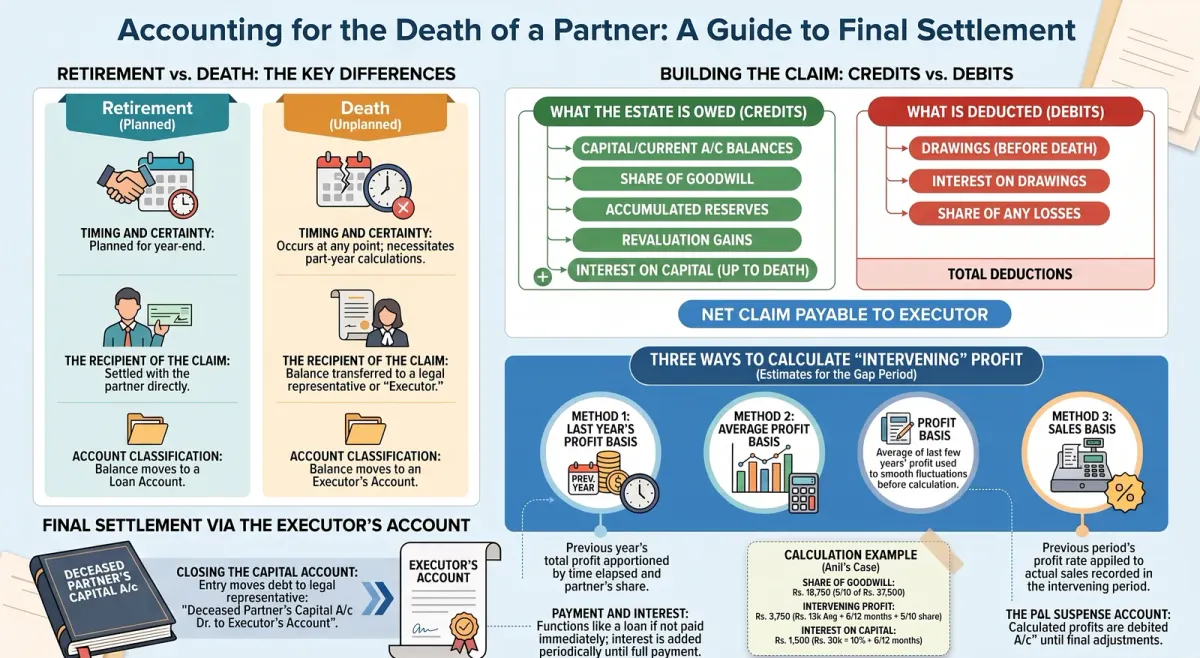
The accounting treatment for the death of a partner closely mirrors that for retirement — goodwill, revaluation, and accumulated profits are all handled the same way. But death introduces one key complication: it can happen at any point during the accounting year, not conveniently at year-end like most retirements. This post explains how that difference is handled, and how a deceased partner’s final claim is settled through an Executor’s Account.
Retirement vs Death: What’s Different in Accounting Treatment
| Basis | Retirement | Death |
|---|---|---|
| Timing | Usually planned, often at year-end | Can occur any time during the year |
| Claim settled with | The retiring partner directly | Legal representative/Executor |
| Profit share calculation | Usually straightforward (year-end figures available) | Must be estimated for a part-year (intervening) period |
| Account used for balance | Retiring Partner's Loan A/c | Executor's Account |
What the Deceased Partner’s Claim Includes
Just like a retiring partner, the deceased partner’s legal representative is entitled to:
-
Credit balance of capital and current accounts
-
Share of goodwill of the firm
-
Share of accumulated profits (reserves)
-
Share of gain on revaluation of assets and liabilities
-
Share of profit up to the date of death
-
Interest on capital up to the date of death
Less any drawings, interest on drawings, and share of losses up to the date of death.
Calculating Share of Profit for the Intervening Period
Since closing the books mid-year to calculate exact profit is impractical, the deceased partner’s share of profit for the period between the last Balance Sheet date and the date of death is usually estimated using one of three methods:
Method 1: On the Basis of Last Year’s Profit
The previous year’s profit is apportioned on a time basis, then multiplied by the deceased partner’s profit share.
Example: Bakul, Champak and Darshan share profits 5:4:1. Profit for the year ended March 31 was Rs. 1,00,000. Champak dies on June 30 (3 months later).
Champak’s share = Rs. 1,00,000 × 3/12 × 4/10 = Rs. 10,000
Method 2: On the Basis of Average Profit
Instead of just the previous year’s profit, the average profit of the last few years is used, and the same time-and-share apportionment is applied. This smooths out any unusually high or low profit in a single year.
Method 3: On the Basis of Sales
If sales figures are more readily available or reliable than profit figures, the profit rate (profit ÷ sales) from a previous period is applied to the intervening period’s sales, and then apportioned by the deceased partner’s profit share.
In all three methods, the calculated amount is recorded as:
| Particulars | Dr (₹) | Cr (₹) |
|---|---|---|
| Profit and Loss Suspense A/c Dr. | ||
| To Deceased Partner’s Capital A/c |
This “suspense” account is later closed by debiting the gaining partners’ capital accounts in their gaining ratio.
Interest on Capital and Drawings up to Death
Interest on capital, where applicable, is calculated only for the actual number of months the deceased partner’s capital remained in the firm during that year — not the full year. Similarly, if the partner withdrew any amount before death, interest on drawings (if the deed requires it) is calculated up to the date of death only.
The Executor’s Account
Once the deceased partner’s Capital Account is finalised, the closing balance is transferred to an Executor’s Account — this is simply the equivalent of a Retiring Partner’s Loan Account, but for the legal representative of someone who has passed away.
Journal Entry:
| Particulars | Dr (₹) | Cr (₹) |
|---|---|---|
| Deceased Partner’s Capital A/c Dr. | ||
| To Executor’s Account |
If part of the amount is paid immediately and the rest later (often with interest), the Executor’s Account is prepared just like a loan account, with interest added periodically until the balance is settled in full.
Solved Example
Anil, Bhanu and Chandu share profits 5:3:2. Anil dies on October 1. Goodwill is valued at 2½ years’ purchase of the average profit of the last four years (Rs. 13,000, Rs. 12,000, Rs. 20,000, Rs. 15,000), giving an average profit of Rs. 15,000 and firm goodwill of Rs. 37,500. Anil’s share of goodwill = 5/10 × 37,500 = Rs. 18,750.
His share of profit for the 6-month intervening period, based on the same average profit, works out to Rs. 15,000 × 6/12 × 5/10 = Rs. 3,750. Interest on his capital of Rs. 30,000 for 6 months at 10% p.a. adds a further Rs. 1,500. All these amounts, along with his capital balance and reserve share, are totalled in his Capital Account and then transferred to his Executor’s Account, half of which is paid immediately, with the balance carried forward.
Exam Tips
-
Always check whether the question specifies the method for calculating the intervening period’s profit — last year’s profit, average profit, or sales-based — since each gives a different figure.
-
Remember that interest on capital and drawings for a deceased partner is calculated only up to the date of death, not the full year.
-
Present the final answer clearly in two parts: the Deceased Partner’s Capital Account and the Executor’s Account.
Practise This Topic
Death-of-partner questions combine several concepts at once — goodwill, revaluation, profit apportionment, and executor accounts. Practise complete exam-style problems with instant step-by-step solutions on ChampionsPrep .
Test Your Knowledge

Death of a Partner: How Is the Deceased Partner's Claim Settled?
Frequently Asked Questions
How is the death of a partner different from retirement in accounting terms? +
Death can occur at any time during the year, requiring an estimate of profit for the intervening period, and settlement is made with the partner's legal representative through an Executor's Account.
What are the methods used to calculate a deceased partner's share of profit? +
The three common methods are based on the previous year's profit, average profit of past years, or the sales-to-profit relationship applied to intervening period sales.
What is an Executor's Account? +
It is the account used to record and settle the amount due to the legal representative of a deceased partner, functioning like a retiring partner's loan account.
Is interest on capital calculated for the full year in case of death? +
No, it is calculated only for the period from the start of the accounting year to the date of death.
How is the Profit and Loss Suspense Account closed? +
It is closed by debiting the gaining partners' capital accounts in their gaining ratio, since they benefit from the deceased partner's exit.
AI-powered practice — free to start