
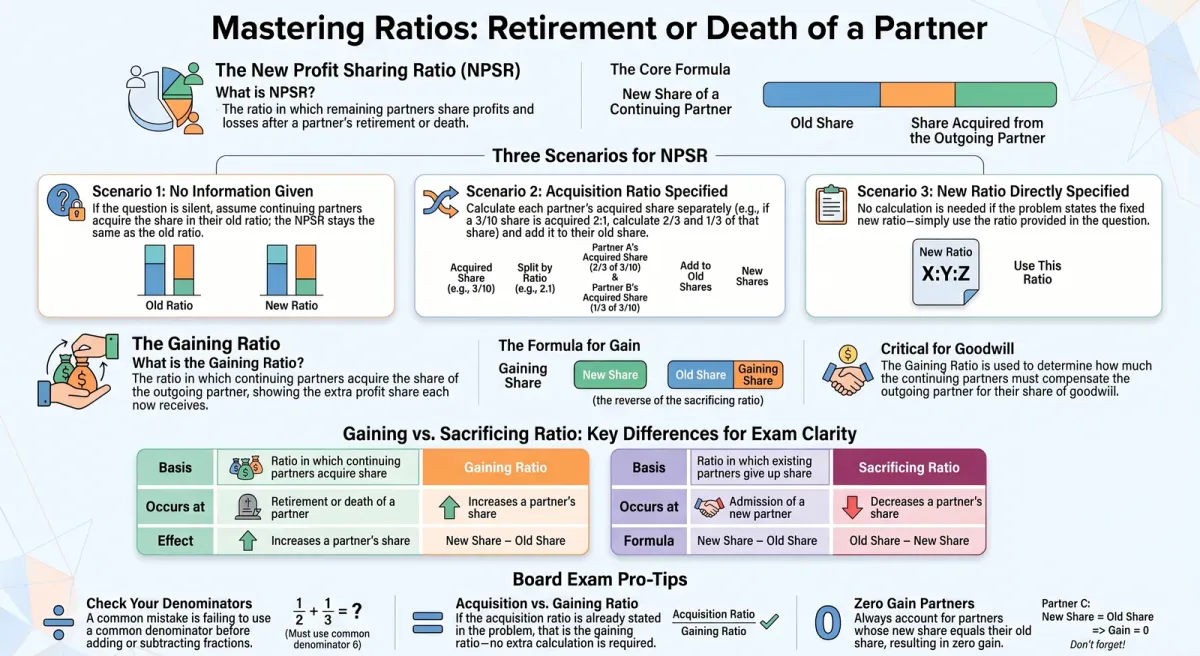
When a partner retires or passes away, a partnership firm doesn’t automatically dissolve — it is “reconstituted,” and the remaining partners continue the business under revised terms. The first thing that changes is how future profits will be divided. This is where new profit sharing ratio and gaining ratio become essential concepts for every CBSE Class 12 Accountancy student. Below, we break down what these ratios mean, how to calculate them, and work through solved examples for your exams.
What Is the New Profit Sharing Ratio?
The new profit sharing ratio (NPSR) is the ratio in which the remaining partners will share profits and losses after a partner retires or dies. Since the outgoing partner’s share doesn’t simply disappear, it must be redistributed among the continuing partners.
The underlying logic is simple:
New Share of a Continuing Partner = Old Share + Share Acquired from the Outgoing Partner
How the “acquired share” is determined depends entirely on the information given in the question.
Situation 1: No Information Given
If a question doesn’t mention how the continuing partners are acquiring the outgoing partner’s share, it is assumed they acquire it in their old profit sharing ratio. In such cases, the new ratio among the remaining partners simply stays the same as their old ratio.
For example, if A, B and C share profits in the ratio 3:2:1 and B retires with no further information, the new ratio between A and C will remain 3:1 — exactly as before.
Situation 2: Acquisition Ratio Specified
Sometimes, continuing partners agree to acquire the outgoing partner’s share in a different ratio. Here, calculate each partner’s acquired share separately and add it to their old share.
Example: Naveen, Suresh and Tarun share profits in the ratio 5:3:2. Suresh retires, and his share is acquired by Naveen and Tarun in the ratio 2:1.
-
Suresh’s share = 3/10
-
Naveen acquires 2/3 of 3/10 = 2/10
-
Tarun acquires 1/3 of 3/10 = 1/10
-
Naveen’s new share = 5/10 + 2/10 = 7/10
-
Tarun’s new share = 2/10 + 1/10 = 3/10
New profit sharing ratio = 7:3
Situation 3: New Ratio Directly Specified
Occasionally, partners simply agree on a fixed new ratio going forward. In such cases, no calculation is needed — you just use the ratio stated in the question.
What Is the Gaining Ratio?
The gaining ratio is the ratio in which the continuing partners have gained a share of profit from the retiring or deceased partner. It shows how much extra profit share each continuing partner is now entitled to, compared to before.
Gaining Share = New Share − Old Share
This is essentially the mirror image of the sacrificing ratio used at the time of admission of a new partner — instead of giving up a share, partners are now gaining one.
When Do You Need to Calculate the Gaining Ratio?
You calculate the gaining ratio only when the new profit sharing ratio of continuing partners is directly given, and you must work backwards. If the acquisition ratio is already stated, that itself is the gaining ratio.
Solved Example
Amit, Dinesh and Gagan share profits in the ratio 5:3:2. Dinesh retires, and Amit and Gagan decide to share future profits in the ratio 3:2.
-
Amit’s old share = 5/10; new share = 3/5 = 6/10 → Gain = 6/10 − 5/10 = 1/10
-
Gagan’s old share = 2/10; new share = 2/5 = 4/10 → Gain = 4/10 − 2/10 = 2/10
Gaining Ratio of Amit and Gagan = 1:2
This means Amit gains 1/3 and Gagan gains 2/3 of Dinesh’s share of profit — a detail that becomes crucial later when adjusting goodwill.
Gaining Ratio vs Sacrificing Ratio
| Basis | Gaining Ratio | Sacrificing Ratio |
|---|---|---|
| Meaning | Ratio in which continuing partners acquire a retiring/deceased partner's share | Ratio in which existing partners give up share for a new partner |
| Occurs at | Retirement or death of a partner | Admission of a new partner |
| Effect on share | Increases a partner's share | Decreases a partner's share |
| Formula | New Share − Old Share | Old Share − New Share |
Why This Topic Matters for Your Board Exam
Nearly every numerical question on retirement or death of a partner begins with these two ratios, because they’re reused later — especially while adjusting goodwill, where the outgoing partner is compensated in the continuing partners’ gaining ratio. Getting this first step wrong can throw off your entire answer.
Common Mistakes Students Make
-
Confusing gaining ratio with the acquisition ratio — if the acquisition ratio is already stated, no further calculation is needed.
-
Forgetting to use a common denominator before adding or subtracting fractions.
-
Mixing up old and new share — always subtract old from new, never the reverse.
-
Ignoring a partner who neither gains nor sacrifices — their new share can equal their old share, meaning zero gain.
Final Thoughts
Mastering these two ratios lays the foundation for the entire chapter on retirement and death of a partner. Once you’re comfortable here, goodwill adjustment and capital adjustment become far easier, since both build directly on these ratios.
Related Reading
-
Change in Profit Sharing Ratio Among Existing Partners (Class 12)
-
Reconstitution of a Partnership Firm: Meaning & Modes (2026 Guide)
-
Sacrificing Ratio in Partnership Accounts: Meaning, Formula and Examples
Practise This Topic
Nearly every retirement or death numerical starts with the new profit sharing ratio and gaining ratio, and a slip here throws off the whole answer. Practise chapter-wise ratio questions with instant solutions on ChampionsPrep .
Test Your Knowledge

New Profit Sharing Ratio and Gaining Ratio on Retirement or Death of a Partner
Frequently Asked Questions
What is the difference between new profit sharing ratio and gaining ratio? +
The new profit sharing ratio is the ratio in which continuing partners will share future profits, while the gaining ratio shows how much extra share each partner has gained compared to their old share.
How do you calculate the new profit sharing ratio if no information is given? +
In the absence of specific information, it is assumed that continuing partners acquire the outgoing partner's share in their old profit sharing ratio, so the new ratio equals the old ratio among the remaining partners.
Can the gaining ratio be different for each continuing partner? +
Yes. Depending on how the outgoing partner's share is distributed, one partner may gain more than another, or a partner may not gain at all.
Why is the gaining ratio important when accounting for goodwill? +
Because the retiring or deceased partner's share of goodwill is compensated by the continuing partners in their gaining ratio, since they are the ones benefiting from the increased profit share.
Is the gaining ratio always equal to the old profit sharing ratio? +
Not always. It equals the old ratio only when the acquisition ratio isn't separately specified; otherwise, it must be calculated as New Share minus Old Share.
AI-powered practice — free to start