
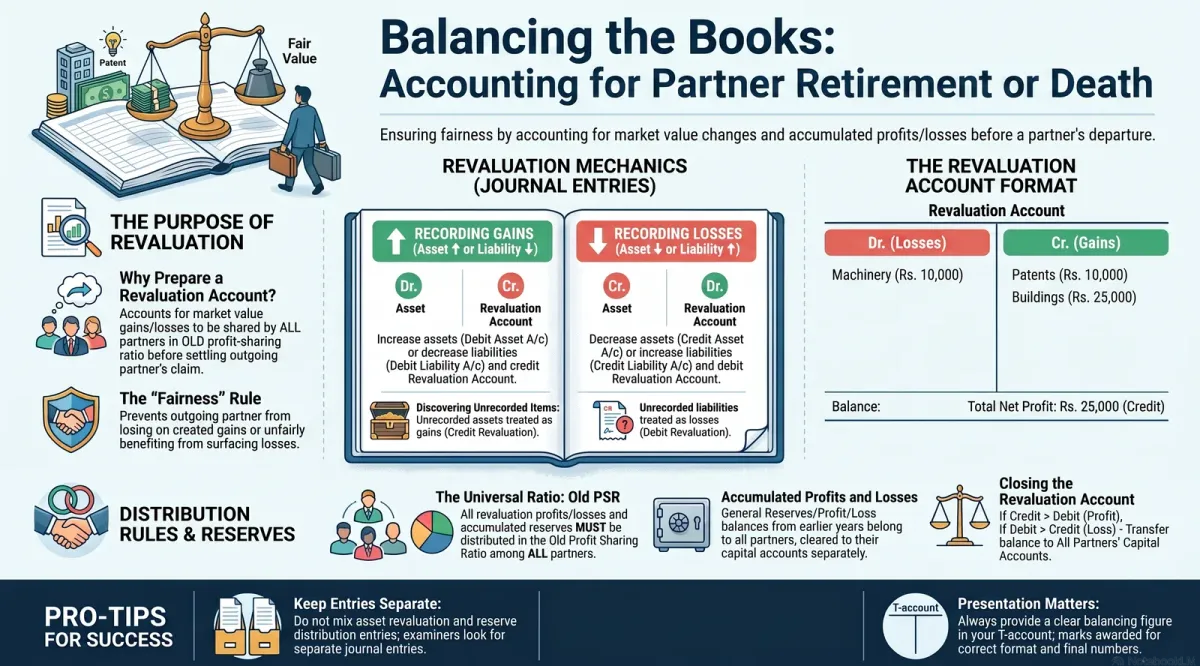
Book values of assets and liabilities rarely match their true worth by the time a partner retires or dies. A building bought years ago may now be worth much more; a debtor may have become doubtful. Before settling the outgoing partner’s claim, the firm must reflect these true values — and that’s exactly what the Revaluation Account is for.
Why a Revaluation Account Is Prepared
The purpose is simple: to ensure that any gain or loss arising from undervalued or overvalued assets and liabilities — up to the date of retirement or death — is shared by all partners, including the outgoing one, in their old profit sharing ratio. This way, the outgoing partner neither loses out on a gain they helped create, nor unfairly benefits from a loss that surfaces later.
Journal Entries for Revaluation
Increase in the Value of an Asset
| Particulars | Dr (₹) | Cr (₹) |
|---|---|---|
| Asset A/c Dr. | ||
| To Revaluation A/c |
Decrease in the Value of an Asset
| Particulars | Dr (₹) | Cr (₹) |
|---|---|---|
| Revaluation A/c Dr. | ||
| To Asset A/c |
Increase in the Amount of a Liability
| Particulars | Dr (₹) | Cr (₹) |
|---|---|---|
| Revaluation A/c Dr. | ||
| To Liability A/c |
Decrease in the Amount of a Liability
| Particulars | Dr (₹) | Cr (₹) |
|---|---|---|
| Liability A/c Dr. | ||
| To Revaluation A/c |
Unrecorded Assets and Liabilities
An unrecorded asset discovered at this stage is debited to the Asset A/c and credited to Revaluation A/c; an unrecorded liability is debited to Revaluation A/c and credited to the Liability A/c. These are amounts that existed but were never entered in the books — bringing them in ensures the reconstituted firm starts with accurate figures.
Distributing the Profit or Loss on Revaluation
Once all the above entries are passed, the Revaluation Account is balanced. If the credit side (gains/decreases in liabilities) exceeds the debit side (losses/increases in liabilities), it’s a profit on revaluation; otherwise, it’s a loss. This net figure is transferred to all partners’ capital accounts, including the retiring/deceased partner, in the old profit sharing ratio.
Profit entry: Revaluation A/c Dr. → To All Partners’ Capital A/cs Loss entry: All Partners’ Capital A/cs Dr. → To Revaluation A/c
Treatment of Accumulated Profits and Losses
Apart from asset/liability revaluation, a firm’s Balance Sheet may also carry accumulated profits (General Reserve) or accumulated losses (a debit balance in the Profit and Loss Account) from earlier years. Since these belong to all partners jointly, they too must be distributed before the outgoing partner’s claim is finalised — again, in the old profit sharing ratio.
For accumulated profits/reserves:
| Particulars | Dr (₹) | Cr (₹) |
|---|---|---|
| Reserve A/c Dr. | ||
| To All Partners’ Capital A/cs |
For accumulated losses:
| Particulars | Dr (₹) | Cr (₹) |
|---|---|---|
| All Partners’ Capital A/cs Dr. | ||
| To Profit and Loss A/c |
Solved Example
Mitali, Indu and Geeta share profits 5:3:2. Geeta retires. It is agreed that Machinery (book value Rs. 1,50,000) be valued at Rs. 1,40,000; Patents (Rs. 30,000) at Rs. 40,000; and Buildings (Rs. 1,00,000) at Rs. 1,25,000.
-
Machinery decreases by Rs. 10,000 → debit to Revaluation A/c
-
Patents increase by Rs. 10,000 → credit to Revaluation A/c
-
Buildings increase by Rs. 25,000 → credit to Revaluation A/c
Net profit on revaluation = Rs. 35,000 (credit) − Rs. 10,000 (debit) = Rs. 25,000, shared by Mitali, Indu and Geeta in their old ratio 5:3:2 — that is, Rs. 12,500, Rs. 7,500 and Rs. 5,000 respectively.
Format of the Revaluation Account
| Dr. Particulars (Losses/Decreases) | Amount | Cr. Particulars (Gains/Increases) | Amount |
|---|---|---|---|
| Decrease in asset values | xxx | Increase in asset values | xxx |
| Increase in liabilities | xxx | Decrease in liabilities | xxx |
| Unrecorded liabilities | xxx | Unrecorded assets | xxx |
| Profit transferred to capital A/cs | xxx | Loss transferred to capital A/cs | xxx |
Exam Tips
-
Always use the old ratio for distributing revaluation profit/loss and accumulated reserves — this is the single most tested concept in this section.
-
Keep asset revaluation entries and reserve/accumulated loss entries separate; don’t mix them into one journal entry.
-
Double-check whether the question is asking you to revalue only for the retiring partner’s benefit (in which case a Memorandum Revaluation Account may be used) or to permanently revise the books.
-
Present your Revaluation Account neatly with a clear balancing figure — examiners award marks for correct format, not just the correct number.
Practise This Topic
Revaluation Account questions test both concept and presentation. Get topic-wise practice sets, model answer formats, and instant feedback on ChampionsPrep .
Test Your Knowledge

Revaluation of Assets and Liabilities & Accumulated Profits on Retirement or Death of a Partner
Frequently Asked Questions
Why is a Revaluation Account prepared at retirement or death of a partner? +
To record the true current value of assets and liabilities and bring unrecorded items into the books, so any resulting gain or loss is fairly shared by all partners before the outgoing partner's claim is settled.
In which ratio is revaluation profit or loss shared? +
It is always shared among all partners, including the retiring or deceased one, in their old profit sharing ratio.
How is an increase in the value of an asset recorded? +
By debiting the Asset Account and crediting the Revaluation Account.
Are accumulated profits and losses treated the same way as revaluation profit or loss? +
Yes, both are distributed among all partners in the old profit sharing ratio, though recorded through separate journal entries.
What happens to unrecorded assets or liabilities discovered at retirement? +
They are brought into the books through the Revaluation Account; an unrecorded asset is credited to it, and an unrecorded liability is debited to it.
AI-powered practice — free to start