
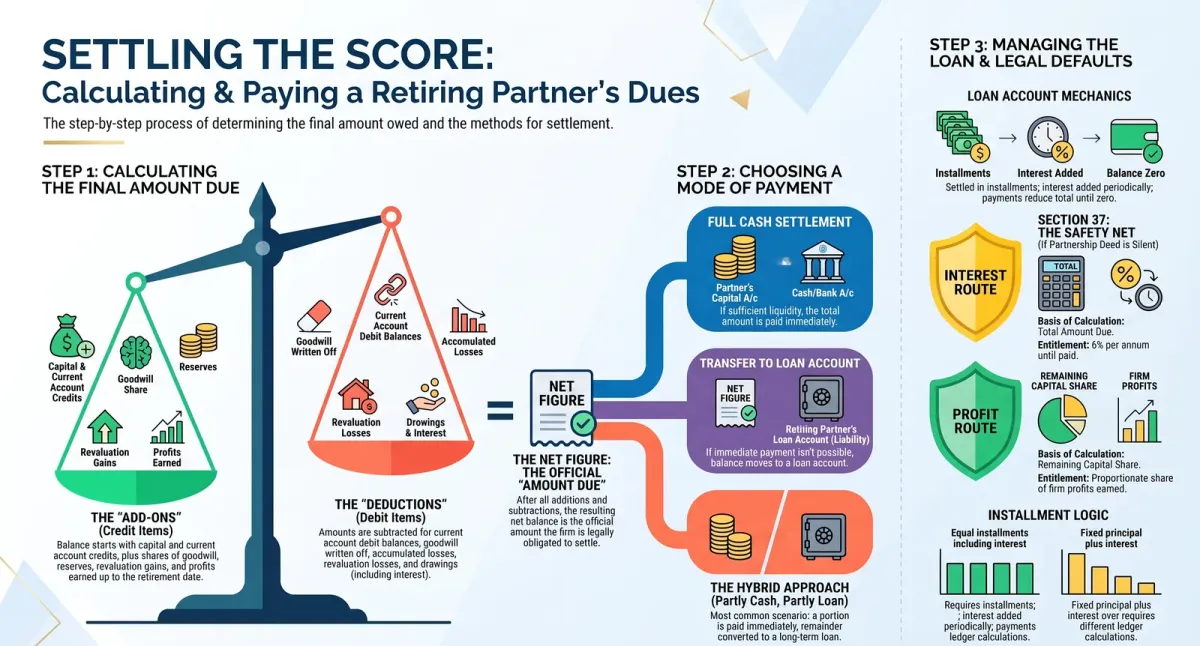
Once all adjustments — goodwill, revaluation, reserves, and profit share — have been made, a firm arrives at the final amount owed to a retiring partner. But how is this amount actually paid out? This post covers the components of the amount due, the different modes of payment, and how a Retiring Partner’s Loan Account works when the firm can’t pay everything at once.
What Makes Up the Amount Due to a Retiring Partner?
The final balance in a retiring partner’s capital account, ready for settlement, typically includes:
-
Credit balance of capital and current accounts
-
Share of goodwill
-
Share of accumulated profits/reserves
-
Share of gain on revaluation of assets and liabilities
-
Share of profit up to the date of retirement
-
Interest on capital and any salary/commission due
From this, the following are deducted, if applicable:
-
Debit balance of current account
-
Share of goodwill written off
-
Share of accumulated losses
-
Share of loss on revaluation
-
Drawings and interest on drawings up to the date of retirement
The net figure is the amount the firm must now pay the retiring partner.
Modes of Payment to a Retiring Partner
Full Payment in Cash
If the firm has sufficient funds, the entire amount can be paid immediately:
| Particulars | Dr (₹) | Cr (₹) |
|---|---|---|
| Retiring Partner’s Capital A/c Dr. | ||
| To Cash/Bank A/c |
Entire Amount Treated as a Loan
If the firm cannot pay immediately, the whole balance may be transferred to a loan account, to be repaid later, usually with interest:
| Particulars | Dr (₹) | Cr (₹) |
|---|---|---|
| Retiring Partner’s Capital A/c Dr. | ||
| To Retiring Partner’s Loan A/c |
Partly Cash, Partly Loan
This is the most common scenario in exam problems — part of the amount is paid immediately, and the balance is transferred to a loan account:
| Particulars | Dr (₹) | Cr (₹) |
|---|---|---|
| Retiring Partner’s Capital A/c Dr. (total amount due) | ||
| To Cash/Bank A/c (amount paid) | ||
| To Retiring Partner’s Loan A/c (amount of loan) |
The Retiring Partner’s Loan Account
Until it is fully repaid, this loan account is shown on the liabilities side of the Balance Sheet. Each year (or instalment period), interest is added to the outstanding balance, and the instalment paid is deducted:
For interest: Interest A/c Dr. → To Retiring Partner’s Loan A/c For payment: Retiring Partner’s Loan A/c Dr. → To Cash/Bank A/c
This cycle repeats until the loan is paid off in full.
Section 37 of the Indian Partnership Act, 1932
What happens if the partnership deed says nothing about how or when the retiring partner should be paid? This is where Section 37 steps in. It gives the outgoing partner (or their legal representative, in case of death) the right to choose between:
-
Interest at 6% per annum on the amount due, from the date of retirement/death until it is fully paid, or
-
A proportionate share of the profits earned by the firm using that partner’s share of capital, for the period the amount remains unpaid.
This provision exists to protect an outgoing partner’s interests when the deed is silent, and it’s a frequently asked theory point in board exams.
Solved Example: Instalment Payment with Interest
Amrinder, Mahinder and Joginder are partners. On Mahinder’s retirement, Rs. 60,000 becomes due to him, to be paid in four equal yearly instalments including interest @12% p.a. on the unpaid balance.
Using the standard annuity approach, each equal instalment (covering both principal and interest) works out to approximately Rs. 19,754 per year. In Year 1, interest of Rs. 7,200 (12% of Rs. 60,000) is added, and the instalment of Rs. 19,754 is paid, leaving a reduced balance to carry forward. This process is repeated each year — interest is calculated afresh on the outstanding balance — until the account reaches zero after the fourth payment.
Alternatively, if the deed specifies unequal instalments (say, a fixed principal amount plus interest each year), the loan account is prepared the same way, but the principal component paid remains constant while only the interest component reduces each year.
Exam Tips
-
Always show the Retiring Partner’s Loan Account as a separate ledger account when instalments are involved — don’t merge it with the Capital Account.
-
Read the question carefully to see whether instalments are “equal amounts including interest” or “equal principal plus interest” — the two produce different figures.
-
Remember that Section 37 applies only when there is no agreement on the mode of settlement; if the deed specifies terms, those terms override Section 37.
Practise This Topic
Loan account and instalment-based questions often trip up students under time pressure. Build speed and accuracy with structured practice sets and instant solutions on ChampionsPrep .
Test Your Knowledge

How Is the Amount Due to a Retiring Partner Settled?
Frequently Asked Questions
What does the amount due to a retiring partner include? +
It includes the capital balance, share of goodwill, share of reserves, share of revaluation gain, and share of profit up to retirement, less any losses, drawings and interest on drawings.
What happens if a firm cannot pay a retiring partner immediately? +
The unpaid amount is transferred to the Retiring Partner's Loan Account, shown on the liabilities side of the Balance Sheet until fully repaid.
What does Section 37 of the Indian Partnership Act, 1932 provide? +
In the absence of an agreement, the outgoing partner may choose between 6% per annum interest on the unpaid amount or a proportionate share of profits earned using their capital.
Is interest compulsory on a retiring partner's loan account? +
Only if the partnership deed or settlement terms specify it; otherwise, Section 37 provides the default entitlement.
Can a retiring partner be paid partly in cash and partly through a loan account? +
Yes, this is a common arrangement where part is paid immediately and the remaining balance is transferred to a loan account for future settlement.
AI-powered practice — free to start