
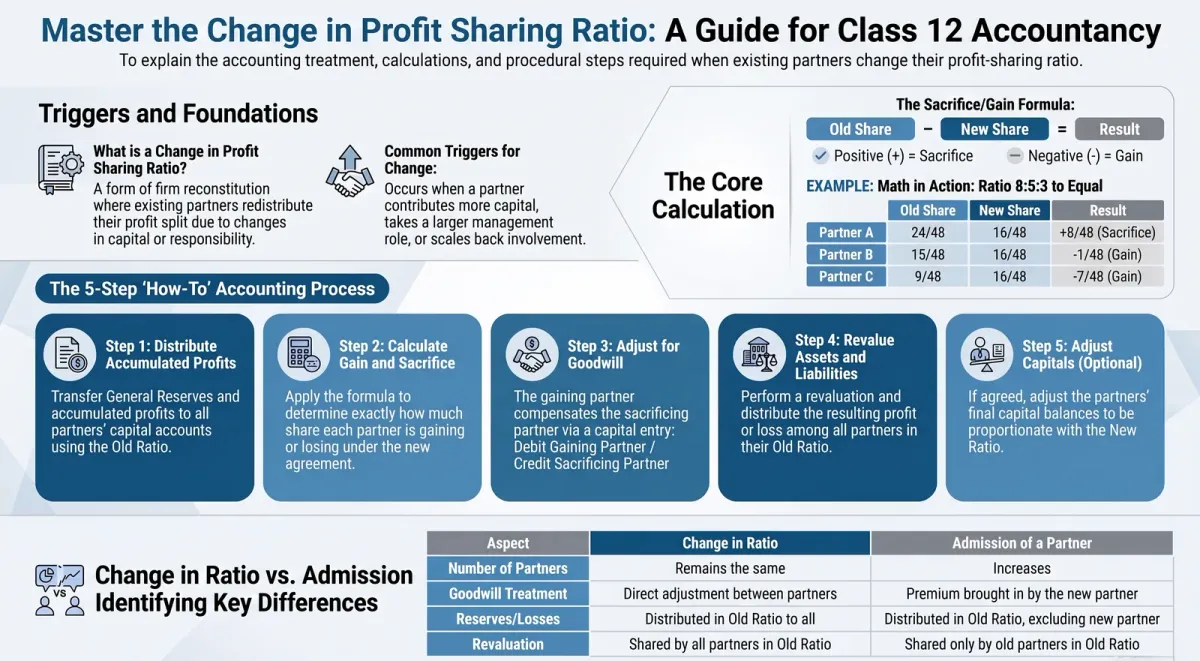
Not every reconstitution involves someone joining or leaving a firm. Sometimes the same partners simply decide their existing profit split no longer makes sense — perhaps one partner has taken on more responsibility or contributed additional capital — and they agree to a new ratio. This is called a change in profit sharing ratio among existing partners, a distinct reconstitution scenario tested in CBSE Class 12 Accountancy.
What Triggers a Change in Profit Sharing Ratio?
This typically happens when a partner starts contributing significantly more capital, takes on a larger managerial role, scales back involvement without formally retiring, or when partners mutually feel the current split no longer reflects each person’s contribution. Even though no partner joins or leaves, this still counts as reconstitution, because the profit-sharing terms have genuinely changed.
The Core Concept: Gain and Sacrifice
Just as in admission of a partner, a change in ratio creates winners and losers: a partner whose new share is smaller than their old share has sacrificed; one whose new share is larger has gained. The formula: Sacrifice or Gain = Old Share − New Share (a positive result is a sacrifice, negative is a gain).
Worked Example: Calculating Gain and Sacrifice
Example: A, B and C share profits 8:5:3. They decide to share profits equally going forward.
-
A: 8/16 − 1/3 = 24/48 − 16/48 = 8/48 → sacrifices 1/6
-
B: 5/16 − 1/3 = 15/48 − 16/48 = −1/48 → gains 1/48
-
C: 3/16 − 1/3 = 9/48 − 16/48 = −7/48 → gains 7/48
So A alone sacrifices, while both B and C gain, with C gaining considerably more. This illustrates an important exam point: multiple partners can gain simultaneously at the expense of a single partner, or vice versa.
Why Does Goodwill Still Matter Here?
Since some partners are now entitled to a larger share of future super-profits and others a smaller share, the same logic used in admission applies: the gaining partner must compensate the sacrificing partner, since they’re effectively “buying” a bigger slice of the firm’s earning capacity. This is handled through a direct capital account adjustment, without raising and writing off a full Goodwill account:
Gaining Partner's Capital A/c        Dr.
    To Sacrificing Partner's Capital A/c
The amount used is the gaining partner’s share of total firm goodwill, corresponding to the profit share gained.
Other Adjustments That Accompany a Change in Ratio
A change in profit sharing ratio triggers the same set of adjustments seen on admission of a partner, since it’s fundamentally the same type of event:
Revaluation of Assets and Liabilities: Assets and liabilities are revalued, and the resulting profit or loss is distributed among all partners in their old ratio, since the change applies only going forward.
Distribution of Accumulated Profits and Reserves: Any General Reserve or accumulated profits existing at the time of change are distributed to all partners in their old ratio, as these were earned under the old arrangement.
Adjustment of Partners’ Capitals: If partners wish, capitals can also be adjusted proportionate to the new ratio, following the same approach as admission-of-partner problems.
Putting It All Together: A Mini Case
Suppose three partners sharing profits 3:3:2 decide to share profits equally from the next financial year. Their balance sheet shows a General Reserve of Rs. 80,000, and the firm’s goodwill is valued at Rs. 90,000.
The sequence: distribute the General Reserve in the old ratio (3:3:2); calculate each partner’s gain or sacrifice using old and new ratios; determine each partner’s share of goodwill corresponding to that gain or sacrifice and pass a single adjustment entry debiting the gainer(s) and crediting the sacrificer(s); revalue assets/liabilities if needed, distributing profit/loss in the old ratio; and finally adjust capitals to the new ratio if required. Following this order — reserve, then goodwill, then revaluation, then capital — helps you avoid missing a step under exam pressure.
Change in Ratio vs Admission of a Partner: Key Differences
| Aspect | Change in Ratio | Admission of a Partner |
|---|---|---|
| Number of partners | Stays the same | Increases by one (or more) |
| Goodwill treatment | Direct adjustment between gaining and sacrificing partners | Premium brought in by new partner, distributed to old partners |
| Reserves/losses | Distributed in old ratio among existing partners | Distributed in old ratio, excluding new partner |
| Revaluation | Shared by all partners in old ratio | Shared only by old partners in old ratio |
Quick Recap
A change in profit sharing ratio is a reconstitution event even though no partner joins or leaves. Partners either gain or sacrifice, calculated by comparing old and new shares; goodwill is adjusted directly between gaining and sacrificing partners; and accumulated reserves, losses, and revaluation profit/loss are all distributed in the old ratio. Capital adjustment to the new ratio remains an optional step, as in admission scenarios.
Related Reading
-
Accumulated Profits & Capital Adjustment on Admission of a Partner
-
Reconstitution of a Partnership Firm: Meaning & Modes (2026 Guide)
-
New Profit Sharing Ratio on Admission of a Partner (With Examples)
Practise This Often-Overlooked Topic Before Boards
Change in profit sharing ratio questions are sometimes skipped in revision because they resemble admission-of-partner problems — but examiners often test the subtle differences. ChampionsPrep offers pay-per-use practice sets covering this exact topic with fully solved gain/sacrifice and goodwill adjustment problems.
Test Your Knowledge

Change in Profit Sharing Ratio Among Existing Partners (Class 12)
Frequently Asked Questions
Is a change in profit sharing ratio considered reconstitution of the firm? +
Yes. Even though the partners remain the same, a change in the profit sharing agreement legally ends the old agreement and creates a new one, which is the definition of reconstitution.
How is gain or sacrifice calculated when the profit sharing ratio changes? +
It is calculated as the difference between a partner's new share and old share; a smaller new share means a sacrifice, and a larger new share means a gain.
How is goodwill adjusted when there is a change in profit sharing ratio? +
The gaining partner's capital account is debited and the sacrificing partner's capital account is credited with the value of goodwill corresponding to the share gained or sacrificed.
In what ratio are accumulated reserves distributed when the ratio changes? +
They are distributed among all partners in their old profit sharing ratio, since these reserves relate to profits earned before the change took effect.
Can more than one partner gain at the same time in a change of ratio? +
Yes. It is entirely possible for two or more partners to gain simultaneously while one or more other partners sacrifice, depending on how the new ratio is structured.
AI-powered practice — free to start