
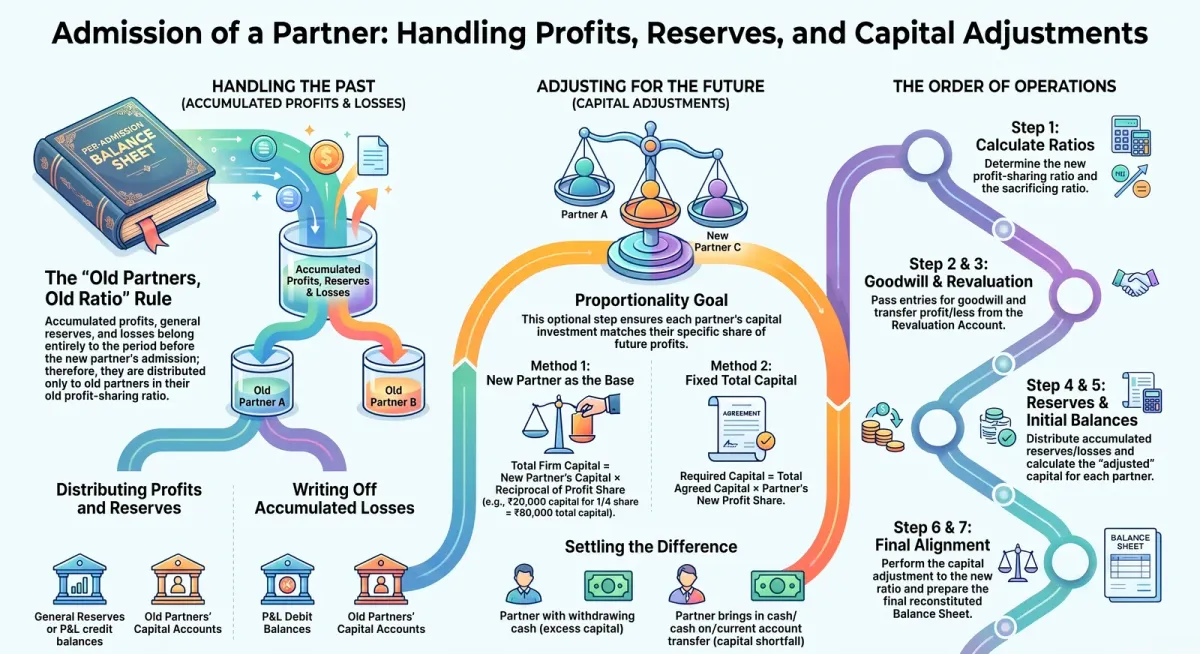
Beyond goodwill and revaluation, two more adjustments round out the accounting process when a new partner joins a firm: distributing accumulated profits or losses that already exist in the books, and — if the partners choose — adjusting partners’ capitals to match the new profit sharing ratio. Both topics are frequently combined in the same exam question, so it’s worth understanding them together.
Part 1: Accumulated Profits, Reserves and Losses
Why Do These Need Adjustment?
A firm’s balance sheet, at the time a new partner is admitted, may already carry balances like General Reserve or a credit/debit balance in the Profit and Loss Account — representing profits or losses earned entirely before the new partner joined. Since the incoming partner has no claim over these, they must be distributed among the old partners only, in their old profit sharing ratio, the same logic used for revaluation profit/loss.
Accumulated reserves are distributed with: General Reserve/P&L (credit) A/c Dr., To Old Partners’ Capital A/c (old ratio). Accumulated losses are written off with: Old Partners’ Capital A/c (old ratio) Dr., To Profit and Loss A/c (debit balance).
Worked Example
Rajinder and Surinder share profits in the ratio 4:1. On admitting Narender, the balance sheet shows a General Reserve of Rs. 20,000 and a debit balance of Rs. 10,000 in the Profit and Loss Account.
General Reserve A/c Dr. 20,000 → To Rajinder’s Capital A/c 16,000, To Surinder’s Capital A/c 4,000. Rajinder’s Capital A/c Dr. 8,000, Surinder’s Capital A/c Dr. 2,000 → To Profit and Loss A/c 10,000.
Both entries use the old ratio (4:1), since these balances belong entirely to the period before Narender’s admission.
Part 2: Adjustment of Partners’ Capital
When Does This Arise?
Sometimes, simply admitting a new partner and adjusting for goodwill and revaluation isn’t enough — the partners also want their capital balances to be proportionate to the new profit sharing ratio. This is a separate, optional step that only applies when the question specifically asks for it.
Approach 1: Using the New Partner’s Capital as the Base
If the new partner’s capital and their share of profit are known, you can work out what the total capital of the firm should be, and from there, calculate what each old partner’s capital ought to be.
Formula: Total Capital of Firm = New Partner’s Capital × (Reciprocal of Their Profit Share)
Example: A and B share profits 2:1. C is admitted for a 1/4 share and brings Rs. 20,000 as capital. After all other adjustments, A’s and B’s capitals stand at Rs. 45,000 and Rs. 15,000 respectively. Partners agree capitals should match the new ratio (2:1:1).
Total capital of firm = 20,000 × 4 = Rs. 80,000. A’s required capital (2/4 share) = Rs. 40,000; B’s required capital (1/4 share) = Rs. 20,000. Since A has Rs. 45,000 (Rs. 5,000 excess), A withdraws Rs. 5,000; since B has only Rs. 15,000 (Rs. 5,000 short), B brings in Rs. 5,000 — recorded as A’s Capital A/c Dr. 5,000 To Cash A/c, and Cash A/c Dr. 5,000 To B’s Capital A/c.
Approach 2: Using a Given Total Capital Figure
Sometimes, the question directly states the agreed total capital of the reconstituted firm. In that case, each partner’s required capital is simply their profit share multiplied by this total.
Required Capital of a Partner = Total Agreed Capital × That Partner’s New Profit Share
Once you know each partner’s required capital, compare it to their actual (adjusted) capital balance:
-
If actual capital exceeds required capital → the partner withdraws the excess.
-
If actual capital is less than required capital → the partner brings in the shortfall.
Alternative: Adjusting Through Current Accounts
Instead of physically bringing in or withdrawing cash, partners may transfer the excess or deficiency to their Current Accounts. This keeps Capital Accounts fixed at the agreed proportionate amounts, with any surplus or shortfall sitting separately: excess capital is debited to the Capital A/c and credited to the Current A/c; a shortfall is debited to the Current A/c and credited to the Capital A/c.
Order of Operations: A Step-by-Step Checklist
When a question combines goodwill, revaluation, accumulated profits, and capital adjustment, follow this sequence: (1) calculate the new profit sharing ratio and sacrificing ratio; (2) pass goodwill entries; (3) prepare the Revaluation Account and transfer profit/loss (old ratio); (4) distribute accumulated reserves and losses (old ratio); (5) calculate each partner’s adjusted capital balance; (6) adjust capitals to the new ratio if required; (7) prepare the final balance sheet.
This order matters because capital adjustment in step 6 depends entirely on having correct, fully adjusted figures from steps 2–4.
Quick Recap
Accumulated reserves and profits are credited, and accumulated losses debited, to old partners’ capital accounts in the old ratio. Capital adjustment is a separate, optional step used only when partners want capitals proportionate to the new ratio — total capital can be derived from the new partner’s capital or a stated agreed total, and any excess or shortfall is settled in cash or through Current Accounts.
Related Reading
-
Treatment of Goodwill on Admission of a Partner (Journal Entries)
-
Revaluation of Assets and Liabilities on Admission of a Partner
-
New Profit Sharing Ratio on Admission of a Partner (With Examples)
Put the Full Admission Process Together With Practice
Questions combining goodwill, revaluation, reserves, and capital adjustment are the longest and highest-scoring in the Class 12 board paper. ChampionsPrep offers pay-per-use, fully worked practice sets that walk through the entire admission-of-partner process, so you can practise the parts you find toughest.
Test Your Knowledge

Accumulated Profits & Capital Adjustment on Admission of a Partner
Frequently Asked Questions
How are accumulated profits and reserves treated on admission of a partner? +
They are transferred to the old partners' capital accounts in their old profit sharing ratio, since these amounts relate to profits earned before the new partner joined.
What happens to a debit balance in the Profit and Loss Account at the time of admission? +
It is written off by debiting the old partners' capital accounts in their old profit sharing ratio.
Is capital adjustment compulsory on admission of a new partner? +
No. It is done only when the partners specifically agree that capitals should be made proportionate to the new profit sharing ratio.
How is the total required capital of the firm calculated using the new partner's capital? +
Total capital equals the new partner's capital multiplied by the reciprocal of their profit share, for example, if a 1/4 share corresponds to a given capital, total capital equals that capital multiplied by four.
What happens if a partner's actual capital is less than their required capital after adjustment? +
The partner must bring in additional cash to cover the deficiency, or alternatively, the shortfall can be transferred to their Current Account if the firm uses that approach.
AI-powered practice — free to start