
Every business builds a reputation over time — a name customers trust, a location they return to, a team that runs things efficiently. In accounting, that accumulated reputation has a rupee value: goodwill. Understanding it properly is essential before tackling its valuation methods and treatment on admission of a partner, both heavily tested in CBSE Class 12 Accountancy.
What Is Goodwill?
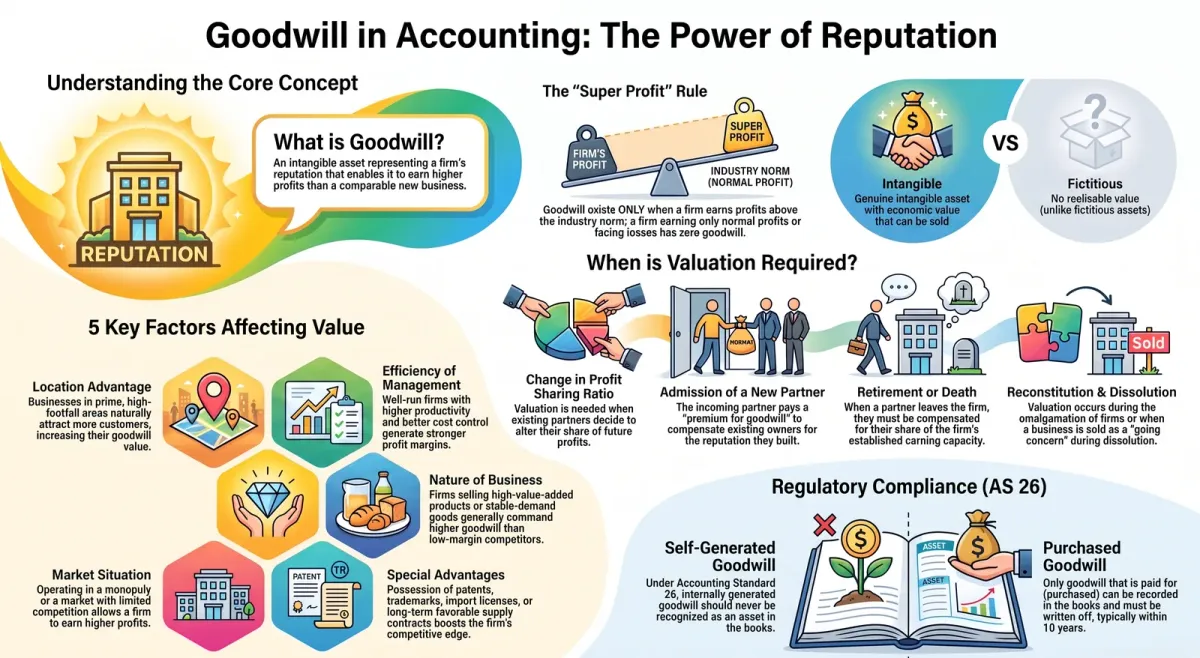
Goodwill is an intangible asset that represents the value of a firm’s reputation, built up over years, which allows it to earn profits higher than what a comparable new business could earn. It has no physical form — you can’t touch it — but it has very real economic value, because it reflects the firm’s ability to attract customers, retain business relationships, and generate steady income.
In simpler terms, goodwill can be described as “the present value of a firm’s anticipated excess earnings” or as “the capitalised value attached to the differential profit-earning capacity of a business.”
Here’s the key idea to internalise: goodwill exists only when a firm earns super profits — that is, profits above what is considered a normal return for that type of business. A firm earning only normal profits, or one running at a loss, has no goodwill, no matter how long it has been operating.
Why Does Goodwill Matter in Partnership Accounting?
When someone buys into an established, profitable business, they aren’t just buying a share of its physical assets — they’re also buying a share of its ability to earn more than a fresh business would. Because of this, whoever pays for that advantage is essentially compensating the existing owners for years of effort that built up the firm’s reputation. This is precisely why a new partner is often asked to bring in an additional amount, over and above their capital contribution, known as a premium for goodwill.
When Does the Need for Goodwill Valuation Arise?
Goodwill isn’t valued as a routine, everyday accounting exercise. The need to value it specifically arises on these occasions:
-
Change in the profit sharing ratio among existing partners
-
Admission of a new partner
-
Retirement of a partner
-
Death of a partner
-
Dissolution of a firm where the business is sold as a going concern
-
Amalgamation of partnership firms
In each of these situations, someone’s share of the firm’s future earning capacity is changing hands, and goodwill valuation ensures that change is compensated fairly.
Key Factors Affecting the Value of Goodwill
Goodwill isn’t a fixed number pulled out of thin air — it’s shaped by several tangible business characteristics. The main factors include:
1. Nature of Business
A business that sells high-value-added products, or one that enjoys consistently stable demand, is generally able to earn more profit than a business selling low-margin, easily substitutable goods. This translates directly into higher goodwill.
2. Location
A business situated in a prime, centrally located area, or one that benefits from heavy footfall, tends to attract more customers effortlessly. This locational advantage boosts earning capacity and therefore raises goodwill.
3. Efficiency of Management
A well-run firm typically enjoys higher productivity and better cost control. Efficient management translates into stronger profit margins, which in turn increases the value of goodwill.
4. Market Situation
Firms operating in conditions of limited competition, or those enjoying something close to a monopoly, are able to command higher profits — and consequently, higher goodwill — than firms operating in a highly competitive market.
5. Special Advantages
A firm that enjoys unique advantages — import licences, long-term supply contracts at favourable rates, well-known collaborators, patents, or registered trademarks — has an edge that competitors cannot easily replicate. These special advantages command a premium in goodwill valuation.
Goodwill Is Not a Fictitious Asset
It’s worth clarifying a common misconception: goodwill is an intangible asset, not a fictitious one. Fictitious assets (like unwritten-off preliminary expenses) have no realisable value at all. Goodwill, by contrast, has genuine economic value and can often be sold, though its value fluctuates and is harder to measure than a tangible asset’s.
Accounting Standard 26 and Goodwill
AS 26 makes an important distinction: self-generated goodwill should never be recognised as an asset in the books. Only purchased goodwill — paid for, such as when a new partner brings in a premium — can be recorded, and it must eventually be written off, typically within ten years. This is why any goodwill account raised on admission is usually written off rather than left on the balance sheet indefinitely.
Quick Recap
Goodwill is an intangible asset representing a firm’s ability to earn super profits due to its reputation, existing only when profits exceed the industry norm. Its value must be assessed during admission, retirement, or death of a partner, and it is shaped by business nature, location, management efficiency, market conditions, and special advantages. Per AS 26, only purchased goodwill can appear in the books.
Next, learn how to actually calculate goodwill’s value using the Average Profit, Super Profit, and Capitalisation methods.
Build a Rock-Solid Foundation in Goodwill
Goodwill questions often carry the highest marks in board papers, rewarding students who understand the concept, not just the formula. ChampionsPrep offers pay-per-use practice sets on goodwill theory and numericals for CBSE and State Board Class 12 Commerce students. Practise smart, pay only for what you need.
Test Your Knowledge

Goodwill in Accounting: Meaning, Need and Factors Affecting It
Frequently Asked Questions
What is goodwill in accounting? +
Goodwill is an intangible asset representing the value of a firm's reputation, which enables it to earn profits higher than the normal return expected in its industry.
Does every firm have goodwill? +
No. Goodwill exists only when a firm earns super profits, that is, profits in excess of normal returns. A firm earning only normal profits or incurring losses has no goodwill.
When does the need for valuation of goodwill arise? +
It typically arises on admission of a partner, retirement or death of a partner, change in profit sharing ratio, dissolution involving sale as a going concern, or amalgamation of firms.
What factors affect the value of goodwill? +
Key factors include the nature of the business, its location, efficiency of management, market conditions such as limited competition, and any special advantages like patents or long-term contracts.
Can self-generated goodwill be shown as an asset in the balance sheet? +
No. As per Accounting Standard 26, self-generated goodwill cannot be recognised as an asset; only purchased goodwill, paid for as part of a transaction, can be recorded, and it must be written off over time.
AI-powered practice — free to start