
Methods of Valuation of Goodwill: Average Profit, Super Profit and Capitalisation
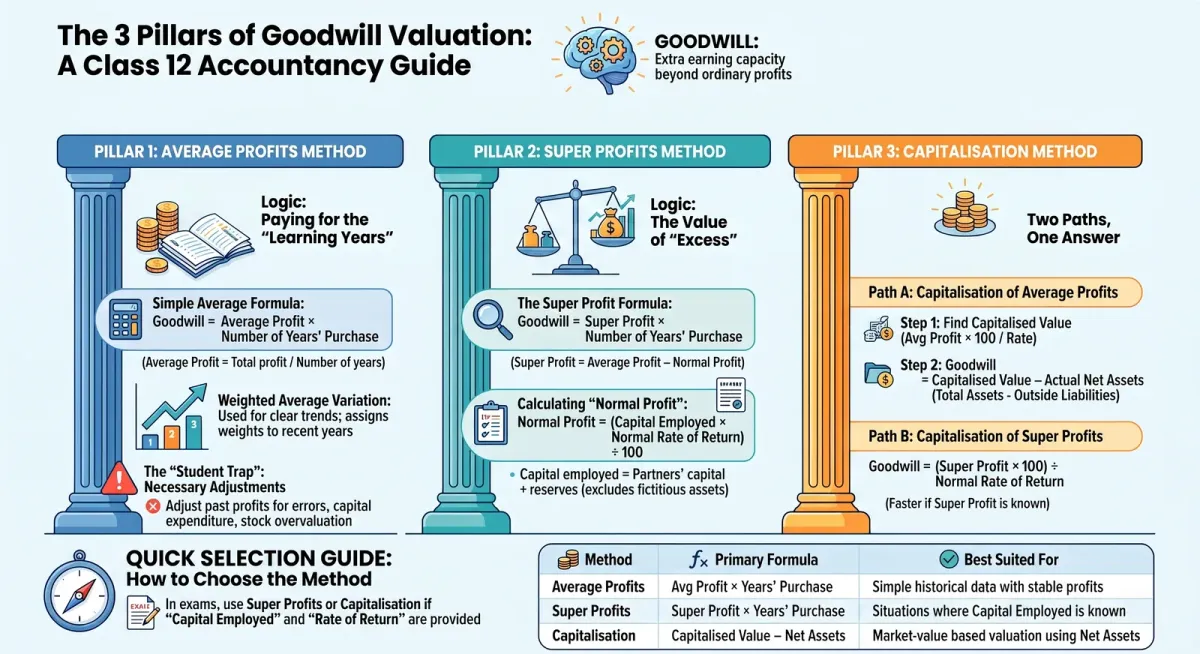
Once you understand what goodwill is, the natural next question is: how do you put a number on it? CBSE Class 12 Accountancy prescribes three methods — Average Profits, Super Profits, and Capitalisation. Each approaches the problem differently, but all three rest on the same idea: goodwill reflects a firm’s capacity to earn more than the ordinary.
Method 1: Average Profits Method
The Logic
This method assumes that a brand-new business wouldn’t be able to earn any profit at all during its first few years. So, if someone is buying into an already-established, profitable firm, they should pay an amount equal to the profits they’d expect to receive during those initial “learning years” — calculated using the firm’s historical average profit.
Formula
Goodwill = Average Profit × Number of Years’ Purchase
Simple Average Example
Suppose a firm’s profits for the last five years were: Rs. 4,00,000; Rs. 3,98,000; Rs. 4,50,000; Rs. 4,45,000; and Rs. 5,00,000. Goodwill is to be valued at 4 years’ purchase of the 5-year average profit.
-
Total profit = Rs. 21,93,000
-
Average profit = 21,93,000 ÷ 5 = Rs. 4,38,600
-
Goodwill = 4,38,600 × 4 = Rs. 17,54,400
Weighted Average Variation
If profits show a clear upward or downward trend, and the question specifies weights, a weighted average gives more importance to recent years, which better reflects the firm’s current earning trend.
Example: Profits over five years were Rs. 20,000, Rs. 24,000, Rs. 30,000, Rs. 25,000, and Rs. 18,000, with weights 1, 2, 3, 4, and 5 respectively assigned in that order. Goodwill is to be valued at 3 years’ purchase of the weighted average.
-
Products: 20,000; 48,000; 90,000; 1,00,000; 90,000 → Total = Rs. 3,48,000
-
Sum of weights = 15
-
Weighted average profit = 3,48,000 ÷ 15 = Rs. 23,200
-
Goodwill = 23,200 × 3 = Rs. 69,600
Important: Only use the weighted average when weights are explicitly given. Also note: before averaging, past profits often need adjustment for items like capital expenditure wrongly charged to revenue, or over/undervaluation of stock — skipping these is a common reason students lose marks.
Method 2: Super Profits Method
The Logic
Average Profits method assumes the buyer’s benefit lies in the entire future profit stream. Critics of this view argue that the real benefit lies only in the excess profit over what any similar business would normally earn on its capital. This excess is called super profit, and it forms the basis of this second method.
Formulas
Normal Profit = (Capital Employed × Normal Rate of Return) ÷ 100
Super Profit = Average Profit − Normal Profit
Goodwill = Super Profit × Number of Years’ Purchase
Note: “Capital employed” here includes partners’ capital plus reserves and surplus, but excludes fictitious assets and existing goodwill.
Worked Example
A firm’s capital employed is Rs. 5,00,000, and the normal rate of return in similar businesses is 10%. The firm’s average profit over the last five years is Rs. 60,000. Goodwill is to be valued at 3 years’ purchase of super profit.
-
Normal profit = 5,00,000 × 10 ÷ 100 = Rs. 50,000
-
Super profit = 60,000 − 50,000 = Rs. 10,000
-
Goodwill = 10,000 × 3 = Rs. 30,000
Tip: Some questions also factor in notional interest on capital plus partners’ salaries before arriving at “normal profit” — simply add both together before subtracting from average profit to get super profit.
Method 3: Capitalisation Method
This method can be applied in two slightly different ways, both of which should give you the same final answer.
(a) Capitalisation of Average Profits
Step 1: Capitalise the average profit at the normal rate of return: Capitalised Value = Average Profit × 100 ÷ Normal Rate of Return
Step 2: Find the firm’s actual net assets (total assets excluding goodwill and fictitious assets, minus outside liabilities).
Step 3: Goodwill = Capitalised Value − Net Assets
Example: A business has earned average profits of Rs. 1,00,000, the normal rate of return is 10%, and net assets are Rs. 8,20,000.
-
Capitalised value = 1,00,000 × 100 ÷ 10 = Rs. 10,00,000
-
Goodwill = 10,00,000 − 8,20,000 = Rs. 1,80,000
(b) Capitalisation of Super Profits
Goodwill = Super Profit × 100 ÷ Normal Rate of Return
Using the same figures: Normal profit = 8,20,000 × 10 ÷ 100 = Rs. 82,000. Super profit = 1,00,000 − 82,000 = Rs. 18,000.
Goodwill = 18,000 × 100 ÷ 10 = Rs. 1,80,000 — exactly matching method (a), as it should.
How to Choose Which Method to Use
You don’t get to pick — the question tells you which method to apply, either directly or indirectly (data like capital employed and normal rate of return signals Super Profit or Capitalisation). Always read carefully for these cues before choosing your formula.
Quick Comparison Table
| Method | Formula | Best Suited When |
|---|---|---|
| Average Profits | Average Profit × Years' Purchase | Simple historical data with stable profits |
| Super Profits | Super Profit × Years' Purchase | Capital employed and normal rate of return are given |
| Capitalisation | Capitalised Value − Net Assets, or Super Profit × 100/Rate | Net assets and normal rate of return are given |
Practise All Three Methods Until They’re Second Nature
Goodwill valuation questions are calculation-heavy, and examiners love mixing methods in the same paper. ChampionsPrep offers pay-per-use practice sets covering all three methods with step-by-step solutions for CBSE and State Board Class 12 Commerce students.
Test Your Knowledge
Interactive Practice: Identify the Convention

Methods of Valuation of Goodwill: Average, Super Profit & Capitalisation
Frequently Asked Questions
What are the three methods of valuation of goodwill? +
The three methods are the Average Profits method, the Super Profits method, and the Capitalisation method, which can itself be applied via average profits or super profits.
What is the formula for goodwill under the Average Profits method? +
Goodwill equals Average Profit multiplied by the Number of Years' Purchase, using either a simple or weighted average of past profits.
What is super profit? +
Super profit is the excess of a firm's actual average profit over the normal profit it should earn on its capital employed, calculated as Average Profit minus Normal Profit.
Do the two variations of the Capitalisation method give the same goodwill value? +
Yes. Capitalising average profits and then subtracting net assets gives the same goodwill figure as directly capitalising the super profit.
When should the weighted average profit be used instead of a simple average? +
Only when the question specifies weights for each year, typically because profits show a rising or falling trend that a simple average wouldn't reflect fairly.
AI-powered practice — free to start