
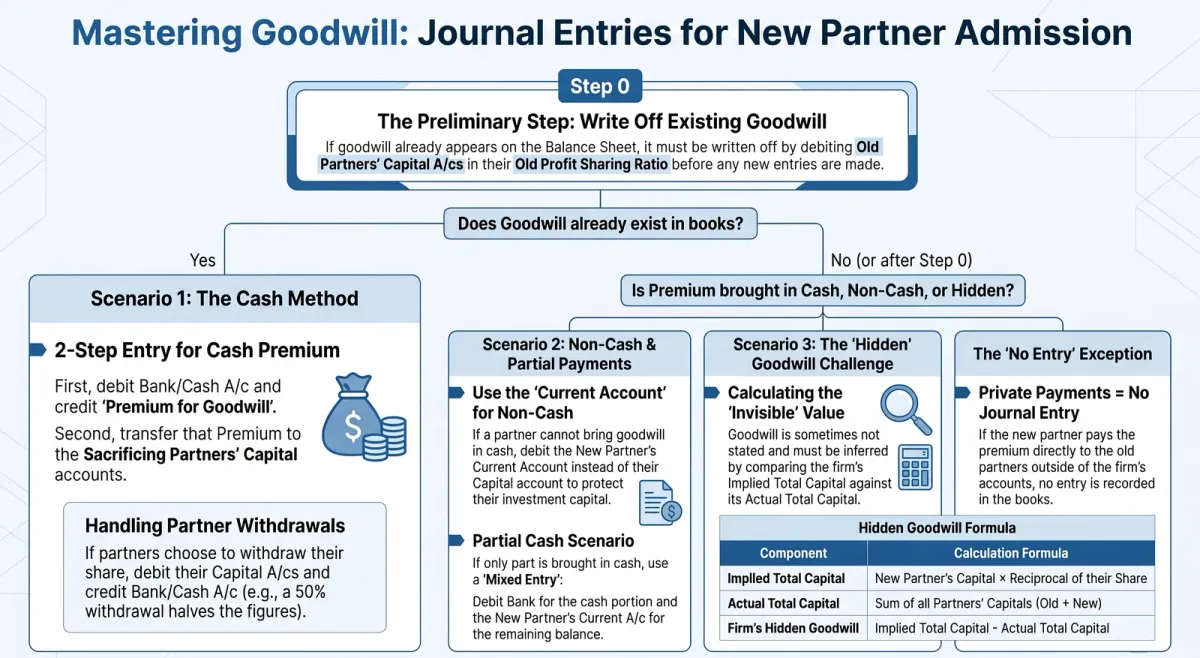
Once you know how to calculate goodwill, the next challenge is recording it correctly in the books. Many CBSE Class 12 Accountancy students lose marks here — not because the concept is hard, but because several distinct scenarios each need their own journal entries. This guide walks through every major situation you’ll encounter.
The Core Idea
When a new partner is admitted, they compensate old partners for the share of future super-profits now theirs. This premium for goodwill is distributed among old partners in their sacrificing ratio, not their old profit ratio, unless the two are identical.
Scenario 1: New Partner Brings Goodwill in Cash
This is the most straightforward case, needing two entries.
Entry 1 — Recording the cash received:
Bank A/c                          Dr.
    To Premium for Goodwill A/c
    To New Partner's Capital A/c
(Capital and premium for goodwill brought in by the new partner)
Entry 2 — Distributing the premium to old partners:
Premium for Goodwill A/c          Dr.
    To Sacrificing Partners' Capital A/c (individually)
(Goodwill distributed in sacrificing ratio)
Example: Sunil and Dalip share profits 5:3. Sachin is admitted for a 1/5 share, bringing Rs. 20,000 as capital and Rs. 4,000 as goodwill by cheque. Bank A/c is debited Rs. 24,000 (Sachin’s Capital Rs. 20,000, Premium for Goodwill Rs. 4,000); the premium is then split Rs. 2,500 to Sunil and Rs. 1,500 to Dalip. Sachin takes his 1/5 share from them in their old 5:3 ratio, so their sacrificing ratio is also 5:3 (Rs. 4,000 × 5/8 = Rs. 2,500 and Rs. 4,000 × 3/8 = Rs. 1,500).
If Old Partners Withdraw Their Goodwill Share
If partners decide to withdraw the goodwill amount (fully or partly), debit the old partners’ capital accounts and credit Bank A/c for the withdrawn amount. For a 50% withdrawal, simply halve the figures.
Scenario 2: Goodwill Already Exists in the Books
If a Goodwill account is already on the balance sheet from an earlier period, it must be written off first, in the old profit sharing ratio, before any new goodwill adjustment is made. Only after this write-off is complete should you record the new partner’s premium as in Scenario 1.
Why old ratio? This goodwill was built up entirely before the new partner joined, so they have no claim to it — it’s simply reversed in the ratio the old partners originally shared profits.
Scenario 3: New Partner Cannot Bring Goodwill in Cash
This is a very common exam scenario, and it splits into two sub-cases.
(a) No Goodwill Exists in the Books
The new partner’s share of goodwill is adjusted through their current account (not capital account), since no actual cash has changed hands.
New Partner's Current A/c          Dr.
    To Sacrificing Partners' Capital A/c (individually)
(Goodwill not brought in cash, adjusted through current account)
Example: Ram and Rahim share profits 3:2. Rahul is admitted for a 1/3 share, brings Rs. 10,000 as capital, but cannot bring his Rs. 30,000 share of goodwill in cash: Rahul’s Current A/c is debited Rs. 30,000, crediting Ram’s Capital A/c Rs. 18,000 and Rahim’s Capital A/c Rs. 12,000. (Rahul takes his 1/3 share from them in their old 3:2 ratio, so the sacrificing ratio is also 3:2.)
(b) Goodwill Already Exists in the Books
Combine two steps: first write off the old goodwill in the old ratio, then raise the new value through the incoming partner’s current account.
Example: Same partners as above, but goodwill of Rs. 15,000 already appears in the books. First write off: Ram’s Capital A/c Dr. 9,000, Rahim’s Capital A/c Dr. 6,000, To Goodwill A/c 15,000. Then, exactly as in (a), adjust Rahul’s Rs. 30,000 share of goodwill through his current account: Rahul’s Current A/c Dr. 30,000, To Ram’s Capital A/c 18,000, To Rahim’s Capital A/c 12,000.
Scenario 4: Partial Goodwill Brought in Cash
Sometimes the new partner brings only part of their goodwill share in cash; the balance is treated like Scenario 3(a), routed through their current account. For example, if the goodwill share is Rs. 50,000 but only Rs. 20,000 comes in cash: Bank A/c Dr. 20,000 and New Partner’s Current A/c Dr. 30,000, both credited to Sacrificing Partners’ Capital A/c (total Rs. 50,000).
Scenario 5: Hidden Goodwill
Sometimes a question doesn’t state the value of goodwill directly — it has to be inferred from the capital the new partner brings in, relative to their profit share.
Example: A and B are partners with capitals of Rs. 45,000 each, sharing profits equally. They admit C for a 1/3 share, and C brings Rs. 60,000 as capital. The implied total capital of the firm (60,000 × 3) is Rs. 1,80,000, but the actual total (45,000 + 45,000 + 60,000) is only Rs. 1,50,000 — a hidden goodwill of Rs. 30,000. C’s share of this (1/3) is Rs. 10,000, adjusted through C’s current account and credited Rs. 5,000 each to A and B.
This “hidden goodwill” technique is a favourite among examiners because it tests real understanding of the capital-profit-goodwill relationship, not just formula memorisation.
When Goodwill Is Paid Privately
If the incoming partner pays goodwill directly and privately to old partners, no entry is passed in the firm’s books, since the transaction never touches the firm’s assets or liabilities.
Quick Recap
Cash goodwill is debited to Bank A/c and distributed to sacrificing partners; existing goodwill is written off first in the old ratio; goodwill not brought in cash is adjusted through the new partner’s current account; hidden goodwill is derived by comparing implied and actual total capital; and privately paid goodwill needs no entry at all.
Related Reading
-
Sacrificing Ratio in Partnership Accounts: Meaning, Formula and Examples
-
Goodwill in Accounting: Meaning, Need and Factors Affecting It
-
Methods of Valuation of Goodwill: Average, Super Profit & Capitalisation
Nail Every Goodwill Journal Entry on Exam Day
Goodwill entries are among the highest-scoring — and highest-risk — questions in the Class 12 board paper. ChampionsPrep offers pay-per-use practice sets with step-by-step journal entries for every scenario above, so you know exactly which entry to use, every time.
Test Your Knowledge

Treatment of Goodwill on Admission of a Partner (Journal Entries)
Frequently Asked Questions
In what ratio is the premium for goodwill distributed among old partners? +
It is distributed in the sacrificing ratio of the old partners, not necessarily their old profit sharing ratio.
What happens to goodwill already appearing in the books at the time of admission? +
It is written off by debiting the old partners' capital accounts in their old profit sharing ratio before any new goodwill adjustment is recorded.
How is goodwill treated if the new partner cannot bring their share in cash? +
The new partner's current account is debited, and the sacrificing partners' capital accounts are credited in the sacrificing ratio, effectively raising goodwill without cash changing hands.
What is hidden goodwill? +
Hidden goodwill is goodwill that is not stated directly but is inferred by comparing the total capital implied by the new partner's capital and share with the actual combined capital of all partners.
Is any entry passed if goodwill is paid privately by the new partner to old partners? +
No. If the payment is made privately outside the firm's bank account, no entry is passed in the firm's books at all.
AI-powered practice — free to start