
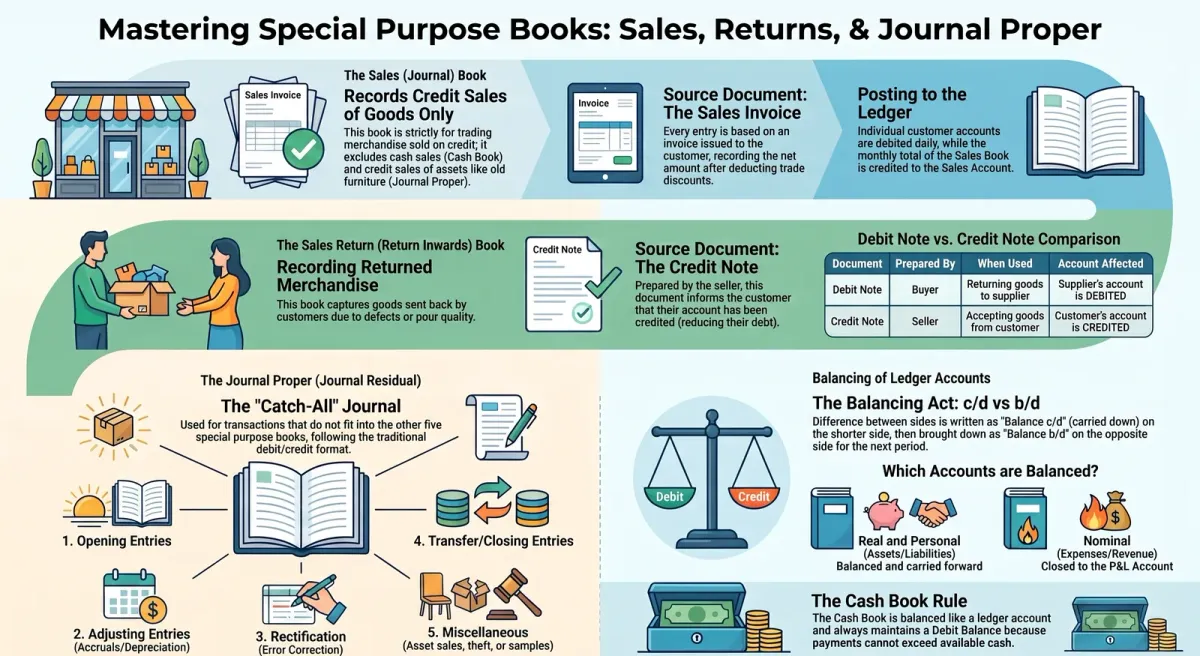
Among the special purpose books introduced in CBSE Class 11 Accountancy Chapter 4, the Purchases Book and Purchases Return Book are two of the most frequently tested. They look deceptively simple — yet many students lose marks by recording the wrong transactions, mishandling trade discounts, or confusing debit notes with credit notes.
This guide breaks down everything you need: what goes in these books, what doesn’t, how they are formatted, and exactly how entries are posted to the ledger.
What Is the Purchases (Journal) Book?
The Purchases Book — formally called the Purchases (Journal) Book — is a special purpose book that records exclusively all credit purchases of goods (i.e., trading merchandise).
What Goes In and What Doesn’t
This distinction is critical and directly tested in school exams:
Recorded in the Purchases Book:
- Credit purchases of goods meant for resale (trading stock / merchandise)
NOT recorded here — go elsewhere:
-
Cash purchases of goods → recorded in the Cash Book
-
Credit purchases of assets (furniture, machinery, vehicles, land) → recorded in the Journal Proper
-
Cash purchases of assets → recorded in the Cash Book
The purchases book deals only with the goods in which the business trades, bought only on credit.
Source Document: The Purchase Invoice
Every entry in the Purchases Book is backed by an invoice (or bill) received from the supplier. This document contains:
-
The invoice number and date
-
Name and address of the supplier
-
Details of goods supplied (description, quantity, rate)
-
Trade discount, if any
-
Net amount payable
Entries are made at the net amount after deducting trade discount. Trade discount is not a financial transaction — it is simply a reduction in price — so it is not recorded separately in the books. Only the net invoice value enters the Purchases Book.
Format of the Purchases Book
Purchases (Journal) Book
-------------------------------------------------------
Date | Invoice No. | Name of Supplier          | L.F. | Amount (₹)
     |             | (Account to be Credited)   |      |
-------------------------------------------------------
The “Account to be Credited” note in the supplier column is a reminder of the double-entry logic: when goods are purchased on credit, the supplier’s account is credited (we owe them money).
Recording and Posting Purchases Book Entries
Recording
For each credit purchase:
-
Enter the date, the supplier’s invoice number, and the supplier’s name.
-
Calculate the net amount after deducting trade discount.
-
Enter the net amount in the Amount column.
Posting to the Ledger
Posting from the Purchases Book involves two steps:
Step 1 — Individual Supplier Accounts (Daily): Each supplier’s account in the ledger is credited with the amount of their invoice. This reflects that the business owes money to the supplier.
Step 2 — Purchases Account (Monthly): At the end of each month, the total of the Purchases Book is posted to the debit of the Purchases Account in the ledger. The narration reads: “Sundries as per Purchases Journal.”
This approach means the Purchases Account accumulates only credit purchases of goods. Cash purchases (recorded separately in the Cash Book) are also posted to this same account, so the final Purchases Account total reflects all purchases — cash and credit combined.
What Is the Purchases Return (Journal) Book?
Businesses do not always keep every item they purchase. Goods may be returned to suppliers because they are defective, damaged, of the wrong specification, or of substandard quality. The Purchases Return Book — also called the Return Outwards Book — records all such returns.
The Debit Note: Source Document for Purchases Returns
When a business returns goods to a supplier, it prepares a Debit Note (in duplicate). The original is sent to the supplier; the duplicate is retained for internal records.
A Debit Note contains:
-
Serial number and date
-
Name of the supplier (the party being debited)
-
Description and quantity of goods returned
-
Rate and amount
-
Reason for returning the goods
Why “Debit Note”? Because the buyer is notifying the supplier that the supplier’s account is being debited in the buyer’s books — effectively reducing the amount owed to them.
Credit Note — The Supplier’s Response
Upon receiving the returned goods, the supplier may issue a Credit Note to the buyer. The credit note acknowledges the return and confirms that the buyer’s account has been credited (reducing what the buyer owes). Either the debit note or the credit note can serve as the source document for recording the return.
Format of the Purchases Return Book
Purchases Return (Journal) Book
------------------------------------------------------------
Date | Debit Note No. | Name of Supplier          | L.F. | Amount (₹)
     |                | (Account to be Debited)    |      |
------------------------------------------------------------
Note that the heading now reads “Account to be Debited” — because the return reduces the amount owed to the supplier, so the supplier’s account is debited.
Recording and Posting Purchases Return Entries
Recording
-
Enter the date and the debit note number.
-
Enter the supplier’s name (the party receiving the returned goods).
-
Record the net amount of goods returned (after applying the same trade discount rate that was used at the time of purchase).
Posting to the Ledger
Step 1 — Individual Supplier Accounts (Daily): Each supplier’s account is debited with the amount returned. This reduces the liability (the amount the business owes to that supplier).
Step 2 — Purchases Return Account (Monthly): At the end of each month, the total of the Purchases Return Book is posted to the credit of the Purchases Return Account (also called Return Outwards Account) in the ledger.
GST in Purchases and Purchases Return Books
Modern businesses must account for Goods and Services Tax (GST). When GST applies, the Purchases Book and Purchases Return Book use an analytical (columnar) format with additional columns:
| Column | Purpose |
|---|---|
| Total Amount | Full invoice value including tax |
| Purchases | Net value of goods (after trade discount) |
| CGST | Central GST amount |
| SGST | State GST amount (intra-state purchases) |
| IGST | Integrated GST amount (inter-state purchases) |
Key GST rules to remember:
-
Intra-state purchases attract CGST + SGST.
-
Inter-state purchases attract IGST only.
-
GST is calculated on the value after deducting trade discount.
-
The same GST treatment applies in the Purchases Return Book.
Common Exam Mistakes
Mistake 1: Recording cash purchases in the Purchases Book. Cash purchases always go in the Cash Book. The Purchases Book is for credit purchases only.
Mistake 2: Recording credit purchases of assets. Buying machinery or furniture on credit goes into the Journal Proper, not the Purchases Book.
Mistake 3: Not deducting trade discount before recording. Always record the net amount after trade discount. Cash discount is never recorded in these books.
Mistake 4: Confusing debit note and credit note. Debit note → prepared by the buyer for goods returned to the supplier. Credit note → prepared by the seller for goods returned by the customer.
Related Reading
-
Special Purpose Books in Accounting | CBSE Class 11 Accountancy Chapter 4
-
Cash Book in Accounting: Single Column & Double Column Explained
-
Subsidiary Books Class 11 Accountancy – Purchase Book, Sales Book, Cash Book Explained
Build Exam Confidence With ChampionsPrep
Purchases Book and Purchases Return Book questions — especially those involving trade discount calculations, GST treatment, and ledger posting — are school exam staples. Students who practise with exam-style problems consistently outperform those who just read the textbook.
At ChampionsPrep , access topic-specific practice sets for Purchases Book, Purchases Return Book, and all other Chapter 4 topics. Detailed solutions with every problem. Pay only for what you use.
Visit ChampionsPrep and start scoring full marks on Purchases Book questions.
Test Your Knowledge

Purchases Book & Purchases Return Book | CBSE Class 11 Accountancy Complete Guide
Frequently Asked Questions
What types of purchases are recorded in the Purchases Book? +
Only credit purchases of trading goods (merchandise meant for resale) are recorded. Cash purchases go in the Cash Book, and credit purchases of assets go in the Journal Proper.
How is trade discount treated in the Purchases Book? +
Trade discount is deducted from the invoice price before recording. Only the net amount after trade discount is entered. Trade discount is never recorded as a separate ledger entry.
What is the difference between a debit note and a credit note? +
A debit note is prepared by the buyer when returning goods to the supplier. A credit note is prepared by the seller when accepting goods returned by the customer.
Why is trade discount not recorded in the books? +
Trade discount is a reduction in the listed price, not a separate transaction. Entries are made at the net amount after deducting it, so no separate record is created. Cash discount, by contrast, is recorded when payment is made.
Where are credit purchases of assets recorded? +
In the Journal Proper. The Purchases Book records only credit purchases of trading goods; credit purchases of assets like machinery or furniture are not goods of the business and go to the Journal Proper.
AI-powered practice — free to start