
What Is a Journal in Accounting? Book of Original Entry – Class 11 Guide
Imagine you are a business owner who completes dozens of transactions every day — buying goods, paying salaries, receiving payments from customers. How do you make sure none of these events are missed, duplicated, or recorded incorrectly?
The answer is the Journal — the first book in which every business transaction is systematically recorded. Before any transaction reaches an account in the ledger, it passes through the journal first. This is why it is called the Book of Original Entry.
This blog gives you a thorough understanding of the journal — its purpose, format, how journal entries are written, the difference between simple and compound entries, and what narration means — all aligned with CBSE Class 11 Accountancy, Chapter 3.
Why Don’t We Record Directly in Accounts?
You might wonder: why not skip the journal and write transactions straight into individual accounts (the ledger)? Technically, you could — but it would create serious problems:
-
You would lose a complete record of each transaction in one place
-
It would be difficult to trace errors, because debits and credits for the same transaction would be scattered across different accounts
-
There would be no chronological record of what happened and when
-
Legal and audit requirements would not be met
The journal solves all of this. It records every transaction in full, in one place, in date order, with the debit, credit, and explanation clearly shown together.
What Is a Journal?
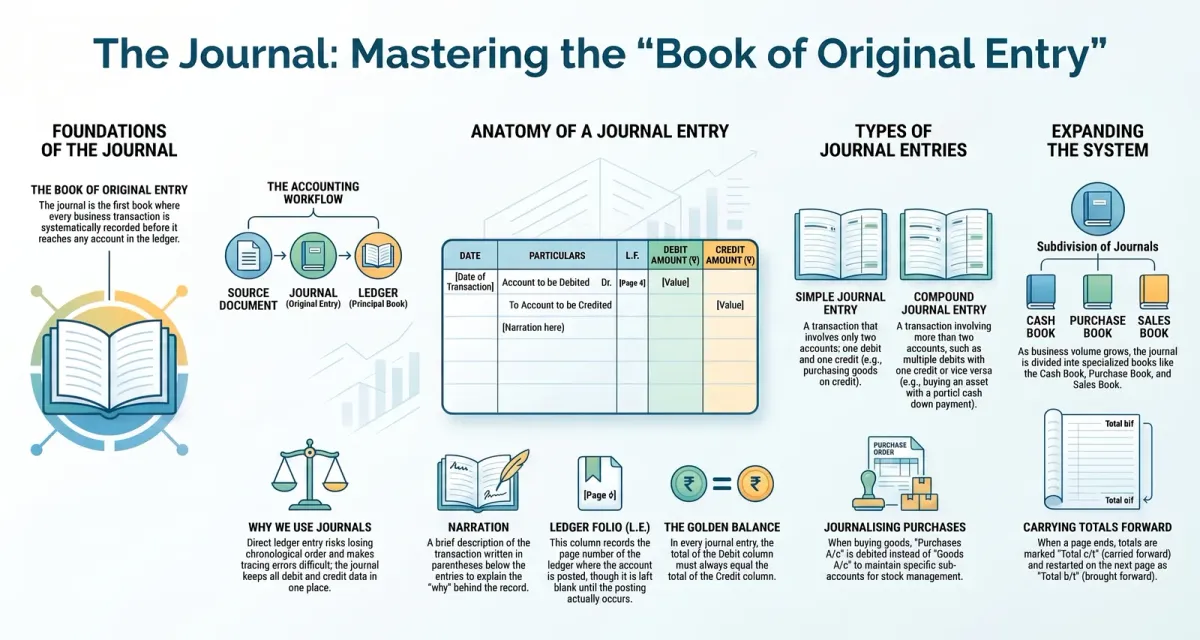
The journal is the basic book of original entry. It is a chronological record of every business transaction — meaning transactions are written in the order in which they occur, not grouped by account type.
After recording in the journal, entries are then transferred (posted) to individual accounts in the ledger.
This two-step process creates a complete and traceable accounting system:
Source Document → Journal (Book of Original Entry) → Ledger (Principal Book)
Format of a Journal
The standard format of a journal has five columns:
| Date | Particulars | L.F. | Debit Amount (₹) | Credit Amount (₹) |
|---|
Column Explanations:
-
Date – The actual date of the transaction (not the date of recording)
-
Particulars – The accounts affected. The debited account is written first with “Dr.” at the end. The credited account is written on the next line, indented, with the prefix “To”
-
L.F. (Ledger Folio) – The page number of the ledger where the account appears. Filled in at the time of posting, not at the time of making the entry
-
Debit Amount – The rupee amount for the account to be debited
-
Credit Amount – The rupee amount for the account to be credited
Below the account titles, a brief description called Narration is written in brackets. A horizontal line in the Particulars column marks the end of each journal entry.
What Is Narration?
Narration is a short explanation of the transaction written below the debit and credit account entries in the journal. It is placed within parentheses and describes the nature of the transaction.
Examples:
-
(Business started with cash)
-
(Goods purchased on credit from M/s Sumit Traders)
-
(Rent paid for the month)
Narration helps anyone reading the journal understand why the entry was made, without needing to refer to the original source document.
Simple Journal Entry
When a transaction involves only two accounts — one debit and one credit — it is called a simple journal entry.
Example: Goods purchased on credit from M/s Govind Traders for ₹30,000.
| Date | Particulars | L.F. | Dr. (₹) | Cr. (₹) |
|---|---|---|---|---|
| Dec. 24 | Purchases A/c Dr. | 30,000 | ||
| To Govind Traders A/c | 30,000 | |||
| (Purchase of goods on credit from Govind Traders) |
Note: Although stock physically increases, the account debited is Purchases A/c, not Goods A/c. In accounting, the goods account is divided into five sub-accounts: Purchases, Sales, Purchase Returns, Sales Returns, and Stock.
Compound Journal Entry
When a transaction involves more than two accounts — either multiple debits with one credit, or one debit with multiple credits — it is called a compound journal entry.
Example: Office furniture purchased from Modern Furniture’s for ₹25,000. ₹5,000 paid in cash immediately, balance of ₹20,000 still payable.
| Date | Particulars | L.F. | Dr. (₹) | Cr. (₹) |
|---|---|---|---|---|
| July 4 | Office Furniture A/c Dr. | 25,000 | ||
| To Cash A/c | 5,000 | |||
| To Modern Furniture A/c | 20,000 | |||
| (Purchase of office furniture, ₹5,000 paid in cash and balance payable) |
Here, one account is debited but two accounts are credited — making it a compound entry.
Journalising in Practice: Rohit’s Transactions
Here is how Rohit’s transactions (from the NCERT example) appear in the journal:
| Particulars | Dr. (₹) | Cr. (₹) |
|---|---|---|
| Cash A/c Dr. — Business started with cash | 5,00,000 | |
| To Capital A/c | 5,00,000 | |
| Bank A/c Dr. — Opened bank account | 4,80,000 | |
| To Cash A/c | 4,80,000 | |
| Furniture A/c Dr. — Bought furniture by cheque | 60,000 | |
| To Bank A/c | 60,000 | |
| Plant & Machinery A/c Dr. — Bought from Ramjee Lal, ₹10,000 advance | 1,25,000 | |
| To Cash A/c | 10,000 | |
| To Ramjee Lal A/c | 1,15,000 | |
| Purchases A/c Dr. — Goods bought on credit | 55,000 | |
| To M/s Sumit Traders A/c | 55,000 | |
| Rajani Enterprises A/c Dr. — Goods sold on profit | 35,000 | |
| To Sales A/c | 35,000 | |
| Total | 12,55,000 | 12,55,000 |
The total of debits equals the total of credits — always.
Books of Original Entry: More Than Just the Journal
The journal proper is just one of several books of original entry. As transaction volumes grow, the journal is subdivided into:
-
(a) Journal Proper – For transactions that don’t fit elsewhere
-
(b) Cash Book – For all cash and bank transactions
-
(c) Day Books – Purchases Book, Sales Book, Purchase Returns Book, Sales Returns Book, Bills Receivable Book, Bills Payable Book
Each of these is a specialized book of original entry. Chapter 4 of Class 11 Accountancy covers Cash Book and Day Books in detail.
Journal Writing is a Skill — Practice Makes It Perfect
Every exam question on journal entries tests the same underlying logic: identify accounts, classify them, apply debit-credit rules, and write the entry with correct narration. The more you practise, the faster and more accurate you become.
ChampionsPrep’s question bank covers hundreds of journalising problems — from simple single-step entries to complex GST and multi-account scenarios — with instant AI-powered solutions.
👉 Start Practising Journal Entries at ChampionsPrep.in
Interactive Simulation: Journal Entries & the Accounting Equation
Observe how each transaction recorded in the journal preserves the fundamental accounting equation (Assets = Liabilities + Capital):
Accounting Equation & Journal Entry Simulator
Adjust initial cash, stock, liabilities, and revenues to examine how dual-aspect journal entries maintain balance sheet equilibrium.
Balance Sheet balances — Liabilities = Assets
Trading A/c
Profit & Loss A/c
Balance Sheet
Test Your Knowledge

What Is a Journal in Accounting? Book of Original Entry Explained – Class 11 CBSE
Frequently Asked Questions
What is the difference between a journal and a ledger? +
The journal is the book of first entry, recording transactions in chronological order. The ledger is the book of second entry, organizing transactions by account. Recording in the journal is called journalising; in the ledger it is called posting.
Why is the journal called the Book of Original Entry? +
Because it is the first book in which a transaction is formally recorded. Every other book in accounting receives its information from the journal.
What is the Ledger Folio (L.F.) column in a journal used for? +
L.F. records the page number of the ledger where the relevant account appears. It is filled in at the time of posting, not when the journal entry is first made.
Can one journal entry have more than two accounts? +
Yes. This is called a compound journal entry. It occurs when a transaction affects more than two accounts — such as buying an asset partly in cash and partly on credit.
What does c/f mean at the bottom of a journal page? +
c/f stands for 'carried forward.' When a journal page is full, the column totals are written as 'Total c/f' and then continued on the next page as 'Total b/f' (brought forward).
AI-powered practice — free to start