
Ledger and Posting in Accounting – Class 11 CBSE Complete Guide
The journal tells you when a transaction happened. The ledger tells you what the total effect on each account has been.
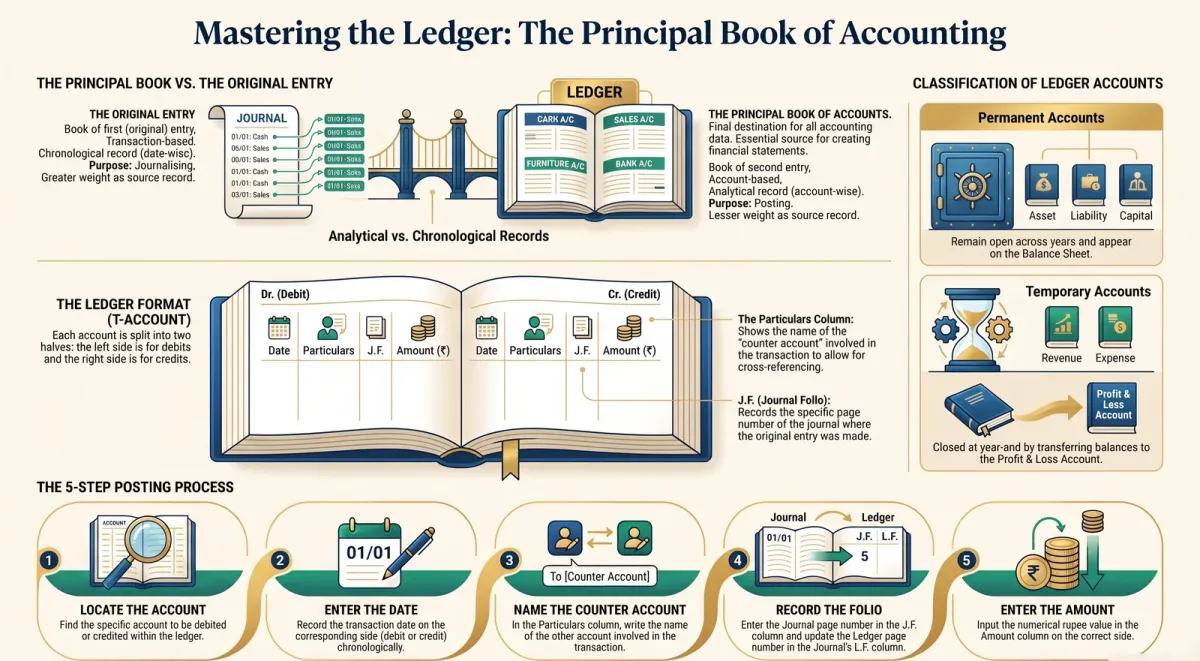
If you want to know how much cash a business has at the end of the month, or how much it owes a particular supplier, you will not find that answer by scrolling through journal entries — you will find it in the ledger. This is why the ledger is called the Principal Book of Accounts: it is the final destination of all accounting data and the source of financial statements.
This blog explains the ledger in full — its meaning, format, utility, the step-by-step process of posting, the classification of ledger accounts, and how the ledger differs from the journal — all aligned with CBSE Class 11 Accountancy, Chapter 3.
What Is a Ledger?
The ledger is the principal book of the accounting system. It is a collection of all accounts — assets, liabilities, capital, expenses, and revenues — to which journal entries are transferred (posted).
In simple terms:
-
The journal records what happened (event-by-event, in date order)
-
The ledger records what it means for each account (account-by-account, showing all debits and credits for that account)
A ledger may be maintained as:
-
A bound register with pages for each account
-
Loose-leaf sheets in a binder
-
Digital records in accounting software like Tally
Each account in the ledger is typically opened on a separate page or card, and once opened, all entries relating to that account are recorded on the same page — on the debit side or credit side as applicable.
Why Is the Ledger Important?
The ledger is not just a storage book — it is the engine that powers financial reporting.
Key Uses of the Ledger:
1. Consolidated View of Each Account All transactions related to a specific account appear in one place. For example, the Cash Account in the ledger shows every receipt and every payment, making it easy to calculate the closing cash balance.
2. Basis for Financial Statements The Balance Sheet and Profit & Loss Account are prepared using the closing balances of ledger accounts. Without a properly posted ledger, financial statements cannot be prepared.
3. Quick Information Retrieval Management can instantly find how much is owed to a particular creditor, or how much a debtor still owes, simply by checking the relevant ledger account.
4. Analytical Classification While the journal organizes data by time, the ledger organizes it by account — making analysis possible. This is why the journal is the chronological record and the ledger is the analytical record.
Format of a Ledger Account
Each account in the ledger follows this standard format:
                     Name of the Account

Dr.                                                          Cr.
_________________________________________________________________
| Date | Particulars | J.F. | Amount (₹) | Date | Particulars | J.F. | Amount (₹) |
|______|_____________|______|____________|______|_____________|______|____________|
Column Explanations:
-
Date – The date of the original transaction, entered chronologically on each side
-
Particulars – The name of the other account involved in the transaction (the counter account)
-
J.F. (Journal Folio) – The page number of the journal where the original entry was made
-
Amount (₹) – The rupee value of the debit or credit entry
The left side is the Dr. (Debit) side and the right side is the Cr. (Credit) side.
Classification of Ledger Accounts
All ledger accounts are classified into two groups based on how long they remain open:
Permanent Accounts (Real and Personal Accounts)
-
Remain open from one accounting year to the next
-
Balances are carried forward to the next period
-
Include all asset, liability, and capital accounts
-
These accounts appear in the Balance Sheet
Temporary Accounts (Nominal Accounts)
-
Opened for one accounting period only
-
Closed at year-end by transferring their balances to the Trading and Profit & Loss Account
-
Include all revenue and expense accounts
-
Examples: Sales, Purchases, Rent, Salaries, Commission Received
What Is Posting?
Posting is the process of transferring entries from the journal (book of original entry) to the individual accounts in the ledger (principal book).
Posting groups all transactions relating to a particular account at one place, making it possible to:
-
Calculate the net balance of that account at any point
-
Track increases and decreases over time
-
Prepare trial balances and financial statements
Posting is done periodically — weekly, fortnightly, or monthly depending on business requirements.
Step-by-Step Process of Posting
Follow these five steps when posting from the journal to the ledger:
Step 1: Locate the account to be debited in the ledger.
Step 2: Enter the date of the transaction in the Date column on the debit side.
Step 3: In the Particulars column on the debit side, write the name of the other account involved (the credit account). For example, if Furniture A/c is being debited because it was purchased by cheque, write “Bank” in the Particulars column of Furniture A/c.
Step 4: In the J.F. column, enter the page number of the journal where the entry was recorded. Also go back to the journal and enter the ledger page number in its L.F. column.
Step 5: Enter the amount in the Amount column on the debit side.
Repeat the same process for the credit side of the account to be credited.
Posting in Practice: Rohit’s Transactions
Here is how the Cash Account appears in the ledger after posting Rohit’s journal entries:
                      Cash Account

Dr.                                                       Cr.
_______________________________________________________________
| Date | Particulars | J.F | Amount | Date | Particulars | J.F | Amount |
|------|-------------|-----|--------|------|-------------|-----|--------|
|      | Capital     |     | 5,00,000 |    | Bank        |     | 4,80,000 |
|      |             |     |        |      | Plant & Mac |     | 10,000 |
The debit side shows cash coming in (from capital introduction). The credit side shows cash going out (to bank and plant advance). The balance — the difference — is the closing cash balance.
Journal vs. Ledger: Key Differences
| Point of Comparison | Journal | Ledger |
|---|---|---|
| Type of entry | Book of first (original) entry | Book of second entry |
| Basis of record | Transaction | Account |
| Sequence | Chronological (date-wise) | Analytical (account-wise) |
| Legal evidence | Greater weight as source record | Lesser weight |
| Process | Journalising | Posting |
| Purpose | To record every event completely | To track each account's net position |
From Journal to Ledger — Master the Full Recording Process
The accounting cycle — from source document to voucher, journal to ledger, trial balance to financial statements — is what Class 11 Accountancy builds brick by brick. Each concept depends on the one before it. If you are ever stuck at any step, ChampionsPrep is ready to help.
Our AI-powered doubt resolution engine covers every concept in Chapter 3 and beyond, giving you precise, step-by-step explanations available any time you need them.
👉 Resolve Your Doubts Instantly on ChampionsPrep
Test Your Knowledge

Ledger and Posting in Accounting – Class 11 CBSE Complete Guide with Format and Examples
Frequently Asked Questions
Why is the ledger called the Principal Book of Accounts? +
Because all financial statements — the Balance Sheet and Profit & Loss Account — are prepared from ledger balances. It is the most important book for financial reporting and analysis.
What is the difference between J.F. in the ledger and L.F. in the journal? +
J.F. (Journal Folio) in the ledger records the journal page number of the original entry. L.F. (Ledger Folio) in the journal records the ledger page number where the account appears.
What does the Particulars column in a ledger account show? +
It shows the name of the counter account — the other account involved in the same transaction — allowing cross-referencing back to the original journal entry.
What is the difference between permanent and temporary accounts? +
Permanent accounts (assets, liabilities, capital) carry forward to the next accounting period. Temporary accounts (revenues and expenses) are closed at year-end by transferring to the Profit & Loss Account.
Can the same account appear on both sides of a ledger? +
Yes. A ledger account can have entries on both the debit and credit sides. The net balance is the difference between the totals of both sides.
AI-powered practice — free to start