
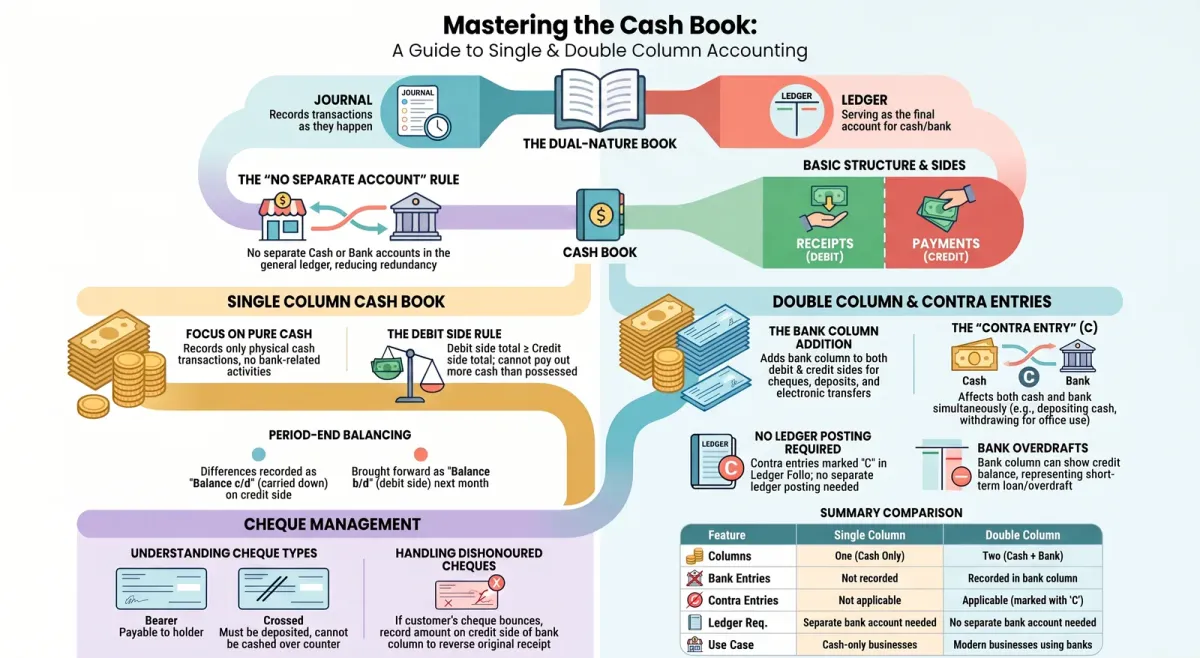
Among all the special purpose books introduced in CBSE Class 11 Accountancy Chapter 4, the Cash Book holds a special place. It is the busiest book in any organisation’s accounting system, and it has a unique characteristic that no other subsidiary book shares — it functions simultaneously as a journal and as a ledger.
Whether you are preparing for your Class 11 school exams or competitive entrance tests like CUET, IPMAT, or SET, a thorough understanding of the Cash Book is non-negotiable.
What Is a Cash Book?
A Cash Book is a special purpose book dedicated to recording all transactions involving cash receipts and cash payments. It begins each accounting period with the opening cash or bank balance and captures every inflow and outflow chronologically throughout the period — typically maintained on a monthly basis.
When a Cash Book is maintained, the business does not open a separate Cash Account or Bank Account in the ledger. The Cash Book itself serves that purpose, which is why it is described as both a book of original entry and a ledger account.
Types of Cash Books
There are three main types of Cash Books, of which Class 11 Chapter 4 covers two in detail:
-
Single Column Cash Book — records only cash transactions
-
Double Column Cash Book — records both cash and bank transactions
-
Petty Cash Book — records small, routine payments (covered separately)
Single Column Cash Book
Structure and Format
The single column Cash Book has two sides, just like a ledger account. The left (debit) side records all cash receipts, and the right (credit) side records all cash payments. There is one amount column on each side — hence the name “single column.”
Columns on each side: Date | Particulars (Receipts or Payments) | Ledger Folio | Amount (₹)
Recording Entries
All cash receipts — including opening balance, cash sales, cash received from debtors, loans received in cash — are recorded on the debit side. All cash payments — including cash purchases, expenses paid, payments to creditors, deposits into the bank — are recorded on the credit side.
Balancing the Single Column Cash Book
At the end of the period, both sides are totalled. Since cash payments can never exceed the total cash available (opening balance plus all receipts), the debit side total is always greater than or equal to the credit side total. The difference, written on the credit side as “Balance c/d,” represents the cash in hand at the end of the period. This balance is brought down on the debit side as “Balance b/d” at the start of the next period.
Posting to the Ledger
The Cash Book’s debit side shows the sources of our cash receipts. When posting to the ledger, these accounts are credited in the ledger. Conversely, the credit side shows where the cash went — these accounts are debited in their respective ledger accounts.
Double Column Cash Book
Why the Double Column Cash Book?
In modern businesses, the vast majority of transactions are routed through the bank. Paying by cheque, receiving cheques from customers, depositing cash into the bank, and withdrawing from the bank are daily occurrences. Rather than recording every bank transaction in the Journal and then posting to the ledger separately, businesses find it far more practical to add a bank column to the Cash Book.
This creates the Double Column Cash Book — two amount columns on each side, one for cash and one for bank.
Banking Basics You Need to Know
Current Account: Businesses typically operate a current account. Banks do not pay interest on current accounts but may charge small fees called incidental charges.
Pay-in-Slip: To deposit cash or cheques into the bank, the business fills in a pay-in-slip. The counterfoil (stamped by the bank) serves as the receipt.
Cheques: The bank provides blank cheque forms. A bearer cheque can be cashed by anyone who holds it. An order cheque is paid only to the named person after identification. When two parallel lines are drawn across a cheque, it is crossed — meaning it must be deposited into a bank account and cannot be encashed over the counter.
Recording Bank Transactions
All deposits into the bank are recorded on the debit side in the bank column. All payments made by cheque or withdrawals from the bank are recorded on the credit side in the bank column.
Understanding Contra Entries
A contra entry is a unique feature of the double column Cash Book. It arises when a transaction involves both the cash column and the bank column simultaneously.
Two situations create contra entries:
- Cash deposited into the bank: Cash decreases, bank balance increases.
-
Debit: Bank column (bank increases)
-
Credit: Cash column (cash decreases)
- Cash withdrawn from the bank for office use: Bank balance decreases, cash increases.
-
Debit: Cash column (cash increases)
-
Credit: Bank column (bank balance decreases)
In both cases, the letter “C” is written in the Ledger Folio column, indicating that these entries are contra entries and should NOT be posted to the ledger. Since both aspects of the transaction appear within the Cash Book itself, no further posting is required.
Bank Overdraft
In normal circumstances, the bank column shows a debit balance (bank has money). However, if the business withdraws more than it has deposited, the bank column shows a credit balance — this is called a bank overdraft. An overdraft is essentially a short-term loan from the bank.
Dishonoured Cheques
If a cheque received from a customer and deposited into the bank is later returned unpaid (usually due to insufficient funds in the customer’s account), the bank debits the firm’s account. In response, the firm enters the dishonoured amount on the credit side of the bank column, effectively reversing the original receipt entry. This restores the customer’s account to its position before the cheque was received.
Key Differences: Single vs Double Column Cash Book
| Feature | Single Column | Double Column |
|---|---|---|
| Columns | One (Cash) | Two (Cash + Bank) |
| Bank transactions | Not recorded | Recorded in bank column |
| Contra entries | Not applicable | Applicable |
| Separate bank account in ledger | Yes | No |
| Use case | Cash-only businesses | Businesses using bank accounts |
Related Reading
-
Special Purpose Books in Accounting | CBSE Class 11 Accountancy Chapter 4
-
Ledger and Posting in Accounting – Class 11 CBSE Complete Guide with Format and Examples
-
Subsidiary Books Class 11 Accountancy – Purchase Book, Sales Book, Cash Book Explained
Practise Cash Book Problems on ChampionsPrep
The Cash Book is one of the highest-weightage topics in CBSE Class 11 school exams and a firm favourite in CUET Commerce, IPMAT, and JIPMAT numerical sections. Getting the format right and mastering contra entries takes focused practice with graded problems.
At ChampionsPrep , you’ll find chapter-wise solved problems, shortcut strategies for balancing Cash Books, and MCQ sets specifically designed for school exam and entrance test preparation — available on a flexible, pay-per-use basis.
Start practising Cash Book problems now at ChampionsPrep .
Test Your Knowledge

Cash Book in Accounting: Single Column & Double Column Explained
Frequently Asked Questions
Why is a Cash Book called both a journal and a ledger? +
Cash transactions are recorded directly in the Cash Book (journal function) and no separate Cash or Bank Account is maintained in the ledger (ledger function), so it serves both purposes.
What is a contra entry in the double column cash book? +
A contra entry records a transaction that affects both the cash and bank columns simultaneously — such as depositing cash into the bank. It is marked 'C' in the LF column to indicate that no ledger posting is needed.
Can the bank column of the cash book show a credit balance? +
Yes. A credit balance in the bank column indicates a bank overdraft — meaning the business has withdrawn more than it deposited.
What does a debit balance in the cash column of a cash book represent? +
It represents cash in hand - the physical cash the business still holds at that point. The cash column can never show a credit balance because a business cannot pay out more cash than it possesses.
What is the difference between a bearer cheque and an order cheque? +
A bearer cheque can be encashed by anyone who holds it, while an order cheque is paid only to the person named on it after identification. Crossing a cheque with two parallel lines restricts it to bank deposit only.
AI-powered practice — free to start