
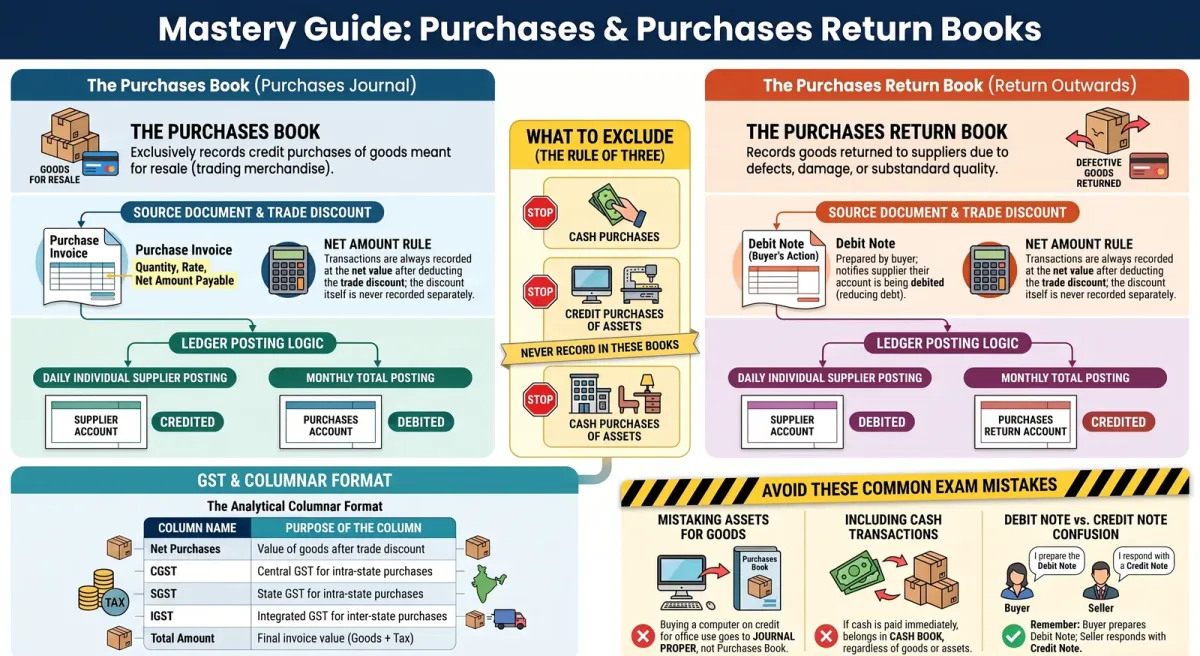
The final trio of special purpose books in CBSE Class 11 Accountancy Chapter 4 — the Sales Book, the Sales Return Book, and the Journal Proper — completes the picture of how a business organises its accounting records. Add to this the critical skill of balancing ledger accounts, and you have everything you need to master Chapter 4 from start to finish.
This guide covers all four topics in one place, with clear explanations, format breakdowns, posting rules, and exam-ready tips.
The Sales (Journal) Book
What Is the Sales Book?
The Sales (Journal) Book is a special purpose book that records all credit sales of goods (trading merchandise). Just as the Purchases Book handles credit purchases of goods, the Sales Book handles credit sales — no more, no less.
What is recorded:
- Credit sales of goods the business trades in
What is NOT recorded here:
-
Cash sales → go into the Cash Book
-
Credit sales of assets (old furniture, equipment, vehicles) → go into the Journal Proper
Source Document: The Sales Invoice
Every entry in the Sales Book is supported by a sales invoice (bill) issued by the business to its customer. This invoice contains the date, invoice number, customer’s name, item details, quantity, rate, applicable trade discount, and the net amount.
Two or more copies of the invoice are typically prepared. The customer receives the original; the bookkeeper uses a copy to record the entry in the Sales Book. The net amount after trade discount is what enters the book.
Format of the Sales Book
Sales (Journal) Book
-----------------------------------------------------------
Date | Invoice No. | Name of Customer          | L.F. | Amount (₹)
     |             | (Account to be Debited)    |      |
-----------------------------------------------------------
The “Account to be Debited” reminder reflects the double-entry logic: when goods are sold on credit, the customer owes us money, so their account is debited.
Posting the Sales Book to the Ledger
Step 1 — Individual Customer Accounts (Daily): Each credit customer’s account in the ledger is debited with their invoice amount. This records the money owed by the customer to the business.
Step 2 — Sales Account (Monthly): At the end of the month, the total of the Sales Book is posted to the credit of the Sales Account in the ledger, narrated as “Sundries as per Sales Book.”
The Sales Return (Journal) Book
What Is the Sales Return Book?
The Sales Return Book — also called the Return Inwards Book — records goods returned by customers. When a customer sends back goods (because they are defective, wrongly supplied, or of poor quality), the business needs a systematic record of these returns.
Source Document: The Credit Note
When a business accepts goods returned by a customer, it prepares a Credit Note (in duplicate) and sends the original to the customer. The credit note acknowledges that the customer’s account has been credited in the business’s ledger — reducing the amount they owe.
The credit note contains:
-
Serial number and date
-
Customer’s name
-
Details of goods returned (description, quantity, rate)
-
Amount credited
-
Reason for accepting the return
Debit Note vs Credit Note — The Definitive Clarification
These two documents appear together in Chapter 4 and are frequently confused in exams:
| Document | Prepared By | When Used | Account Affected |
|---|---|---|---|
| Debit Note | Buyer | Returning goods to supplier | Supplier's account is debited (buyer's books) |
| Credit Note | Seller | Accepting goods from customer | Customer's account is credited (seller's books) |
A simple way to remember: the note is named after the account that is affected in the preparer’s books. When a buyer raises a debit note, they are debiting the supplier. When a seller raises a credit note, they are crediting the customer.
Format of the Sales Return Book
Sales Return (Journal) Book
--------------------------------------------------------------
Date | Credit Note No. | Name of Customer           | L.F. | Amount (₹)
     |                 | (Account to be Credited)    |      |
--------------------------------------------------------------
Posting the Sales Return Book to the Ledger
Step 1 — Individual Customer Accounts (Daily): Each customer’s account is credited with the value of goods returned. This reduces the amount the customer owes.
Step 2 — Sales Return Account (Monthly): The monthly total of the Sales Return Book is posted to the debit of the Sales Return Account (also called Return Inwards Account) in the ledger.
GST in Sales and Sales Return Books
When transactions are subject to GST, both books use an analytical format similar to the Purchases Book:
-
Intra-state sales (seller and buyer in the same state): CGST + SGST apply.
-
Inter-state sales (seller and buyer in different states): IGST applies.
GST is always calculated on the value after deducting trade discount.
The Journal Proper
What Is Journal Proper?
The Journal Proper (also called Journal Residual) is the catch-all journal for transactions that do not belong in any of the five special purpose books. It follows the traditional two-column journal format with separate Debit and Credit amount columns.
Five Categories of Entries in the Journal Proper
1. Opening Entries At the start of a new accounting year, opening balances of all assets, liabilities, and capital are brought into the new set of books through a single opening entry.
2. Adjusting Entries At the end of the accounting period, entries are needed to align the records with the accrual basis — for example, recording outstanding (unpaid) salary, prepaid insurance, depreciation, or advance income received.
3. Rectification Entries Errors discovered in earlier recordings — wrong amounts, wrong accounts, omissions — are corrected through rectification entries in the Journal Proper.
4. Transfer (Closing) Entries At the year end, all revenue and expense accounts are closed by transferring their balances to the Trading Account and Profit & Loss Account. The Drawings Account is transferred to the Capital Account. These are called closing entries.
5. Other Entries
-
Credit purchase or sale of assets (not goods)
-
Goods withdrawn by the owner for personal use
-
Goods distributed as samples for sales promotion
-
Dishonour of cheques (cancellation of discount previously recorded)
-
Loss of goods by fire, theft, or spoilage
-
Endorsement and dishonour of bills of exchange
Balancing of Ledger Accounts
What Does Balancing Mean?
Periodically — typically at the end of each month or accounting year — all ledger accounts need to be balanced. Balancing an account means:
-
Totalling both the debit and credit sides of the account.
-
Finding the difference between the two totals.
-
Writing that difference on the shorter side to make both sides equal. This entry is labelled “Balance c/d” (carried down).
-
The same amount is then brought down on the opposite side as “Balance b/d” (brought down) at the start of the next period.
Debit Balance vs Credit Balance
-
If the debit total exceeds the credit total → Debit Balance (written on the credit side as Balance c/d, brought down on the debit side)
-
If the credit total exceeds the debit total → Credit Balance (written on the debit side as Balance c/d, brought down on the credit side)
Which Accounts Are Balanced?
Real and Personal Accounts (assets, liabilities, capital, debtors, creditors) are balanced. Their balances are carried forward to the next period.
Nominal Accounts (revenues, expenses, gains, losses) are not balanced in the conventional sense. Instead, they are closed by transferring their totals to the Trading Account or Profit & Loss Account at the year end. These are the closing entries made in the Journal Proper.
The Cash Book is balanced like a ledger account — and since cash payments can never exceed total cash available, the Cash Book always shows a debit balance.
Related Reading
-
Purchases Book & Purchases Return Book | CBSE Class 11 Accountancy Complete Guide
-
Petty Cash Book: Meaning, Format & Imprest System | CBSE Class 11 Accountancy
-
Special Purpose Books in Accounting | CBSE Class 11 Accountancy Chapter 4
Complete Chapter 4 — Then Go Further With ChampionsPrep
Sales Book, Sales Return Book, Journal Proper, and Balancing of Accounts bring Chapter 4 of Class 11 Accountancy to a close. But mastery comes from working through problems — varied, challenging, exam-style problems that push you beyond rote learning.
At ChampionsPrep , you get chapter-wise practice questions for the entire Class 11 and 12 Accountancy syllabus, including comprehensive Chapter 4 problem sets with detailed step-by-step solutions. The platform is built for Commerce students preparing for CBSE exams, CUET, IPMAT, JIPMAT, NPMAT, and CLAT (Commerce stream).
Head to ChampionsPrep now — pay only for what you practise.
Test Your Knowledge
Sales Book, Sales Return Book & Journal Proper | CBSE Class 11 Accountancy Guide
Frequently Asked Questions
What types of transactions are recorded in the Journal Proper? +
Opening entries, adjusting entries, rectification entries, closing/transfer entries, credit purchases or sales of assets, goods withdrawn for personal use, goods distributed as samples, and losses by fire or theft.
What is the difference between the Sales Book and the Sales Return Book? +
The Sales Book records all credit sales of goods to customers. The Sales Return Book records goods returned by customers. The former debits customer accounts; the latter credits them.
Why are nominal accounts not balanced in the ledger? +
Nominal accounts are temporary — they are closed at year end by transferring to the Trading or Profit & Loss Account. They do not carry a balance forward to the next period.
What does "Return Inwards" mean? +
Return inwards is another name for the Sales Return Book - goods coming back into the business from customers. Similarly, Return Outwards (the Purchases Return Book) records goods going back out to suppliers.
Who prepares a credit note, and what does it do? +
The seller prepares the credit note in duplicate when accepting goods returned by a customer. The original goes to the customer; it acknowledges that the customer's account has been credited, reducing the amount they owe.
AI-powered practice — free to start