
Every business — no matter how large — has a constant stream of small, repetitive expenses. Auto fares for office staff, postage stamps, stationery purchases, courier charges, refreshments for visitors, cartage for small deliveries — these amounts are individually insignificant, yet they add up and must be recorded properly.
Recording each of these tiny payments in the main Cash Book would make it cluttered, time-consuming, and nearly impossible to analyse. That is exactly why accountants created the Petty Cash Book — a dedicated record for small, routine cash payments.
In CBSE Class 11 Accountancy Chapter 4, the Petty Cash Book is introduced alongside the Cash Book as the third type of cash recording mechanism. Understanding it well earns you marks in both theory and numerical sections of the school exam.
What Is a Petty Cash Book?
A Petty Cash Book is a subsidiary book maintained specifically to record small, frequent cash payments that would otherwise clutter the main Cash Book. These payments — commonly called petty expenses — typically include conveyance, stationery, postage, telegrams, courier charges, cartage, and miscellaneous office expenses.
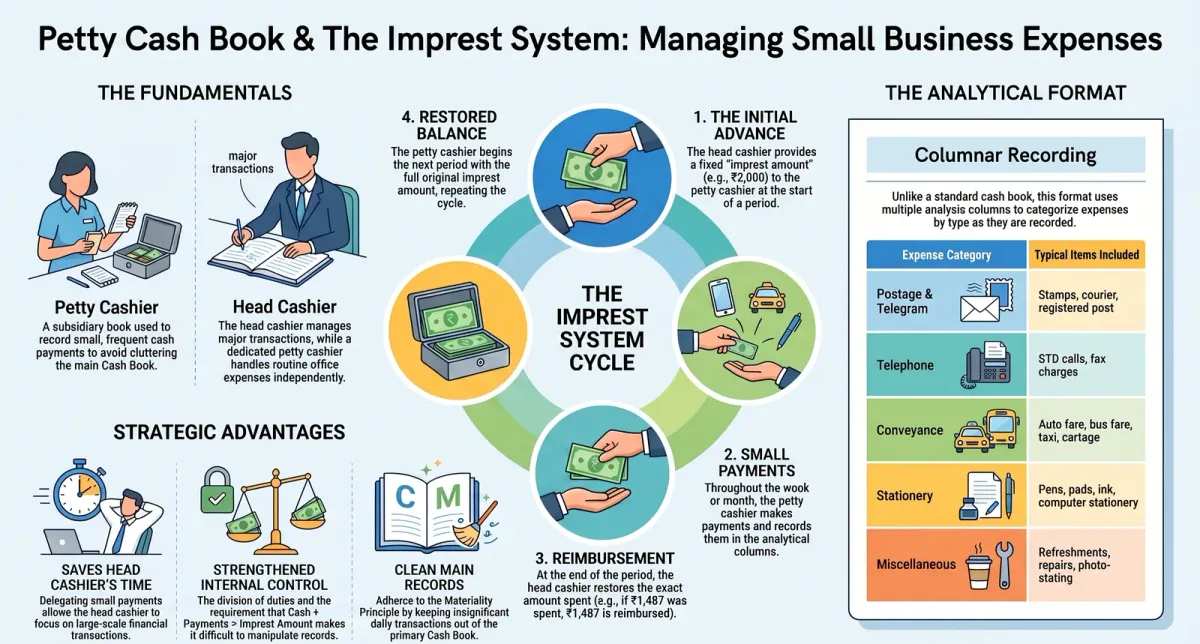
In large organisations, a separate employee called the petty cashier is appointed to handle and record these payments. The petty cashier operates independently of the main cashier (also called the head cashier), who manages all major cash and bank transactions.
The Imprest System
The Petty Cash Book operates on a well-designed cash management framework called the Imprest System. Here is how it works:
Step 1 — Initial Advance: At the beginning of a fixed period (weekly, fortnightly, or monthly), the head cashier hands a predetermined fixed amount to the petty cashier. This amount is called the imprest amount. For example, ₹2,000 at the start of May.
Step 2 — Petty Payments: Throughout the period, the petty cashier uses this imprest amount to make all small payments and records each one in the Petty Cash Book.
Step 3 — Reimbursement: At the end of the period, the petty cashier presents the Petty Cash Book to the head cashier. The head cashier reimburses exactly the amount that was spent. So if ₹1,487 was spent, the petty cashier receives ₹1,487 back.
Step 4 — Restored Balance: With the reimbursement added, the petty cashier begins the next period with the full imprest amount again — in this case, ₹2,000. This cycle repeats every period.
The elegance of the imprest system is that the petty cashier always holds the same maximum amount at the start of each period. It makes verification easy — the cash in hand plus the total payments recorded should always equal the imprest amount. Any discrepancy immediately signals an error or irregularity.
Format of the Petty Cash Book
Unlike the simple single-column format of the main Cash Book, the Petty Cash Book uses an analytical (or columnar) format. It has:
-
One column on the receipt (debit) side — recording the imprest amount received at the start and the reimbursement received at the end.
-
Multiple columns on the payment (credit) side — one for the total amount paid, and individual analysis columns for each major category of expense.
Typical Analysis Columns on the Payment Side
| Column | Examples of Items |
|---|---|
| Total Amount Paid | All petty payments |
| Postage & Telegram | Stamps, courier, registered post, speed post |
| Telephone | STD calls, fax charges |
| Conveyance | Auto fare, bus fare, taxi fare, cartage |
| Stationery | Pens, pads, computer stationery, ink |
| Miscellaneous | Refreshments, sanitation, photo-stating, repairs |
The last column is always Miscellaneous, followed by a Remarks column where the nature of miscellaneous payments is described. Every payment is entered in the “Total Amount Paid” column AND in the appropriate analysis column. At the end of the period, all columns are totalled and cross-checked — the total of all analysis columns must equal the total in the “Amount Paid” column.
Preparing the Petty Cash Book — Step by Step
Step 1: Open the receipt side by recording the imprest amount received on Day 1.
Step 2: As each petty expense is incurred, record the date, voucher number, and description in the particulars column. Enter the amount in the “Total Paid” column and also in the relevant analysis column.
Step 3: At the end of the period, total all columns. The “Total Paid” column gives the total expenditure for the period.
Step 4: Calculate the closing balance: Imprest Amount − Total Paid = Balance with Petty Cashier. Enter this as “Balance c/d.”
Step 5: The total of the receipt column (imprest amount) equals the total of the payment column (total paid + balance c/d).
Step 6: At the start of the next period, bring down the balance on the receipt side and add the reimbursement received from the head cashier.
Posting from the Petty Cash Book to the Ledger
The Petty Cash Book is not just a record of expenses — its totals are eventually posted to the main ledger. Here is the process:
-
A Petty Cash Account is opened in the ledger. It is debited when cash is given to the petty cashier, and credited with the total expenditure at the end of the period.
-
Each individual expense account in the ledger (Postage, Conveyance, Stationery, Telephone, Miscellaneous) is debited with the periodic column total from the Petty Cash Book.
-
The Petty Cash Account is then credited with the same total, referenced as “Sundries as per Petty Cash Book.”
-
The balance in the Petty Cash Account after this posting represents the actual cash still held by the petty cashier.
This process keeps the main ledger free of hundreds of tiny individual entries, replacing them with just one entry per expense category per period.
Advantages of Maintaining a Petty Cash Book
1. Saves the Head Cashier’s Time
By delegating small payments to the petty cashier, the head cashier is free to focus on large, important transactions. This improves overall efficiency and accountability.
2. Strengthens Internal Control
The head cashier maintains oversight by reviewing the Petty Cash Book before reimbursing. Division of responsibilities means neither cashier can easily manipulate records without the other noticing, which significantly reduces the risk of fraud or embezzlement.
3. Keeps the Main Cash Book Clean and Readable
Recording dozens of tiny payments in the main Cash Book would make it bulky and difficult to analyse. The materiality principle of accounting requires that only significant transactions feature in the main records. The Petty Cash Book keeps things in their proper place.
Related Reading
-
Cash Book in Accounting: Single Column & Double Column Explained
-
Special Purpose Books in Accounting | CBSE Class 11 Accountancy Chapter 4
-
Ledger and Posting in Accounting – Class 11 CBSE Complete Guide with Format and Examples
Ace Chapter 4 With ChampionsPrep
Petty Cash Book numerical questions — especially those requiring you to prepare the full columnar book, balance it, and post to the ledger — appear consistently in CBSE school exams. Getting them right requires practice with authentic exam-style problems.
At ChampionsPrep , you get step-by-step solved petty cash book problems, timed practice sets, and concept-review notes — on a pay-per-use platform built specifically for Class 11 and 12 Commerce students.
Visit ChampionsPrep and solve your first petty cash book problem today — no subscription required.
Test Your Knowledge

Petty Cash Book: Meaning, Format & Imprest System | CBSE Class 11 Accountancy
Frequently Asked Questions
What is the imprest amount in a petty cash book? +
The imprest amount is the fixed sum given to the petty cashier at the start of each period. At the end of the period, the cashier is reimbursed exactly the amount spent, restoring the balance to the full imprest.
Why does the petty cash book use a columnar (analytical) format? +
The columnar format allows each payment to be simultaneously categorised under expense heads like postage, conveyance, and stationery. The column totals are posted directly to ledger accounts, saving time.
What is the difference between the petty cashier and the head cashier? +
The head cashier manages large transactions and maintains the main Cash Book. The petty cashier handles only small, routine payments and maintains the Petty Cash Book.
How does the imprest system help in verifying the petty cash book? +
Cash in hand plus the total of payments recorded should always equal the imprest amount. If the two sides do not reconcile, the discrepancy immediately signals an error or irregularity.
When is the Petty Cash Account in the ledger credited? +
At the end of the period, after each expense account is debited with its analysis column total, the Petty Cash Account is credited with the same total, referenced as "Sundries as per Petty Cash Book".
AI-powered practice — free to start