
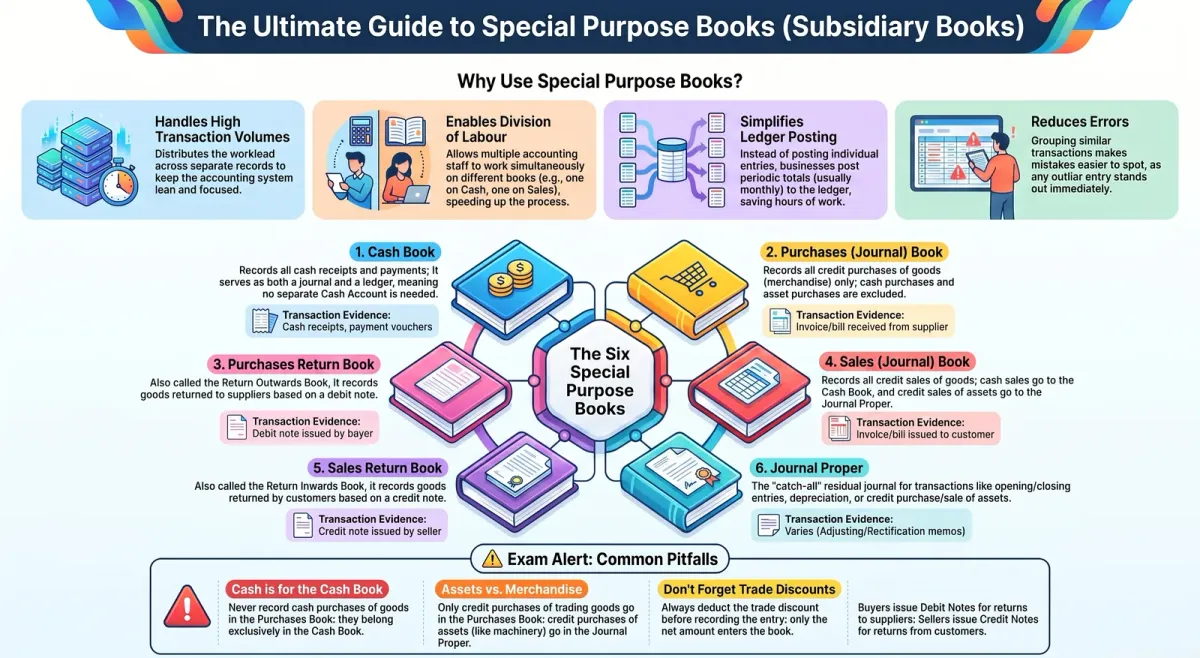
When a business is small, recording every transaction in a single journal works perfectly well. But as the business grows and the number of transactions multiplies, that single journal quickly becomes unmanageable. Entries pile up, errors creep in, and locating any particular record turns into a time-consuming exercise. This is the problem that special purpose books — also called subsidiary books or daybooks — were designed to solve.
CBSE Class 11 Accountancy Chapter 4 introduces these books as a natural extension of the journalising skills you built in Chapter 3. Understanding them well is essential not just for your school exams, but for every accounting course and competitive exam you take going forward.
What Are Special Purpose Books?
Special purpose books are sub-divisions of the main journal. Rather than recording every business transaction in one generalised journal, accountants separate transactions by type and maintain a dedicated book for each category. Each book handles one kind of repetitive transaction — and together, they cover the entire range of a business’s day-to-day financial activity.
Any transaction that does not fit into any of these specialised books is recorded in a book called the Journal Proper, also known as the Journal Residual. This serves as the catch-all for less common or non-repetitive entries.
Why Businesses Need Special Purpose Books
1. Managing High Transaction Volumes
A business processing hundreds of transactions every week cannot practically funnel everything through one journal. Special purpose books distribute the workload across separate records, keeping each one lean and focused.
2. Making Division of Labour Possible
With separate books for separate transaction types, multiple accounting staff can work simultaneously — one clerk on the Cash Book, another on the Purchases Book, a third on the Sales Book. This dramatically speeds up the recording process and reduces bottlenecks.
3. Reducing Errors
When similar transactions are grouped together, errors are far easier to spot. An incorrect entry in the Purchases Book stands out immediately because every other entry in that book relates to a credit purchase of goods.
4. Simplifying Ledger Posting
Perhaps the biggest advantage is efficiency in posting. Instead of transferring each individual entry to the ledger, businesses post periodic totals — typically monthly. The monthly total of the Sales Book, for instance, is posted to the Sales Account in one single entry. This saves hours of work every accounting period.
5. Applying the Materiality Principle
Good accounting practice requires that insignificant details do not clutter the main records. Keeping petty expenses in a separate Petty Cash Book, for example, ensures that the main Cash Book stays clean and shows only transactions that matter.
The Six Special Purpose Books in Class 11 Chapter 4
1. Cash Book
Records all transactions involving cash receipts and payments. The Cash Book is unique because it serves as both a journal and a ledger for cash — no separate Cash Account is needed in the ledger when a Cash Book is maintained.
2. Purchases (Journal) Book
Records all credit purchases of goods (merchandise). Cash purchases of goods and credit purchases of assets such as furniture or machinery are NOT recorded here.
3. Purchases Return (Journal) Book
Also known as the Return Outwards Book, this records goods returned to suppliers. The source document that triggers an entry here is a debit note issued by the buyer.
4. Sales (Journal) Book
Records all credit sales of goods. Cash sales go into the Cash Book. Sales of assets such as old furniture on credit go into the Journal Proper — not here.
5. Sales Return (Journal) Book
Also called the Return Inwards Book, this records goods returned by customers. The source document is a credit note issued by the seller.
6. Journal Proper
The residual journal. Any transaction that cannot logically be placed in any of the above five books is recorded here. This includes opening entries, adjusting entries, rectification entries, closing entries, purchase or sale of assets on credit, and goods withdrawn by the owner for personal use.
The Role of Source Documents
Every entry in a special purpose book must be backed by a source document — the original evidence of the transaction. Without a source document, an entry has no verifiable foundation.
| Book | Source Document |
|---|---|
| Cash Book | Cash receipts, payment vouchers |
| Purchases Book | Invoice/bill received from supplier |
| Purchases Return Book | Debit note issued by buyer |
| Sales Book | Invoice/bill issued to customer |
| Sales Return Book | Credit note issued by seller |
| Journal Proper | Varies by transaction type |
Common Exam Mistakes to Avoid
Understanding the rules is not enough — you also need to avoid the traps that exam questions are specifically designed to expose.
Mistake 1: Recording cash purchases in the Purchases Book. Cash purchases always go in the Cash Book, never in the Purchases Book.
Mistake 2: Recording credit purchases of assets in the Purchases Book. Only credit purchases of trading goods (merchandise) belong here. A credit purchase of machinery, furniture, or land goes into the Journal Proper.
Mistake 3: Forgetting to deduct trade discount. Trade discount is always deducted before recording. Net amount after discount is what enters the book.
Mistake 4: Confusing debit notes and credit notes. A debit note is prepared by the buyer when returning goods to the supplier. A credit note is prepared by the seller when accepting goods returned by the customer.
Master Accountancy With ChampionsPrep
Chapter 4 lays the foundation for everything that follows in Class 11 and Class 12 Accountancy — from Trial Balance to Final Accounts. The concepts here also appear regularly in CUET (Commerce), IPMAT, JIPMAT, and NPAT entrance exams.
At ChampionsPrep , you get chapter-wise MCQs, solved illustrations, concept videos, and AI-powered doubt resolution — all available on a pay-per-use model so you pay only for what you actually use.
Visit ChampionsPrep and start practising Chapter 4 today.
Test Your Knowledge

Special Purpose Books in Accounting | CBSE Class 11 Accountancy Chapter 4
Frequently Asked Questions
What is the difference between a special purpose book and the general journal? +
A general journal records every transaction in one place. A special purpose book is dedicated to one category of transactions, making recording faster and less error-prone.
Why is the Cash Book considered both a journal and a ledger? +
Cash receipts and payments are recorded directly in the Cash Book (journal function), and no separate Cash Account is needed in the ledger (ledger function).
Which transactions are recorded in the Journal Proper? +
Opening entries, adjusting entries, rectification entries, closing entries, credit purchases/sales of assets, goods withdrawn for personal use, and loss of goods by fire or theft.
Which source document supports an entry in the Sales Return Book? +
A credit note issued by the seller, who prepares it when accepting goods returned by a customer.
Why are credit purchases of assets not recorded in the Purchases Book? +
The Purchases Book is meant only for credit purchases of goods bought for resale. A credit purchase of furniture, machinery or land is recorded in the Journal Proper instead.
AI-powered practice — free to start