
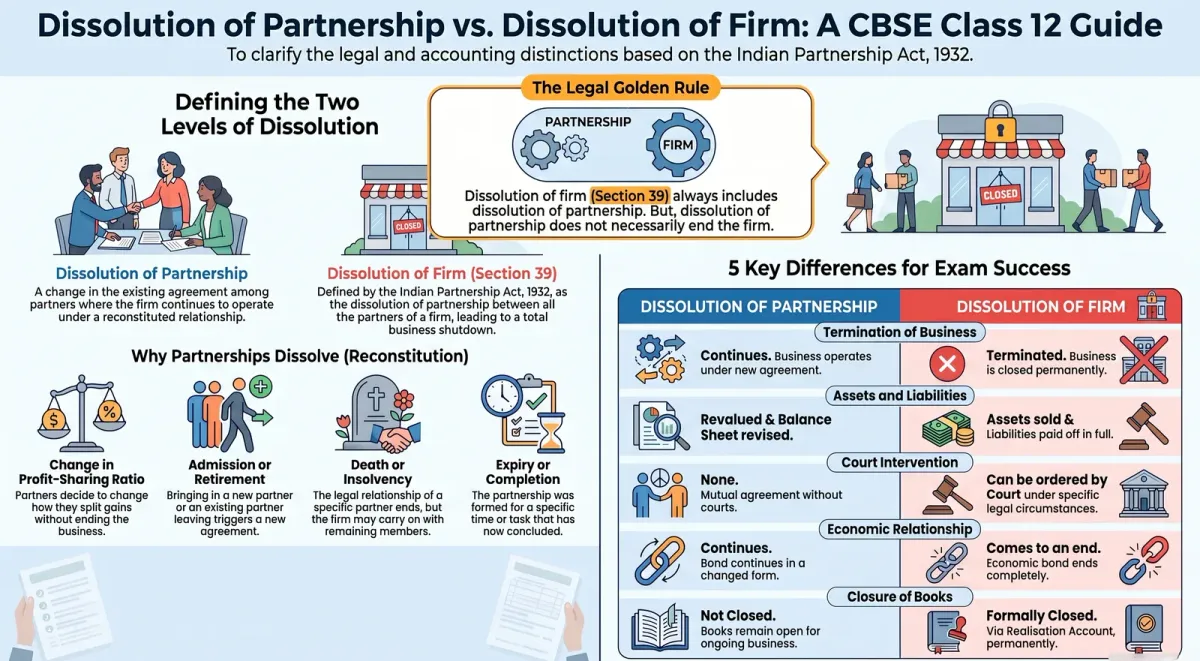
If you have started Chapter 4 of your Class 12 Accountancy syllabus, you have probably noticed that “dissolution of partnership” and “dissolution of firm” sound almost identical — yet your textbook treats them as two different concepts. This confusion costs students easy marks every year, in both CBSE board exams and competitive tests like CUET. This guide breaks down the meaning of both terms, explains the legal basis under Section 39 of the Indian Partnership Act, 1932, and lists five clear points of difference for exam-ready answers.
What Does “Dissolution” Actually Mean?
In everyday language, dissolution simply means “coming to an end.” In partnership accounting, this ending can happen at two levels: the relationship between some partners changes while the business carries on (dissolution of partnership), or the relationship between all partners breaks down completely and the business shuts down (dissolution of the firm). Understanding this one distinction unlocks almost the entire chapter.
Dissolution of Partnership: Meaning
Dissolution of partnership refers to any change in the existing agreement between partners that does not end the business itself. The firm may continue operating under the same name, with the remaining partners simply reconstituting their relationship. This can happen because of:
-
A change in the existing profit-sharing ratio among partners
-
Admission of a new partner
-
Retirement of a partner
-
Death of a partner
-
Insolvency of a partner
In each of these cases, only the partnership agreement is dissolved — the firm’s business, its assets, and its books of account continue as before, just with a revised set of partners or terms.
Two other events are different. A firm formed for a fixed term is dissolved when that term expires, and a firm formed for a particular venture is dissolved when the venture is completed. Under Section 42 of the Indian Partnership Act, 1932, these events dissolve the firm itself unless the partners have agreed otherwise.
Dissolution of a Firm: Meaning (Section 39)
Section 39 of the Indian Partnership Act, 1932, defines dissolution of a firm as the dissolution of partnership between all the partners of a firm. In simple words, when every single partner decides to part ways, the firm itself ceases to exist. This is a much bigger event than dissolution of partnership: the business closes entirely, all assets are sold or realised, all liabilities are paid off, books of account are permanently closed, and no further business is transacted except winding-up activities.
An important legal nuance: dissolution of a firm always results in dissolution of partnership (since all partners’ relationships end), but dissolution of partnership does not necessarily result in dissolution of the firm (the business can continue with the remaining or new partners).
5 Key Differences Between Dissolution of Partnership and Dissolution of Firm
Here is a side-by-side comparison based on the five criteria most commonly tested in CBSE exams.
1. Termination of Business In dissolution of partnership, the business is not terminated — it continues as usual. In dissolution of a firm, the business of the firm is closed permanently.
2. Settlement of Assets and Liabilities When only the partnership is dissolved, assets and liabilities are revalued and a fresh balance sheet is prepared to reflect the new partnership structure. When the firm itself is dissolved, assets are actually sold in the market and liabilities are paid off in full.
3. Court’s Intervention Dissolution of partnership happens purely by mutual agreement, so courts do not get involved. Dissolution of a firm can be ordered by a court under specific circumstances in the Partnership Act.
4. Economic Relationship In dissolution of partnership, the economic relationship between partners continues, though in a changed form (for example, a new profit-sharing ratio). In dissolution of a firm, this economic relationship comes to a complete end.
5. Closure of Books Since the business continues after dissolution of partnership, there is no need to close the books of account. But when a firm is dissolved, the books of account must be formally closed, because the firm no longer exists as a business entity.
Why This Distinction Matters for Exams and Real Business
CBSE frequently tests this distinction through objective-type “true or false” questions and short-answer questions asking students to list differences. Getting even one point wrong — for instance, saying that dissolution of partnership requires closing the books — can cost you marks in an otherwise well-attempted paper.
Beyond exams, this concept matters in real business too. If one partner in a three-partner firm retires and the rest agree to continue, only the partnership is dissolved — operations continue uninterrupted. But if all three decide to shut down entirely, that is dissolution of the firm, requiring a full winding-up process, including preparation of a Realisation Account.
Quick Recap
-
Dissolution of partnership changes the relationship between some partners; the firm continues.
-
Dissolution of a firm ends the relationship between all partners under Section 39; the business is fully wound up.
-
Every dissolution of a firm involves dissolution of partnership, but not vice versa.
-
The five differences — business termination, asset/liability settlement, court’s role, economic relationship, and closure of books — are the most exam-relevant.
Ready to Master Dissolution of Partnership Firm?
Understanding the theory is just the first step — scoring full marks needs regular practice with solved examples and MCQs. On ChampionsPrep , our AI-powered, pay-per-use question banks let you practice exactly the topics you find difficult, from dissolution of partnership to full Realisation Account problems, at just ₹10 per use. Visit https://app.championsprep.in today.
Test Your Knowledge
Dissolution of Partnership vs Dissolution of Firm: Meaning and Key Differences
Frequently Asked Questions
What is the main difference between dissolution of partnership and dissolution of firm? +
Dissolution of partnership changes the relationship among some partners while the business continues, whereas dissolution of a firm ends the relationship among all partners and closes the business entirely.
Does dissolution of a firm always mean dissolution of partnership? +
Yes. Since dissolution of a firm involves breaking the relationship between all partners, it automatically results in dissolution of partnership as well.
Is court intervention required for dissolution of partnership? +
No. Dissolution of partnership is usually a mutual, internal arrangement between partners and does not require court intervention. Dissolution of a firm, however, can be ordered by a court under the Indian Partnership Act, 1932.
Which section of the Indian Partnership Act defines dissolution of a firm? +
Section 39 of the Indian Partnership Act, 1932, defines dissolution of a firm as the dissolution of partnership between all the partners of a firm.
Are books of account closed in both types of dissolution? +
No. Books of account are closed only when the firm itself is dissolved. In dissolution of partnership, the business continues, so there is no need to close the books.
AI-powered practice — free to start