
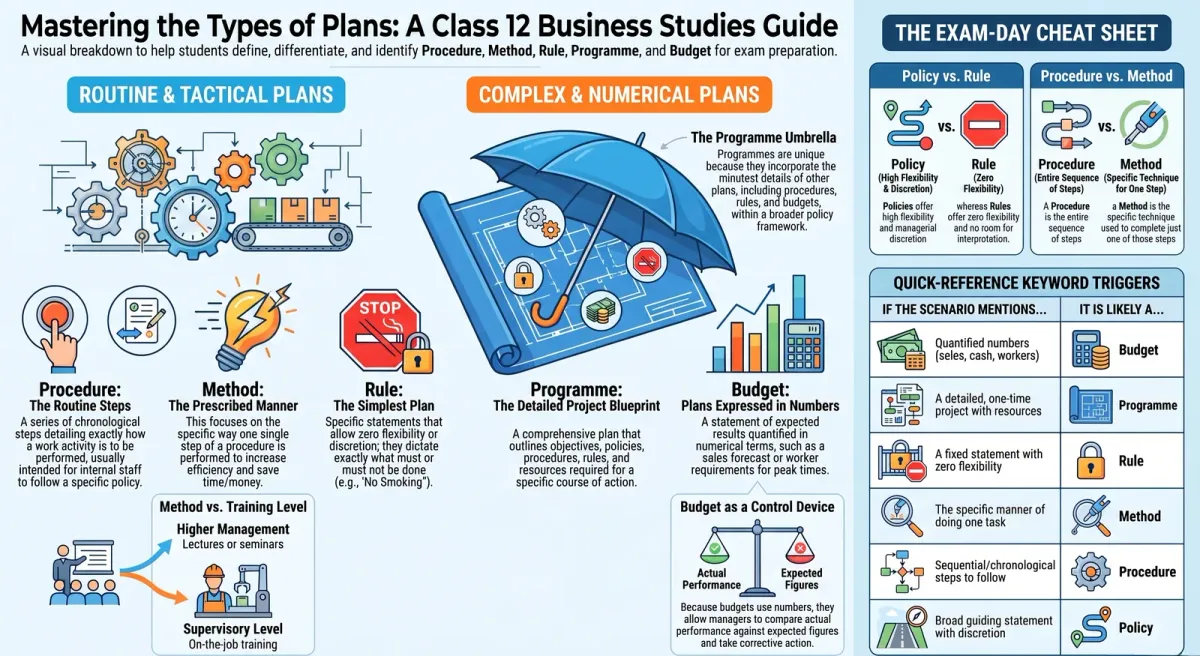
In Part 1 of this series, we covered single-use vs standing plans, along with objectives, strategy and policy. This post completes the classification of plans from Chapter 4 of CBSE Class 12 Business Studies by covering procedure, method, rule, programme and budget — and closes with a quick exam-prep guide to help you tell these plan types apart under exam pressure.
Procedure: The Routine Steps
Procedures are routine steps on how to carry out activities. They detail the exact manner in which any work is to be performed, specified in chronological order. For example, there may be a specific procedure for requisitioning supplies before production begins.
Procedures are generally meant for insiders to follow, and the sequence of steps is designed to enforce a policy and attain pre-determined objectives. Policies and procedures are closely interlinked — procedures are essentially the steps carried out within a broader policy framework.
Method: The Prescribed Manner of Performing a Task
Methods provide the prescribed ways or manner in which a task has to be performed, considering the objective at hand. A method deals with one specific step of a procedure and specifies exactly how that step is to be performed. The method chosen may vary from task to task — selecting the proper method saves time, money and effort, and increases overall efficiency.
For example, when imparting training to employees at different levels, different methods are appropriate: for higher-level management, orientation programmes, lectures and seminars work well, while at the supervisory level, on-the-job training and work-oriented methods are more suitable.
Rule: The Simplest Type of Plan
Rules are specific statements that inform exactly what is to be done. They do not allow for any flexibility or discretion, reflecting a managerial decision that a certain action must or must not be taken. Rules are usually the simplest type of plan, because there is no compromise or change unless a policy decision is specifically taken to alter them. For example, “no smoking in the factory premises” is a rule with zero room for individual interpretation.
Programme: The Detailed Project Blueprint
Programmes are detailed statements about a project that outline the objectives, policies, procedures, rules, tasks, and human and physical resources required, along with the budget needed to implement any particular course of action. Programmes include the entire gamut of activities as well as how the project contributes to the organisation’s overall policy and business plan. The minutest details are worked out here — procedures, rules and budgets — all within the broader policy framework.
Budget: A Plan Expressed in Numbers
A budget is a statement of expected results expressed in numerical terms — essentially a plan that quantifies future facts and figures. For example, a sales budget may forecast the sales of different products in each area for a particular month, or show the number of workers required in a factory at peak production times.
Since a budget represents all items in numbers, it becomes easier to compare actual figures against expected figures and take corrective action where needed. This is why a budget is also considered a control device, in addition to being a planning instrument. A common example is the cash budget — a statement showing estimated cash inflows (generally from cash sales) and cash outflows (costs and expenses of operations) over a given period. The net cash position is determined as: Cash inflows − Cash outflows = Surplus or Deficiency.
Quick Comparison: Standing Plans at a Glance
| Type of Plan | What It Defines | Flexibility |
|---|---|---|
| Policy | General response to a situation | High — allows managerial discretion |
| Procedure | Chronological steps to follow | Moderate — fixed sequence, insider use |
| Method | How one specific step is performed | Moderate — task-specific |
| Rule | Exactly what must/must not be done | None — no discretion allowed |
How to Distinguish These Types of Plans in Exams
CBSE case-based questions often describe a business scenario and ask you to identify the type of plan involved. A useful approach:
-
If it quantifies numbers (sales, cash, workers) → it’s a budget.
-
If it’s a detailed, one-time project blueprint with a full set of resources and rules → it’s a programme.
-
If it’s a fixed statement allowing zero flexibility (e.g., “payments only via e-transfer”) → it’s a rule.
-
If it explains the exact manner of performing one task (e.g., a training technique) → it’s a method.
-
If it lists sequential steps to follow → it’s a procedure.
-
If it’s a broad guiding statement open to managerial discretion → it’s a policy.
Complete Your Chapter 4 Preparation with ChampionsPrep
From objectives to budgets, every type of plan can appear in a case-based question. ChampionsPrep’s AI-powered platform gives Class 12 Commerce students unlimited chapter-wise MCQs and long-answer practice for Planning, with instant explanations for just ₹10 per session. Visit https://app.championsprep.in to complete your Chapter 4 revision today.
Test Your Knowledge

Types of Plans Part 2: Procedure, Method, Rule, Programme & Budget (Class 12)
Frequently Asked Questions
What is the difference between a procedure and a method? +
A procedure lists the sequential, chronological steps for carrying out an entire activity, while a method deals with just one step of that procedure, specifying the prescribed manner in which that particular step is performed.
Why are rules considered the simplest type of plan? +
Because rules are specific statements that clearly state what must or must not be done, allowing no flexibility or discretion — there is no compromise or change unless a policy decision is taken to alter the rule.
How is a programme different from a budget? +
A programme is a detailed statement about an entire project — covering objectives, policies, procedures, rules, resources and budget — while a budget is only the numerical component, a statement of expected results (like costs and revenue) expressed in numbers.
Why is a budget considered both a planning tool and a control device? +
Because making a budget involves forecasting, which places it under planning, but since it represents figures numerically, actual results can easily be compared against expected figures, making it useful for detecting deviations and taking corrective action — a core part of controlling.
If a company decides that all payments must be made only through e-transfers with no exceptions, what type of plan is this? +
This is a rule, since it is a specific, standing statement that informs exactly what must be done and allows no flexibility or discretion.
AI-powered practice — free to start