
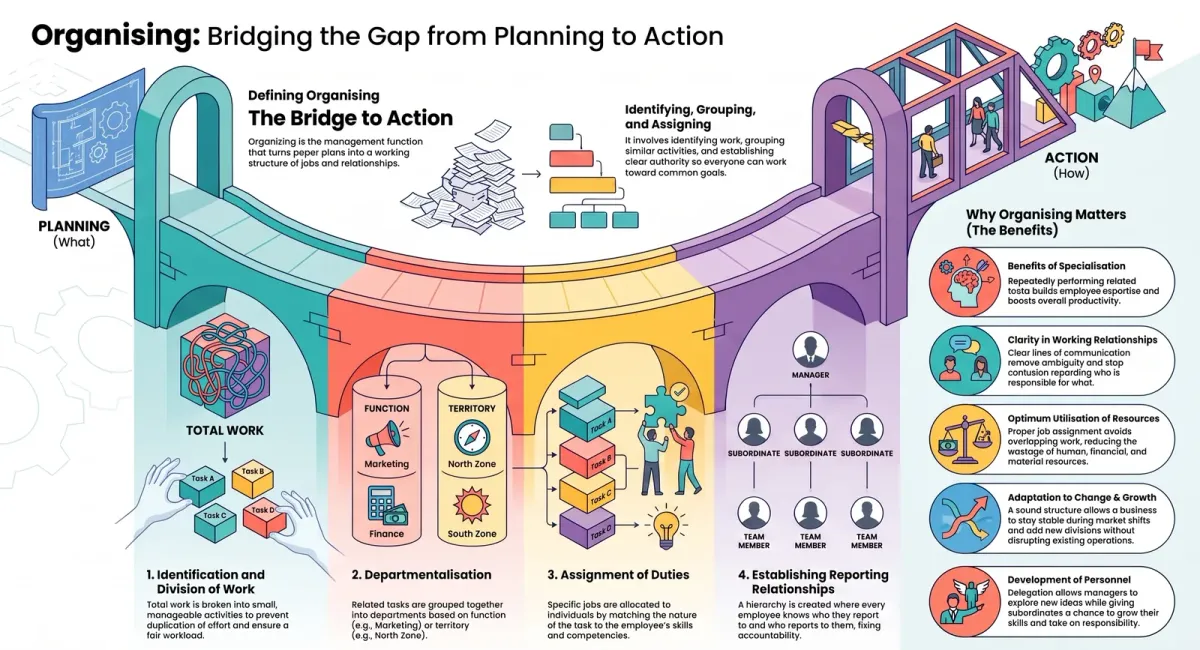
Once a business has decided what it wants to achieve through planning, the next question is how it will get there. This is where organising — the second function of management — comes in. In CBSE Class 12 Business Studies Chapter 5, organising is the function that turns plans on paper into a working structure of jobs, people, and relationships. This post breaks down its meaning, its step-by-step process, and why it matters for every enterprise, big or small.
What is Organising? (Meaning and Definition)
Think about how a school fete actually comes together. The entire event is broken down into task groups — a food committee, a decoration committee, a ticketing committee — each handling one specific area, all supervised by an overall event in-charge who keeps the groups coordinated. That, in essence, is what organising looks like in a business setting too.
Formally, organising is the management function that identifies and groups the work to be done, assigns it to suitable people, and establishes clear authority and reporting relationships so that everyone can work together effectively toward common goals. Management thinkers Louis Allen and Theo Haimann both describe organising along similar lines — as a process of dividing and grouping activities while building clear authority relationships between the people who perform them.
In simple terms, organising is the bridge between planning and action. A plan only stays a plan until someone organises the resources, roles, and reporting lines needed to carry it out.
Steps in the Process of Organising
CBSE Class 12 Business Studies identifies four clear steps in the process of organising. Understanding this sequence is essential, since exam questions often ask students to explain or apply these steps to a business scenario.
Step 1: Identification and Division of Work
The first step is to identify all the work that needs to be done to achieve the plans already laid down, and then break it into smaller, manageable activities. Dividing work this way prevents duplication of effort and ensures the workload is shared fairly across employees rather than piled onto one person.
Step 2: Departmentalisation
Once work has been broken into small activities, similar activities are grouped together into departments — a process called departmentalisation. This grouping promotes specialisation, since employees within a department focus on related tasks. Departments are commonly formed on the basis of function (production, marketing, finance) or product/territory (north zone, south zone, or cosmetics division, garments division).
Step 3: Assignment of Duties
After departments are formed, specific jobs must be allocated to individual employees based on their skills and competencies. A good organiser matches the nature of the job to the ability of the person doing it — assigning routine, repetitive tasks to those suited for them, and more complex responsibilities to employees with the right expertise.
Step 4: Establishing Authority and Reporting Relationships
Simply assigning work isn’t enough — every employee also needs to know who they report to and who reports to them. This final step creates a hierarchical structure that clarifies the extent of authority each person holds and fixes accountability for results, enabling smooth coordination between departments.
Importance of Organising
Why does a chapter of the NCERT syllabus devote so much attention to this single management function? Because organising directly determines whether a business can translate its plans into real, coordinated action. Here are the key benefits covered in the syllabus:
- Benefits of specialisation: Systematic allocation of jobs means employees
repeatedly perform related tasks, building expertise and improving productivity.
- Clarity in working relationships: Clear lines of communication remove ambiguity
about who reports to whom, helping fix responsibility and avoid confusion.
- Optimum utilisation of resources: Proper assignment of jobs avoids overlapping
work, minimising the wastage of material, financial and human resources.
- Adaptation to change: A well-organised structure can be modified as the business
environment shifts, giving the enterprise the stability it needs to survive and grow.
- Effective administration: A clear description of jobs and duties avoids confusion
and duplication, making the whole enterprise easier to manage.
- Development of personnel: Delegating routine work frees up managers’ time,
letting them explore new ideas while giving subordinates a chance to build their skills and take on more responsibility.
- Expansion and growth: A sound structure lets a company add new departments,
divisions, or geographic markets without disturbing its existing operations.
Organising’s Link to the Other Functions of Management
Organising doesn’t work in isolation — it depends directly on planning, since the work that needs to be organised comes from objectives already decided upon. An effective structure then sets the stage for staffing, directing, and controlling. This is why organising follows planning in the NCERT sequence of management functions — it is the essential link between deciding what to do and actually getting it done.
For Class 12 board exams, expect both short factual questions (steps of organising, definitions) and longer application-based questions where you’re given a business scenario and asked to identify which organising step is missing or poorly implemented.
Ready to Master Organising for Your Board Exams?
Reading about organising is only half the job — the other half is practising enough application-based and case-study questions to handle whatever CBSE Class 12 Business Studies throws at you in the exam. ChampionsPrep gives you AI-powered, exam-focused practice sessions for just ₹10 per session — built specifically for CBSE and Maharashtra State Board Class 11–12 Commerce students, and for aspirants preparing for CUET, IPMAT, JIPMAT, NPAT and SET.
👉 Start your first practice session on ChampionsPrep today and turn your understanding of Organising into exam-ready marks.
Test Your Knowledge

Organising in Management: Meaning, Process and Importance
Frequently Asked Questions
What is organising in management? +
Organising is the management function that involves identifying and dividing work, grouping related activities into departments, assigning duties to employees, and establishing authority and reporting relationships to help people work together effectively toward common objectives.
What are the four steps in the process of organising? +
The four steps are: (1) identification and division of work, (2) departmentalisation, (3) assignment of duties, and (4) establishing authority and reporting relationships.
Why is organising considered important for a business? +
Organising is important because it leads to specialisation, clarity in working relationships, optimum use of resources, easier adaptation to change, effective administration, development of personnel, and facilitates expansion and growth.
How is organising related to planning? +
Organising follows planning directly — it takes the objectives and plans already decided upon and translates them into a working structure of jobs, departments, and authority relationships needed to implement those plans.
What is departmentalisation in the organising process? +
Departmentalisation is the step where similar or related activities, after being divided, are grouped together into departments — commonly on the basis of function (like production or marketing) or product/territory — to encourage specialisation and easier coordination.
AI-powered practice — free to start