
Every business, from a roadside petrol pump to a large manufacturing company, depends on institutional credit to keep running. That dependence is what makes banking one of the most important business services covered in Class 11 Business Studies. This post walks through what a bank legally is, the four types of banks operating in India, and the specific functions commercial banks perform for their customers.
What Is a Bank, Legally Speaking?
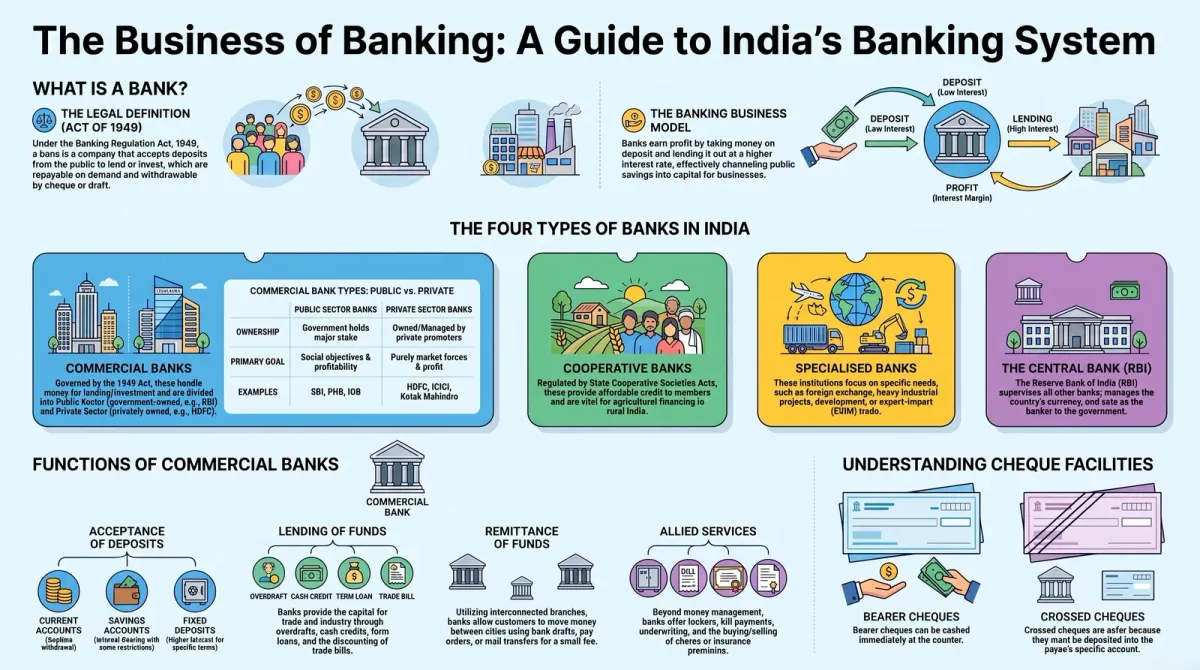
Under the Banking Regulation Act, 1949, a banking company is one that transacts the business of banking — accepting deposits of money from the public for the purpose of lending or investment, where those deposits are repayable on demand or otherwise and withdrawable by cheque, draft or order. In simpler words, a bank takes money on deposit and earns a margin of profit by lending that money out again. In doing so, it mobilises the savings of ordinary people and channels those funds into capital and revenue expenditure for businesses, while also earning fee income through interest, discount and commission on financial services.
The Four Types of Banks
Banking needs vary enormously — a farmer, a factory owner and an exporter all require very different kinds of support — so India’s banking system is organised into four broad categories.
Commercial Banks
Commercial banks are institutions dealing purely in money, governed by the Banking Regulation Act, 1949. They accept deposits from the public for the purpose of lending or investment, and are split into two groups: public sector banks, where the government holds a major stake and social objectives often take priority over pure profitability (SBI, PNB, IOB), and private sector banks, owned and managed by private promoters and free to operate purely on market forces (HDFC Bank, ICICI Bank, Kotak Mahindra Bank).
Cooperative Banks
Governed by the provisions of the State Cooperative Societies Act, cooperative banks exist mainly to provide cheap credit to their own members. They play an especially important role in rural India, where they are a major source of agricultural financing.
Specialised Banks
These include foreign exchange banks, industrial banks, development banks and export-import banks, each built to serve the specific needs of a particular kind of activity — funding heavy turnkey industrial projects or supporting foreign trade, for example.
Central Bank
Every country has one central bank that supervises, controls and regulates all commercial banks operating within it. It also acts as banker to the government and manages the country’s currency and credit policy. In India, this role belongs to the Reserve Bank of India (RBI).
Alongside this structure, Indian policy has deliberately pushed banking away from a narrow urban, class-based, short-term-profit orientation and towards rural coverage, mass banking, innovative practices and long-term development goals — a shift that shapes how public sector banks in particular are expected to behave.
Functions of Commercial Banks
Commercial banks perform a wide range of functions, some of which are their basic or primary business and others which count as agency or general-utility services.
Acceptance of Deposits
Deposits form the base of a bank’s lending operations, since banks act as both borrowers and lenders of money. Deposits are usually taken through three kinds of accounts: current accounts, which can be withdrawn at any time without prior notice; savings accounts, which encourage individual saving and pay RBI-decided interest but come with some withdrawal restrictions; and fixed deposits, time deposits that earn a higher rate of interest, with premature withdrawal permitted only after forfeiting a portion of the interest earned.
Lending of Funds
Using the money collected through deposits, banks provide loans and advances in several forms — overdrafts, cash credits, discounting of trade bills, term loans and consumer credit. These funds are what ultimately finance a large share of trade, industry and transport activity in the economy.
Cheque Facility
Banks collect cheques drawn on other banks on behalf of their customers, making the cheque the most convenient and inexpensive medium of exchange available. Cheques come in two forms: bearer cheques, encashable immediately at the counter, and crossed cheques, which can only be deposited into the payee’s own account.
Remittance of Funds
Because bank branches are interconnected, customers can transfer funds from one place to another using bank drafts, pay orders or mail transfers, usually for a small commission. The bank issuing the draft can be presented at another branch or bank in a different city for the payee to collect the amount.
Allied Services
Beyond these core functions, banks also offer services such as bill payments, locker facilities, underwriting, buying and selling shares and debentures on instruction, paying insurance premiums, and collecting dividends on behalf of customers.
Why This Matters for Every Business
Whether a business needs working capital, a safe place to park surplus cash, or a reliable way to move money between cities, it is commercial banking that makes all of this possible. Understanding the different types of banks and what each one actually does is essential not just for exams, but for making sense of how real businesses — including the one you may run someday — access institutional credit.
Related Reading
Ready to Master Business Studies Chapter 4?
Practice unlimited chapter-wise questions, get AI-generated explanations, and track your CUET/board exam readiness — all on ChampionsPrep. It is free to register, and you pay as you use. Start learning on ChampionsPrep today.
Test Your Knowledge

Banking Services for Business: Types of Banks and Functions of Commercial Banks
Frequently Asked Questions
What are the four types of banks in India? +
India's banking system consists of commercial banks (public and private sector), cooperative banks, specialised banks (foreign exchange, industrial, development, export-import), and the central bank, which is the Reserve Bank of India.
What is the difference between public and private sector banks? +
In public sector banks, the government holds a major stake and the bank usually emphasises social objectives; in private sector banks, private promoters own, manage and control operations, which are run purely as per market forces.
What are the primary functions of a commercial bank? +
The core functions are acceptance of deposits, lending of funds, providing cheque facilities, remitting funds between places, and offering allied services such as lockers and bill payments.
What is the difference between a bearer cheque and a crossed cheque? +
A bearer cheque can be encashed immediately at a bank counter, while a crossed cheque can only be deposited into the payee's own bank account, making it a safer instrument.
Why are cooperative banks important in rural India? +
Cooperative banks are governed by State Cooperative Societies laws and exist mainly to provide cheap credit to their members, making them a critical source of agricultural financing across rural India.
AI-powered practice — free to start