
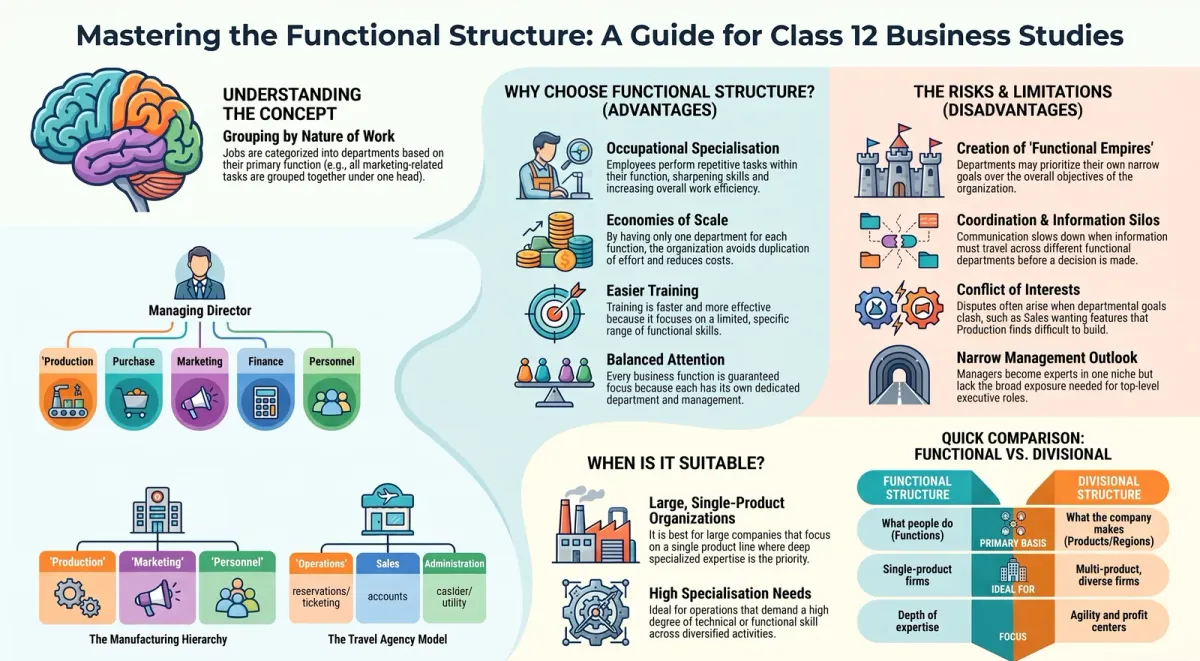
Once a company decides to organise its work into departments, the next big decision is how those departments should be arranged. CBSE Class 12 Business Studies Chapter 5 identifies two broad types of organisation structure — functional and divisional. This post focuses on the functional structure: what it means, when it works well, and where it tends to fall short.
What is a Functional Structure?
A functional structure groups jobs of a similar nature under common functional heads, creating separate departments for each major function of the business. In a typical manufacturing company, this means separate departments for production, purchase, marketing, finance and personnel — each headed by a functional manager, all reporting up to a coordinating head such as the Managing Director. Within a functional structure, departments may be divided further into sections, but the overall design always groups similar or related jobs together.
Picture a simple travel agency divided into three parts: operations (handling reservations, ticketing and customer care), sales (accounts) and administration (bookkeeping, cashier, utility staff). Each subhead is built around what the job does, not which product or region it serves — that’s the functional principle at work.
Advantages of Functional Structure
The functional structure remains popular because it delivers several real operational benefits:
- Occupational specialisation: Employees repeatedly perform tasks within their own
function, sharpening their skills and improving efficiency.
- Better control and coordination within a department: Since tasks within a
department are similar, supervision and coordination become easier.
- Higher managerial and operational efficiency: Focused departments tend to run
more smoothly, which lifts overall profitability.
- Minimal duplication of effort: Because each function exists only once across the
organisation, resources aren’t wasted on repeated departments — this creates economies of scale and lowers costs.
- Easier training: Since each department focuses on a limited set of skills, new
employees can be trained faster and more effectively.
- Balanced attention across functions: No single business function gets ignored,
since each has its own dedicated department and head.
Disadvantages of Functional Structure
Despite these strengths, a purely functional design has real limitations that become more visible as a company grows or diversifies:
- Functional empires: Departments can start prioritising their own goals over the
organisation’s overall objectives, sometimes at the cost of cooperation with other departments.
- Coordination problems: Since departments are organised by function rather than by
product, information often has to travel across several functionally different departments, slowing things down.
- Conflict of interest: When departmental goals clash — for example, sales wants a
customer-friendly product design while production finds it difficult to manufacture — disputes can hurt the organisation’s overall interests.
- Inflexibility: Employees who specialise deeply in one function can develop a
narrow outlook, finding it harder to appreciate other perspectives within the business.
- Limited management training: Functional heads gain deep expertise in a single
area but rarely get exposure to the full range of business operations, which can limit their readiness for top management roles.
When is a Functional Structure Most Suitable?
According to the NCERT syllabus, a functional structure works best for organisations that are large in size, have diversified activities and operations that demand a high degree of specialisation. It suits companies with a single, focused product line where depth of expertise in each function matters more than agility across multiple product categories.
Functional Structure vs Divisional Structure — A Quick Preview
While the functional structure organises work around what people do (production, marketing, finance), the divisional structure — covered in detail in our next post — organises work around what the company makes (product lines, brands, or regions). Businesses with a single product usually favour the functional route; those with multiple, diverse product lines tend to shift toward a divisional design as they grow. We’ll explore this second structure, along with its own set of advantages and disadvantages, in the next post in this series.
Ready to Master Organising for Your Board Exams?
Reading about organising is only half the job — the other half is practising enough application-based and case-study questions to handle whatever CBSE Class 12 Business Studies throws at you in the exam. ChampionsPrep gives you AI-powered, exam-focused practice sessions for just ₹10 per session — built specifically for CBSE and Maharashtra State Board Class 11–12 Commerce students, and for aspirants preparing for CUET, IPMAT, JIPMAT, NPAT and SET.
👉 Start your first practice session on ChampionsPrep today and turn your understanding of Organising into exam-ready marks.
Test Your Knowledge

Functional Structure of Organisation: Meaning, Advantages and Disadvantages
Frequently Asked Questions
What is a functional structure of organisation? +
A functional structure is an organisational design that groups jobs of a similar nature together under separate functional departments — such as production, marketing, finance and personnel — each headed by a functional manager who reports to a coordinating head.
What are the main advantages of a functional structure? +
Key advantages include occupational specialisation, better control and coordination within departments, higher managerial and operational efficiency, minimal duplication of effort leading to economies of scale, and easier employee training.
What are the disadvantages of a functional structure? +
Disadvantages include the risk of functional empires that overemphasise departmental goals, coordination problems across departments, conflicts of interest between departments, inflexibility due to narrow specialisation, and limited top-management training for functional heads.
When is a functional structure most suitable for a business? +
A functional structure is most suitable for large organisations with diversified activities and operations that require a high degree of specialisation, typically those built around a single, focused product line.
How is a functional structure different from a divisional structure? +
A functional structure groups work by function (like production or marketing), while a divisional structure groups work by product line or region, with each division working as a largely self-contained, multifunctional profit centre.
AI-powered practice — free to start