
Think about a small petrol pump owner in a village. He needs fuel transported from a refinery, a place to store it safely, a bank willing to fund his stock on credit, insurance against fire or theft, and a phone line to stay in touch with suppliers. None of these needs are met by buying a “product” — they are met through services. This post explains what services actually are, the features that set them apart from goods, and the three categories every service falls into.
What Do We Mean by Services?
In everyday language, a service is something you experience rather than something you own. When you consult a doctor, you are not purchasing the doctor — you are paying for advice, expertise and time. Formally, services can be defined as separately identifiable, essentially intangible activities that satisfy a want, without necessarily being tied to the sale of a physical product or another service.
A good, in contrast, is a physical object that can be handed over to a buyer, along with a transfer of ownership. A video cassette of a movie is a good; watching that movie in a cinema hall is a service. The distinction matters because businesses that sell services — banks, insurers, transporters, telecom operators — have to think about customer experience very differently from businesses that sell tangible products.
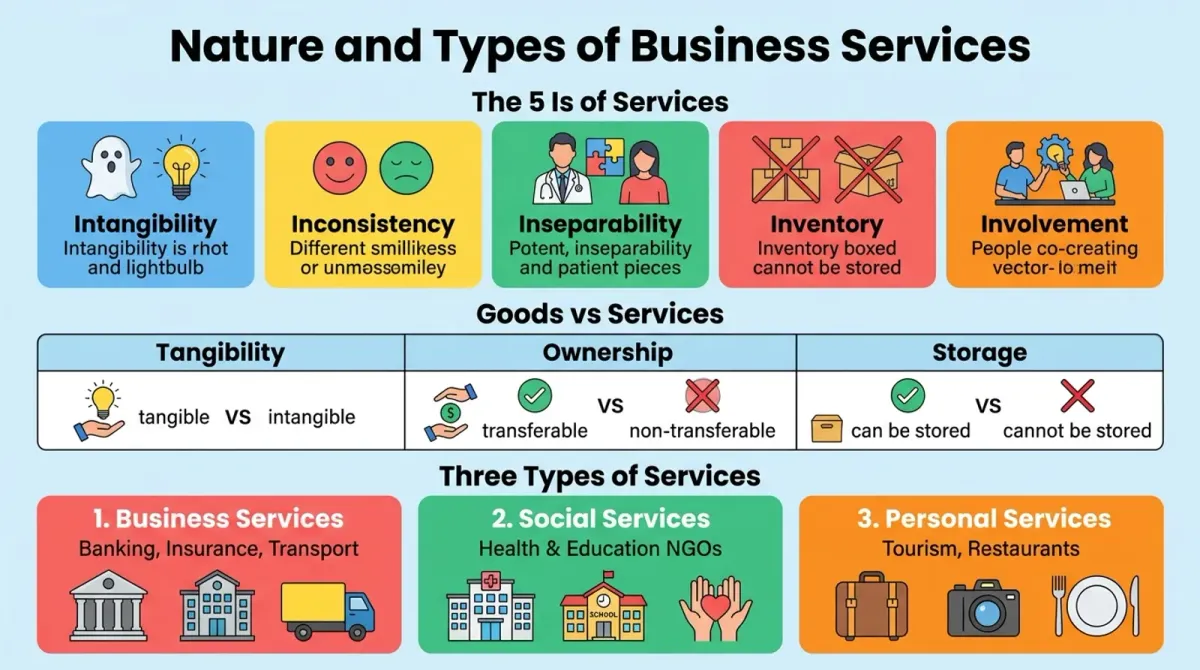
The Five Basic Features of Services (the Five Is)
Services share five characteristics that set them apart from goods. These are often remembered as the “five Is.”
Intangibility
Services cannot be touched, tasted or seen before they are bought. You cannot inspect a haircut or a consulting session in advance the way you would inspect a shirt. This means the quality of a service can only be judged through experience, which puts pressure on providers to consistently deliver a good outcome.
Inconsistency
Because there is no standard physical product, no two deliveries of a service are ever identical. A mobile network plan used by one customer feels different from the same plan used by another, since needs and usage patterns vary. Providers need the flexibility to adapt their offering to each customer.
Inseparability
Most services are produced and consumed at the same moment. A haircut cannot be manufactured today and sold next month the way a car can. Even where technology substitutes for a human — an ATM replacing a bank teller, for instance — the customer’s presence and interaction with the process remains essential.
Inventory (Less)
Since services have little or no physical form, they cannot be stockpiled for later. A train ticket can sit in a drawer, but the actual journey only exists while it is being provided. This makes matching supply with real-time demand a constant challenge for service businesses.
Involvement
Customers actively participate in how a service is delivered. Someone using self-checkout at a fast-food counter is shaping the service in real time — not possible with a manufactured good bought off a shelf.
How Are Services Different From Goods?
Two differences stand out above the rest: ownership and presence. Goods involve a transfer of ownership from seller to buyer; services do not — you cannot “own” a doctor’s treatment, only its effect. Second, delivering a service usually requires both provider and consumer to be present at the same time, whereas goods can be produced in one place and consumed somewhere else, weeks or months later. Because services are consumed at the point of delivery, there is nothing left over to store as inventory, unlike goods, which can be manufactured in bulk and warehoused for future sale.
Types of Services: Business, Social and Personal
Once we understand what a service is, it helps to sort services into three broad groups.
Business Services
These are services used by enterprises to run their operations — banking, insurance, transportation, warehousing and communication are the classic examples. A manufacturer cannot function without a bank to fund working capital, an insurer to cover its factory and stock, and a transporter to move raw material and finished goods.
Social Services
These are provided largely with a social goal in mind, such as improving living standards, spreading education, or improving public health in underserved areas. NGOs and government bodies typically run these, sometimes charging a modest fee just to cover costs rather than to earn a profit.
Personal Services
These vary from customer to customer based on individual taste, since no two people experience them the same way. Tourism, restaurants and recreational activities fall into this bucket — a restaurant meal that delights one diner may not satisfy another at all.
Why Business Services Matter Today
Modern enterprises cannot compete by doing everything in-house. A company that tried to run its own bank, insure its own risks, and operate its own transport fleet would struggle against competitors who instead rely on specialised providers built for exactly these functions. This is why businesses increasingly depend on banks for funds, insurers for risk cover, transporters for logistics, and telecom and postal networks to stay connected with vendors and customers. India has also become a global hub for delivering many of these business services to companies abroad, a trend that has only accelerated as digital infrastructure has improved.
Ready to Master Business Studies Chapter 4?
Practice unlimited chapter-wise questions, get AI-generated explanations, and track your CUET/board exam readiness — all on ChampionsPrep. It is free to register, and you pay as you use. Start learning on ChampionsPrep today.
Test Your Knowledge
What Are Business Services? Meaning, Nature and Types Explained
Frequently Asked Questions
What is the simplest definition of a service? +
A service is an intangible economic activity that satisfies a want through an interaction between a provider and a customer, without necessarily transferring ownership of anything physical.
What are the five Is of services? +
The five basic features of services are Intangibility, Inconsistency, Inseparability, Inventory (less), and Involvement — together they explain why services must be managed differently from goods.
How exactly do goods and services differ? +
Goods are physical, can be owned, and can be produced and stored separately from consumption. Services are intangible acts that cannot be owned and are usually produced and consumed together, leaving nothing to store as inventory.
What are the three types of services? +
Services are broadly classified into business services (banking, insurance, transport), social services (education and healthcare provided for social goals), and personal services (tourism, restaurants) that vary by customer preference.
Why do businesses depend so heavily on business services? +
Specialised providers of banking, insurance, transport and communication let a business focus on its core activity instead of building every support function in-house, which keeps operations efficient and competitive.
AI-powered practice — free to start