
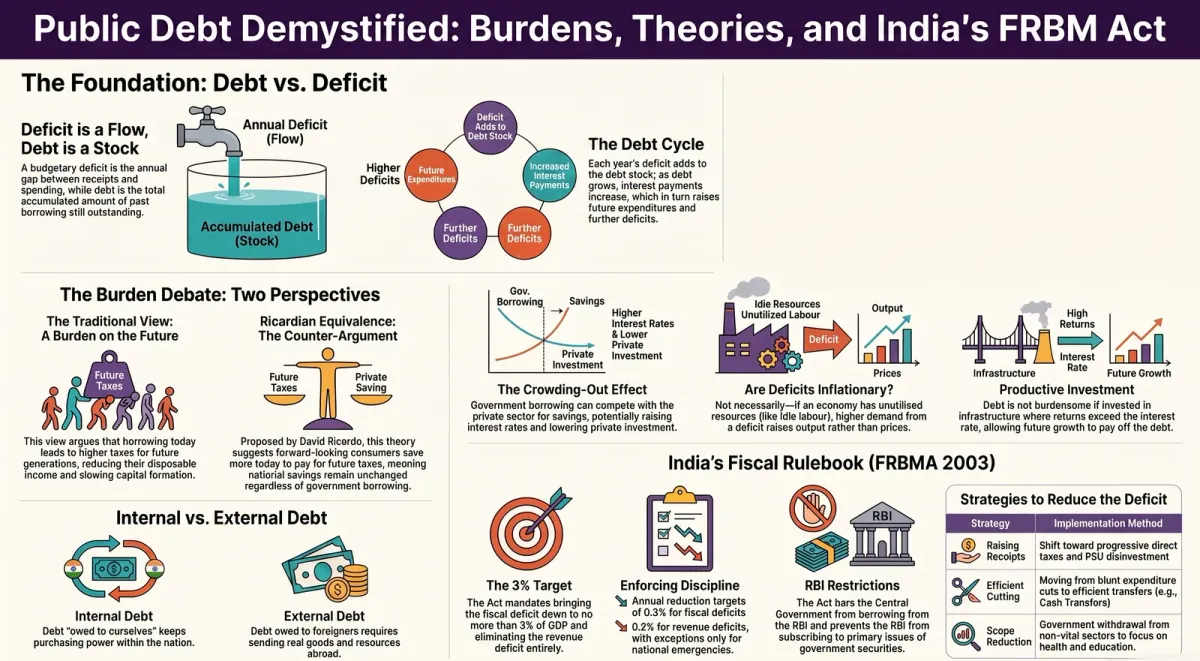
Does government debt burden future generations, or does that concern miss how families and economies really behave? This debate, along with how India tries to keep debt under control, is one of the richest sections of the government budget chapter. Here’s a complete, exam-focused breakdown.
How Government Debt Builds Up: Deficits as a Flow, Debt as a Stock
Budgetary deficits must be financed somehow — through taxation, borrowing, or printing money. In practice, governments rely heavily on borrowing, and this is what creates government debt.
The key distinction: deficit is a flow, while debt is a stock. Each year’s deficit adds to the accumulated stock of debt. If a government borrows year after year, debt keeps building up, and interest owed on it keeps growing too — these interest payments become part of future expenditure, adding further to the debt.
Is Public Debt a Burden? Two Competing Views
The Traditional View: Debt Burdens Future Generations
The conventional argument: when the government borrows today by issuing bonds, it may repay them decades later by raising taxes — often on a younger generation just entering the workforce, reducing their disposable income and consumption. It’s also argued that government borrowing reduces savings available to the private sector, lowering capital formation and growth.
This view assumes people are somewhat short-sighted: when the government cuts taxes and runs a deficit, consumers spend more out of higher after-tax income, not fully internalising that future taxes will be needed to repay the debt — and even if they do, they may assume the burden falls on someone else.
Ricardian Equivalence: The Counter-Argument
Ricardian equivalence, named after David Ricardo, offers a sharp counter-argument. It assumes consumers are forward-looking: they understand borrowing today means higher taxes tomorrow, and because they care about their children and grandchildren (the family being the continuing decision-making unit), they save more right now. This increase in private saving offsets the government’s dissaving, so national savings remain unchanged.
The theory is called “equivalence” because it implies that whether the government finances spending through immediate taxation or through borrowing (to be repaid later via taxes), the economic impact is the same.
Debt Owed to Ourselves vs Debt Owed to Foreigners
You’ll often hear that “debt doesn’t matter because we owe it to ourselves.” This holds some truth domestically — resources transfer between generations, but purchasing power stays within the nation. The logic breaks down for debt owed to foreigners: interest payments on foreign debt require sending real goods abroad, making such debt a genuine burden regardless of which generation bears it.
Are Fiscal Deficits Inflationary? And the Crowding-Out Debate
Two other common criticisms of deficits deserve attention:
-
Inflation concern: Higher spending or tax cuts raise aggregate demand; if firms can’t expand output to match, prices rise. But with unutilised resources (idle labour and capacity), higher demand mainly raises output, not prices — so a high fiscal deficit need not be inflationary.
-
Crowding-out concern: Government borrowing competes with corporate bonds for a limited pool of savings, potentially “crowding out” private investment. But this assumes savings are fixed — if deficit spending raises production and income, savings themselves rise, letting both government and private investment grow together.
Whether debt truly becomes burdensome depends on how it’s used: funds invested in productive infrastructure, with returns exceeding the interest rate, let future growth pay off the debt without it weighing on the economy — debt must always be judged against the growth of the economy as a whole.
Deficit Reduction: How Can Governments Cut Debt?
Deficits, and debt accumulation, can be reduced through:
-
Raising receipts: greater reliance on direct (progressive) taxes rather than regressive indirect taxes, and raising capital receipts through PSU disinvestment
-
Cutting expenditure efficiently: better planning and administration rather than blunt cuts — studies show transferring ₹1 to the poor via food subsidy costs the government ₹3.65, suggesting cash transfers could be far more efficient
-
Reducing the scope of government: withdrawing from certain sectors, though this risks hurting vital areas like agriculture, education, and health
FRBMA 2003: India’s Fiscal Discipline Law
To institutionalise fiscal discipline, India enacted the Fiscal Responsibility and Budget Management Act (FRBMA), 2003. As originally enacted, its key features included:
-
A mandate to bring the fiscal deficit down to no more than 3% of GDP, and to eliminate the revenue deficit, thereafter building a revenue surplus
-
Annual reduction targets under the original 2004 rules — 0.3% of GDP for the fiscal deficit and 0.5% for the revenue deficit
-
Exceptions allowed only for national security, natural calamity, or other exceptional circumstances
-
Restrictions on the central government borrowing from the RBI, and a bar on the RBI subscribing to primary issues of government securities from 2006-07
-
A requirement to table three statements alongside the budget: the Medium-term Fiscal Policy Statement, the Fiscal Policy Strategy Statement, and the Macroeconomic Framework Statement
-
Quarterly review of receipts and expenditure trends before Parliament
Since the 2018 amendments, the Act no longer targets the revenue deficit. It targets the fiscal deficit (3% of GDP) together with government debt ceilings — 40% of GDP for central government debt and 60% for general government debt — and allows limited deviations in specified circumstances. The targets and timelines have been revised since, notably after the pandemic, so check the latest Union Budget’s FRBM statements for the current numbers.
Many states have since enacted similar legislation, making rule-based fiscal management a broader institutional norm.
Strengthen Your Long-Answer Writing on Public Debt
Questions on Ricardian equivalence and the burden of debt are almost always long-answer or “elucidate” type — and scoring well means practicing how to structure a balanced, well-argued response. On ChampionsPrep , access AI-powered practice questions covering exactly this kind of analytical topic for CBSE Class XII Commerce, at just ₹10 per use.
Test Your Knowledge

Public Debt, Ricardian Equivalence & FRBMA Explained (Class 12)
Frequently Asked Questions
What is the difference between government deficit and government debt? +
Deficit is a flow - the annual gap between government expenditure and receipts - while debt is a stock, the total accumulated amount of past borrowing still outstanding. Each year's deficit, if financed by borrowing, adds to the stock of debt.
What does Ricardian equivalence argue about government deficits? +
It argues that taxation and borrowing are equivalent ways of financing government spending, because forward-looking consumers will save more today in anticipation of future taxes needed to repay debt, leaving national savings unaffected either way.
Is all government debt equally burdensome? +
No. Debt owed domestically ("to ourselves") keeps purchasing power within the nation, even though resources are transferred between generations. Debt owed to foreigners is more directly burdensome, since interest payments require sending real goods and resources abroad.
Are fiscal deficits always inflationary? +
Not necessarily. If the economy has unutilised resources, an increase in aggregate demand from a deficit mainly raises output and employment rather than prices. Deficits are more likely to be inflationary when the economy is already near full capacity.
What is the main goal of the FRBMA, 2003? +
The FRBMA aims to ensure fiscal discipline and inter-generational equity and to improve transparency in fiscal operations. As enacted, it bound the central government to cap the fiscal deficit at 3% of GDP and eliminate the revenue deficit; since the 2018 amendments it targets the fiscal deficit and government debt instead of the revenue deficit.
AI-powered practice — free to start