
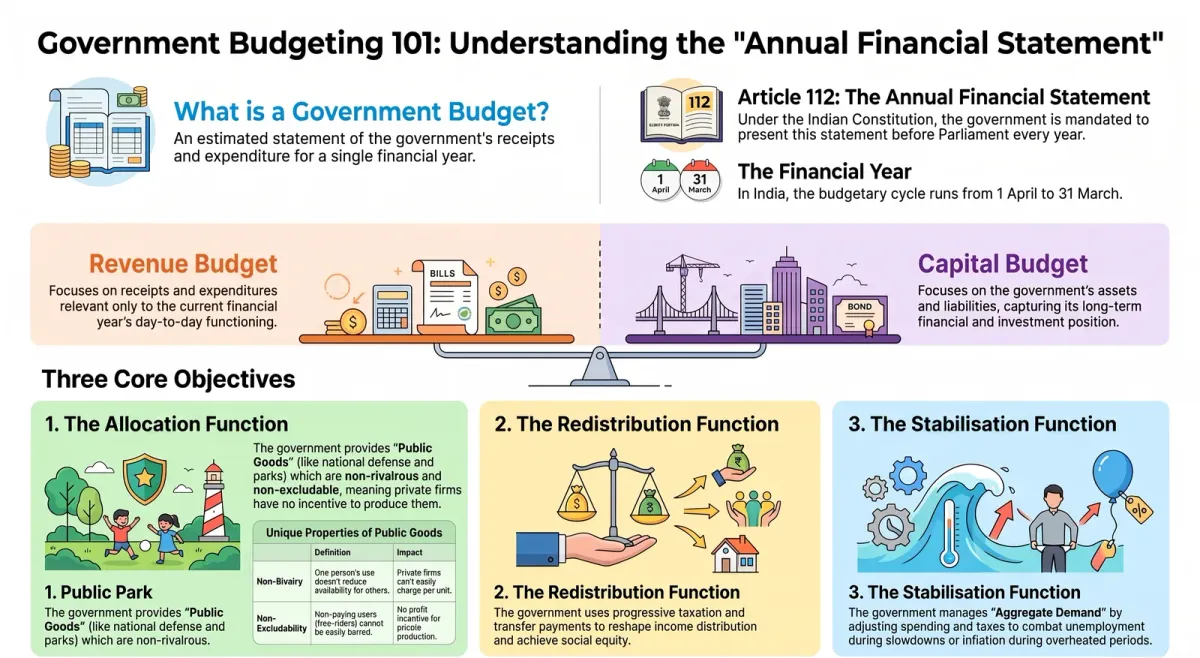
If you’re preparing for CBSE Class 12 Economics, CUET Commerce, or entrance exams like IPMAT and NPAT, understanding the government budget is non-negotiable. It’s one of the most frequently tested topics in Introductory Macroeconomics, and it forms the foundation for related concepts like fiscal deficit, fiscal policy, and public debt. This guide breaks down the meaning, structure, and objectives of the government budget in simple, exam-ready language.
What Is a Government Budget?
A government budget is a detailed statement of the government’s estimated receipts and expenditure for a financial year. In India, the financial year runs from 1 April to 31 March, and under Article 112 of the Constitution, the government must present this statement — called the Annual Financial Statement — before Parliament.
The budget is presented in two parts, classified by how each affects the government’s assets and liabilities:
-
Revenue Budget — receipts that neither create a liability nor reduce an asset (taxes, fees, fines), and expenditure that neither creates an asset nor reduces a liability (salaries, pensions, interest on accumulated debt).
-
Capital Budget — receipts that create a liability or reduce an asset (borrowings, recovery of loans, disinvestment), and expenditure that creates an asset or reduces a liability (building a road, repaying a loan).
This split matters because it separates the government’s routine operating transactions (revenue budget) from transactions that change its assets or liabilities (capital budget) — a distinction that resurfaces throughout the chapter, especially when studying deficits.
Why Do We Need a Government Budget at All?
India operates as a mixed economy — one where both the private sector and the government play active roles in economic life. Markets are efficient at allocating many resources, but they fail in specific situations. The government budget exists to correct these failures and steer the economy toward broader social goals. This purpose is captured in three core objectives of the government budget.
The Three Objectives of Government Budget
1. Allocation Function
Markets work well for private goods — clothes, food, a movie ticket — because these goods are rivalrous (one person’s consumption reduces what’s left for others) and excludable (you can be stopped from consuming them if you don’t pay).
Public goods behave differently. Take national defence or a public park: one citizen’s benefit doesn’t reduce anyone else’s, and there’s no practical way to stop a non-paying citizen from enjoying it. These two properties — non-rivalry and non-excludability — mean private firms have little incentive to supply such goods, since non-paying “free-riders” can enjoy the benefit anyway.
Because markets under-supply public goods, the government must step in. This is the allocation function — the government funds public goods like defence, roads, and administration through the budget (public provision), and may also produce them directly (public production).
2. Redistribution Function
National income flows either to the private sector (households and firms, called private income) or to the government (public income). What reaches households as personal income, and what they can ultimately spend as personal disposable income, is shaped directly by government taxes and transfers.
Through progressive taxation — where the tax rate rises with income — and targeted transfer payments, the government reshapes the income distribution to make it fairer. This is the redistribution function, and it’s central to exam questions about equity in the Indian economy.
3. Stabilisation Function
Aggregate demand in an economy depends on the spending decisions of millions of private agents, and it doesn’t always match the level needed for full employment. When demand is too low, unemployment rises and output stays below potential, since wages and prices don’t automatically adjust downward. When demand is too high relative to output, inflation sets in instead.
The government smooths out these swings by adjusting its own spending and taxation — expanding demand during a slowdown, and pulling back when the economy overheats. This deliberate demand management is the stabilisation function, and it connects directly to the fiscal policy and multiplier concepts covered later in the chapter.
How These Functions Connect to the Rest of the Chapter
These three objectives aren’t just theory — they’re the lens through which the rest of the government budget chapter makes sense. When you study revenue and fiscal deficits later, notice how a large revenue deficit often signals the government prioritising current consumption over productive capital investment, which undermines the allocation function. Similarly, when you study the multiplier effect, you’re really studying a tool of the stabilisation function in action.
Quick Revision Points for Exams
-
Government budget = Revenue Budget + Capital Budget
-
Financial year in India: 1 April to 31 March (Article 112)
-
Allocation function → provision of public goods (non-rival, non-excludable)
-
Redistribution function → progressive taxes and transfers improve income equity
-
Stabilisation function → managing aggregate demand to control unemployment and inflation
Related Reading
-
Aggregate Demand and Equilibrium Income in the Two-Sector Model | Class 12 Macroeconomics
-
Excess and Deficient Demand: Inflationary and Deflationary Gaps Explained
Ready to Master Government Budget for Boards and CUET?
Reading theory is only half the battle — scoring well means practicing exam-style questions until the concepts stick. On ChampionsPrep , you get AI-powered, pay-per-use practice questions built specifically for CBSE Class XII Commerce and CUET Economics, at just ₹10 per use. Start practicing government budget questions today and walk into your exam with confidence.
Test Your Knowledge

Government Budget Class 12: Meaning, Objectives & Functions Explained
Frequently Asked Questions
What is the difference between a revenue budget and a capital budget? +
A revenue budget groups receipts that neither create a liability nor reduce an asset with expenditure that neither creates an asset nor reduces a liability - the government's routine operations, including interest payments on past debt. A capital budget groups receipts that create a liability or reduce an asset (borrowings, recovery of loans) with expenditure that creates an asset or reduces a liability (building a road, repaying a loan).
Why can't private companies provide public goods efficiently? +
Because public goods are non-rivalrous and non-excludable, non-paying users (free-riders) can still enjoy the benefits. This breaks the link between payment and consumption that private markets rely on, so firms have no profit incentive to supply these goods.
What is the difference between public provision and public production? +
Public provision means a good is financed through the government budget and made available without direct payment, regardless of who produces it. Public production means the government itself manufactures or delivers the good.
How does the redistribution function reduce income inequality? +
Through progressive taxation (higher rates for higher incomes) and transfer payments to lower-income groups, the government reshapes the distribution of personal disposable income to make it more equitable.
Is the stabilisation function only about controlling inflation? +
No. It works both ways - the government raises aggregate demand during unemployment and reduces it during periods of excess demand and inflation.
Keep practising Economics
AI-powered feedback and structured revision for Economics — free to start, at your own pace.
AI-powered practice — free to start