
Can an economy end up saving less even when everyone in it tries to save more? It sounds impossible, but this is exactly what the Paradox of Thrift demonstrates — and it’s a favourite conceptual question in CBSE board exams and Commerce entrance tests. In this post, we’ll also connect it to two related ideas: full employment income and the gap between deficient demand and excess demand.
What Is the Paradox of Thrift?
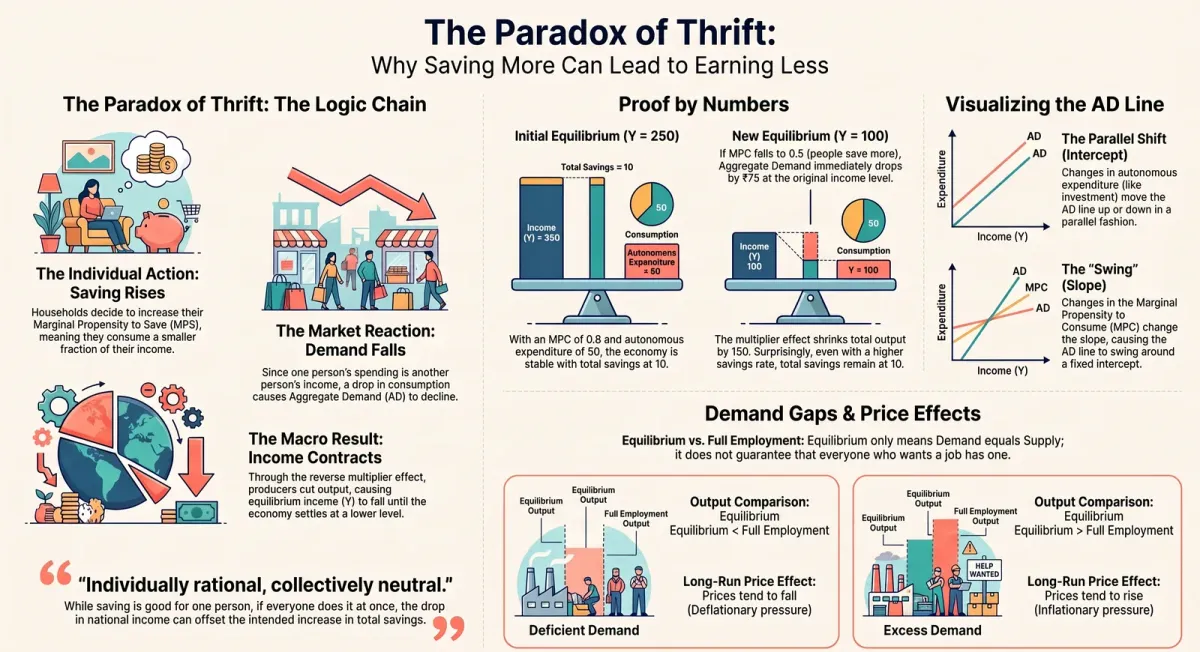
The Paradox of Thrift states that if everyone in the economy tries to increase the proportion of income they save (i.e., the MPS rises, or equivalently, MPC falls), the total value of savings in the economy does not necessarily rise — it may decline or remain unchanged.
This sounds counterintuitive at first. If people save more, shouldn’t total savings go up? The trick lies in remembering that one person’s spending is another person’s income. When everyone cuts back on consumption simultaneously, aggregate demand falls, which — through the reverse multiplier effect — causes equilibrium income itself to fall. And since savings depend on income, falling income can offset the very increase in the savings rate that triggered the whole process.
Working Through the Numerical Example
Let’s say the economy starts at an equilibrium of Y = 250, with total autonomous expenditure A = 50 and MPC = 0.8. Suddenly, due to fears of an economic downturn, people become more cautious and MPC falls from 0.8 to 0.5 (i.e., MPS rises from 0.2 to 0.5).
At the original income level of 250, this sudden drop in MPC causes aggregate demand to fall by:
(0.8 − 0.5) × 250 = 0.3 × 250 = 75
This ₹75 fall in aggregate demand creates excess supply, and just like in the multiplier mechanism, producers cut back output round after round. The total fall in output works out to:
75 / (1 − 0.5) = 150
So the new equilibrium income is:
Y₂ = 250 − 150 = 100
Now here’s the surprising part. Let’s calculate savings at both equilibria:
-
Before: S₁ = Y₁ − C₁ = 250 − (40 + 0.8 × 250) = 250 − 240 = 10
-
After: S₂ = Y₂ − C₂ = 100 − (40 + 0.5 × 100) = 100 − 90 = 10
Despite MPS rising sharply, total savings in the economy remain unchanged at 10! This is the Paradox of Thrift in action — individually rational behaviour (saving more) leads to a collectively neutral (or sometimes worse) outcome for total savings, because it drags equilibrium income down.
Why Does the AD Line “Swing” Instead of Shift?
It’s worth noting a subtle graphical distinction here. When autonomous expenditure (A) changes — say, due to a change in investment — the AD line shifts upward or downward in parallel, since only the intercept changes. But when MPC (c) changes, the slope of the AD line changes, causing it to swing upward or downward around a fixed intercept point. A decline in MPC swings the AD line downward, reducing the equilibrium level of income, exactly as we saw in the numerical example above.
Full Employment Income
Full employment level of income is the level of income at which all factors of production — labour, capital, land, and entrepreneurship — are fully employed in the production process.
Here’s an important exam point: equilibrium income and full-employment income are not the same thing. The economy can reach an equilibrium (where Y = AD) at a level of output below, at, or above the full-employment level. Equilibrium simply means there’s no further pressure for output to change — it says nothing about whether everyone is actually employed.
Deficient Demand vs Excess Demand
Since equilibrium output doesn’t have to match full-employment output, two situations can arise:
Deficient Demand
When the equilibrium level of output is less than the full-employment level, it means aggregate demand is insufficient to employ all available resources. This is called deficient demand, and it tends to cause a decline in prices in the long run, along with unemployment of resources.
Excess Demand
When aggregate demand is more than the output the economy can produce at the full-employment level, the situation is one of excess demand. Real output cannot rise beyond full employment — producers cannot expand any further — so the excess demand creates an inflationary gap and pushes prices up.
| Situation | Aggregate Demand vs Output at Full Employment | Long-Run Effect |
|---|---|---|
| Deficient Demand | Aggregate demand below full-employment output | Deflationary gap; prices tend to fall |
| Excess Demand | Aggregate demand above full-employment output | Inflationary gap; prices tend to rise |
Connecting the Dots
The Paradox of Thrift and the deficient/excess demand framework are closely linked: a sudden rise in the savings rate is exactly the kind of shock that can push an economy into deficient demand, since it drags aggregate demand — and equilibrium income — below the full-employment level.
Related Reading
-
Aggregate Demand and Equilibrium Income in the Two-Sector Model | Class 12 Macroeconomics
-
Consumption and Saving Functions Explained: MPC, MPS, APC, APS
Strengthen Your Concepts Today
The Paradox of Thrift and full-employment concepts are classic 3–4 mark conceptual questions in CBSE board exams. Understanding the logic, not just the definitions, is what earns full marks.
👉 Visit ChampionsPrep for AI-powered doubt resolution, concept explainers, and exam-focused practice for Class 11 and 12 Commerce — at just ₹10 per use.
Test Your Knowledge

Paradox of Thrift and Full Employment: Deficient vs Excess Demand Explained
Frequently Asked Questions
What is the Paradox of Thrift in simple words? +
It is the idea that when everyone in an economy tries to save more, total savings may not actually increase; they can decline or stay the same, because falling consumption reduces aggregate demand and, through the multiplier, equilibrium income itself.
Does the Paradox of Thrift mean saving is bad for individuals? +
No. It highlights a difference between individual and collective behaviour; saving more can be rational for one person but may not raise total economy-wide savings if everyone does it simultaneously.
What is the difference between deficient demand and excess demand? +
Deficient demand occurs when aggregate demand falls short of output at the full-employment level, creating a deflationary gap with falling prices; excess demand occurs when aggregate demand exceeds output at the full-employment level, creating an inflationary gap with rising prices.
Is equilibrium income always equal to full-employment income? +
No. Equilibrium only means aggregate demand equals aggregate supply; it can occur below or at full employment. Above full employment, output cannot expand any further, so excess demand shows up as rising prices.
Why does a fall in MPC cause the AD line to swing rather than shift? +
Because MPC is the slope of the AD line. A parallel shift happens only when the intercept, or autonomous expenditure, changes; a change in slope causes the line to swing.
Keep practising Economics
AI-powered feedback and structured revision for Economics — free to start, at your own pace.
AI-powered practice — free to start