
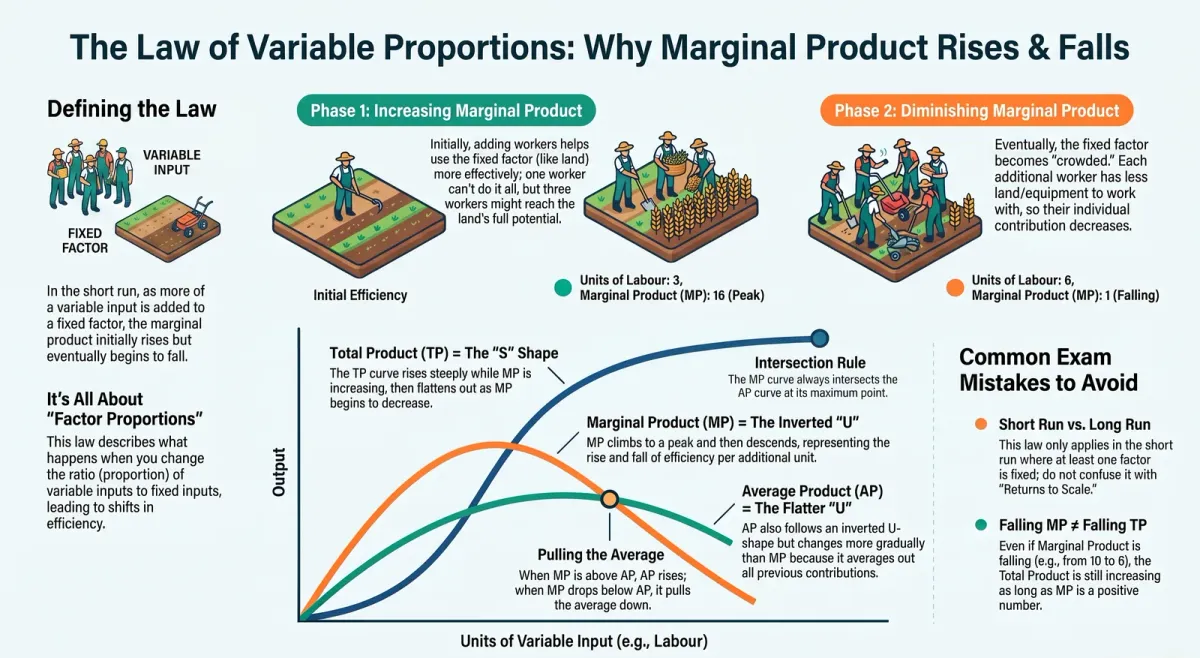
If you have already studied total product, average product, and marginal product, you may have noticed something curious: marginal product does not just keep rising or falling — it first rises, then, after a point, starts falling. This is not a coincidence. It is a well-documented economic principle called the Law of Variable Proportions, also known as the Law of Diminishing Marginal Product — one of the most tested concepts in Class 11 Economics, appearing regularly in CBSE school exams and CUET.
This post explains what the law says, why it happens, and how it shapes the total product, marginal product, and average product curves.
Statement of the Law
The Law of Variable Proportions states that as a firm increases the quantity of a variable input while keeping other inputs constant, the marginal product of that variable input initially rises, but after a certain level of employment, it begins to fall.
This law only applies in the short run, where at least one factor is fixed. It describes what happens as a firm changes the proportion in which the variable input is combined with the fixed input — hence the name “variable proportions.”
Understanding Factor Proportions
To understand why this law holds, it helps to first understand factor proportions — the ratio in which two inputs, such as labour and capital, are combined to produce output. When a firm holds one factor fixed and increases the other, this ratio keeps changing with every additional unit added.
Initially, with very little of the variable input relative to the fixed input, factor proportions are inefficient — there is “too much” of the fixed factor and “too little” of the variable factor. As more of the variable input is added, proportions become progressively better suited to production, and output rises efficiently.
Why Does Marginal Product Rise Initially?
Imagine a farmer with a fixed amount of land who starts out with just one worker. That single worker has far more land than they can effectively cultivate, so much of the land’s productive potential goes unused. As the farmer hires a second and third worker, land per worker falls to a more manageable level, and each additional worker contributes significantly more to total output than before.
In this early phase, adding more of the variable input lets the firm use the fixed factor more effectively, so marginal product increases with each unit employed.
Why MP Eventually Falls
This improvement cannot continue forever. As more workers are added to the same fixed land, it eventually starts to feel “crowded.” Each worker now has less land to work with, so their individual contribution — while still positive — becomes proportionally smaller. This is diminishing marginal product: every additional unit of the variable factor adds less to total output than the unit before it.
This does not mean total output falls — it usually keeps rising, just at a slower rate, until marginal product eventually approaches zero or turns negative.
Shapes of the TP, MP and AP Curves
The Law of Variable Proportions directly determines the shapes of three closely related curves that are almost guaranteed to appear in your exams.
Total Product Curve
The Total Product (TP) curve is positively sloped throughout the relevant range. Its slope, however, is not constant — it rises steeply at first (while MP is increasing) and then flattens out (once MP starts decreasing), giving TP an S-like shape before eventually levelling off.
Marginal Product Curve
Because MP itself rises and then falls, the Marginal Product curve is shaped like an inverted “U.” It climbs from a positive starting value, peaks, and then descends.
Average Product Curve
The Average Product curve is also inverse “U”-shaped, though it rises and falls less sharply than the MP curve. For the very first unit of input, MP and AP coincide. As MP rises above AP, it pulls AP upward too — but AP always rises by a smaller amount than MP, since it drags along the average of previous, lower marginal contributions. Once MP starts falling and dips below AP, AP is pulled downward as well, again more gradually than MP.
This gives a very testable relationship: AP is rising whenever MP is above AP, and AP is falling whenever MP is below AP — with the two curves crossing exactly at AP’s maximum point.
A Quick Numerical Illustration
Suppose the marginal product schedule for successive units of labour reads: 10, 14, 16, 10, 6, 1. Here, MP rises for the first three units (10 → 14 → 16) and then falls continuously afterward. This single sequence is a textbook demonstration of the Law of Variable Proportions in action, and exactly the kind of pattern examiners like to test with slightly different figures.
Common Exam Mistakes to Avoid
-
Do not confuse this law with returns to scale. This law applies in the short run, when only one input varies while another is fixed. Returns to scale, covered next, applies in the long run, when all inputs change together.
-
MP falling does not mean TP is falling. TP can still rise, just at a decreasing rate, as long as MP remains positive.
-
A negative MP is not the same as a firm’s stopping point. Firms usually stop adding the variable input well before MP turns negative, once it becomes unprofitable — a decision involving cost and revenue considerations covered later.
Keep Learning with ChampionsPrep
The Law of Variable Proportions is a favourite for both short-answer and numerical questions in board exams. On ChampionsPrep, practice targeted MCQs and long-answer questions on this exact topic and get instant doubt resolution for just ₹10 per use. Visit ChampionsPrep to sharpen this concept before your next test.
Catch up on the previous post: “Total Product, Average Product and Marginal Product Explained with Formulas & Examples.” Next up: “Returns to Scale Explained: CRS, IRS and DRS with Cobb-Douglas Production Function.”
Test Your Knowledge

Law of Variable Proportions Explained: Why Marginal Product Rises and Falls
Frequently Asked Questions
What is the Law of Variable Proportions? +
It states that as a firm increases a variable input while holding other inputs fixed, the marginal product of that input initially rises and then, after a certain level of employment, begins to fall.
Why is it also called the Law of Diminishing Marginal Product? +
Because its defining feature is the eventual decline in marginal product as more of the variable input is employed against a fixed factor.
Why does marginal product rise in the initial stage of production? +
Because adding more of the variable input to a relatively underused fixed factor improves the factor proportions, allowing the fixed factor to be used more efficiently.
Why does marginal product eventually fall? +
Because beyond a certain point, the fixed factor becomes crowded relative to the variable input, so each additional unit contributes proportionally less output.
What shape do the MP and AP curves take, and how are they related? +
Both are inverse U-shaped. The MP curve intersects the AP curve exactly at AP's maximum point, cutting it from above.
Keep practising Economics
AI-powered feedback and structured revision for Economics — free to start, at your own pace.
AI-powered practice — free to start