
If you have ever wondered how a factory decides how much steel and how many workers it needs to build a car, or how a farmer figures out how much wheat he can grow on a fixed piece of land, you have already brushed against one of the most fundamental ideas in microeconomics — the production function. For CBSE Class 11 Commerce students preparing for school exams and CUET, understanding the production function is the essential first step in Chapter 3, Production and Costs.
This post breaks down the production function in simple language, works through a numerical example, and explains the closely related concept of isoquants.
What Is a Production Function?
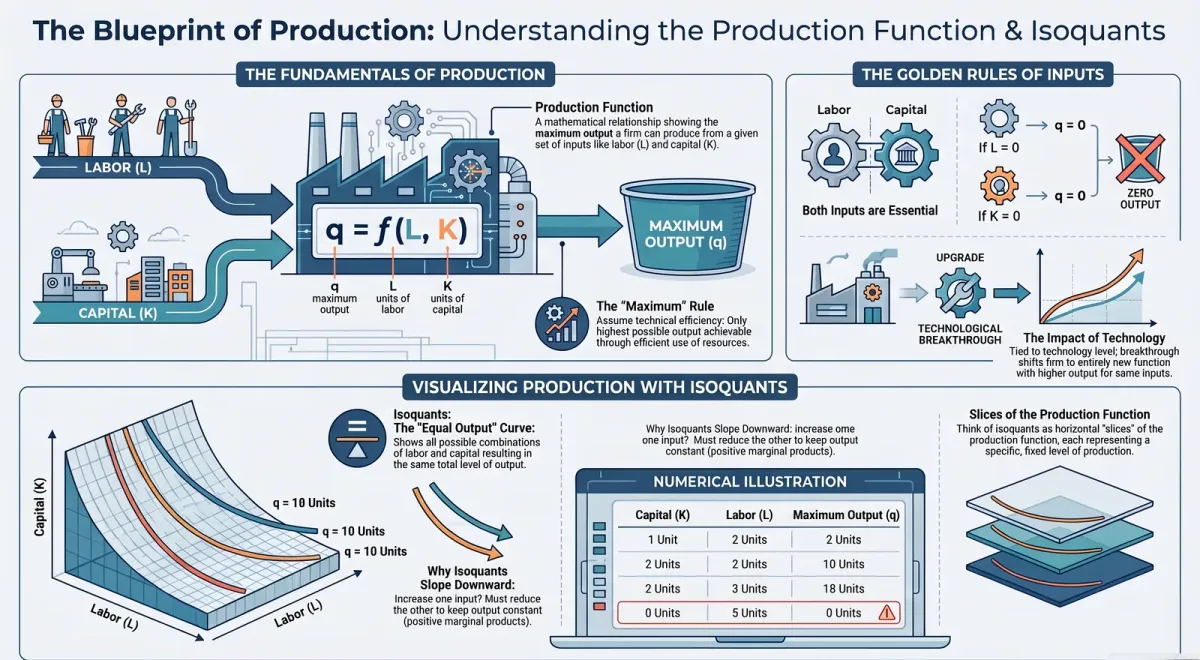
A production function is a rule that connects the inputs a firm uses to the maximum output it can produce from those inputs. Firms — whether a tailor stitching shirts, a car manufacturer, or a rickshaw puller — combine resources like labour, capital, land, and raw materials to create goods or services that can be sold or used in further production.
Economists usually express this relationship for a firm using two inputs, labour (L) and capital (K), as:
q = f(L, K)
Here, q is the maximum output the firm can produce using L units of labour and K units of capital. The word “maximum” matters — a production function describes only the highest output achievable through efficient use of resources, not just any output the firm happens to produce.
A Simple Illustration
Consider a basic production function: q = K × L. If a farmer uses 1 hectare of land (K) and 2 hours of labour (L) each day, this tells us he can grow 2 tonnes of wheat. If he doubles either his land or his labour hours, output rises accordingly. For every combination of L and K, there is exactly one corresponding value of q.
Understanding the Production Function with a Numerical Example
Suppose a firm’s production possibilities are laid out in a table, with labour along one axis and capital along the other. Moving across a row, capital rises while labour stays fixed; moving down a column, labour rises while capital stays fixed. Each combination has a corresponding maximum output figure.
For example, 2 units of labour with 2 units of capital might allow a firm to produce 10 units of output, while 3 units of labour with 2 units of capital could raise output to 18 units. In this table, increasing either input while holding the other constant pushes output higher. That does not continue without limit: if one input stays fixed and more and more of the other is added, its marginal product eventually turns negative and total output falls, as the law of variable proportions shows.
An important observation from such tables is that both inputs are typically necessary. If either labour or capital falls to zero, output collapses to zero as well.
Why a Production Function Reflects Efficient Input Use
A production function is built on the assumption of technical efficiency: for any given combination of inputs, the output shown is the highest possible. It is not possible to squeeze more output from the same labour and capital without changing something else. A firm producing less than this maximum is operating inefficiently, below its true potential.
Production Function and Technology
A production function is always tied to a particular level of technology, which determines how much output a firm can extract from a given input combination. If technology improves — say, a firm adopts more efficient machinery — the same labour and capital can produce more output than before. The firm now operates on an entirely new production function, since the mapping between inputs and maximum output has shifted upward.
What Is an Isoquant?
Once you understand the production function, isoquants become much easier to grasp. Just as an indifference curve shows combinations of goods giving a consumer equal satisfaction, an isoquant shows combinations of two inputs — typically labour and capital — that yield the same maximum level of output.
Each isoquant is labelled with the output level it represents. So if 10 units of output can be produced using three combinations — say (4 labour, 1 capital), (2 labour, 2 capital), and (1 labour, 4 capital) — all three lie on the very same isoquant.
Why Are Isoquants Negatively Sloped?
Isoquants slope downward from left to right. If both inputs have a positive marginal product, then to keep output constant while increasing one input, a firm must reduce the other. This trade-off is exactly why isoquants carry a negative slope. Fixing capital and increasing labour moves a firm onto a higher isoquant, representing greater output.
How Isoquants and the Production Function Connect
Think of isoquants as horizontal “slices” of the production function, each slice representing one fixed level of output. While a production function gives the exact maximum output for a single input combination, a family of isoquants gives a bird’s-eye view of output across the entire range of labour-capital combinations.
Key Takeaways for School Exams and CUET
-
A production function, q = f(L, K), shows the maximum output obtainable from a given set of inputs.
-
It is defined for a specific level of technology; better technology creates an entirely new production function.
-
Both inputs are usually necessary — output is zero if either input is zero.
-
Isoquants show combinations of inputs yielding the same output level and are negatively sloped whenever marginal products are positive.
-
Mastering production functions builds the foundation for the rest of Chapter 3, including total, average, and marginal product, returns to scale, and cost curves.
Keep Learning with ChampionsPrep
Still finding the production function a little abstract? You are not alone — it is one of the trickiest starting points in Microeconomics. On ChampionsPrep, practice topic-wise questions on Production and Costs and get instant doubt resolution for just ₹10 per use — no subscriptions, no pressure, just help when you need it. Visit ChampionsPrep to strengthen your Class 11 Economics fundamentals.
Test Your Knowledge

Production Function Class 11 Economics: Meaning, Formula & Isoquants Explained
Frequently Asked Questions
What is a production function in economics? +
It is a relationship showing the maximum output a firm can produce from a given combination of inputs, such as labour and capital, under a specific level of technology.
What is the formula for a production function? +
The most common way to write it is q = f(L, K), where q is output, L is labour, and K is capital.
Why does a production function assume efficient input use? +
Because it represents the maximum output for any given input combination — by definition, output cannot rise further from the same inputs without a technological improvement.
What happens to a production function if technology improves? +
The same inputs can now produce more output, so a new production function replaces the earlier one.
What is an isoquant, and how is it related to the production function? +
An isoquant is the set of input combinations yielding the same output level — essentially an alternative, graphical way of representing the information in a production function.
Keep practising Economics
AI-powered feedback and structured revision for Economics — free to start, at your own pace.
AI-powered practice — free to start