
One of the most commonly misunderstood ideas in Class 11 Economics is the difference between the short run and the long run. Many students assume these terms refer to a specific number of days, months, or years — but in economics, they mean something quite different. Getting this concept right matters, since it underpins cost curves later in Chapter 3, Production and Costs, and it appears frequently in CBSE school exams and CUET.
This post explains the short run and long run clearly, along with fixed and variable factors, so you never mix them up again.
Why the Short Run and Long Run Are Not About Calendar Time
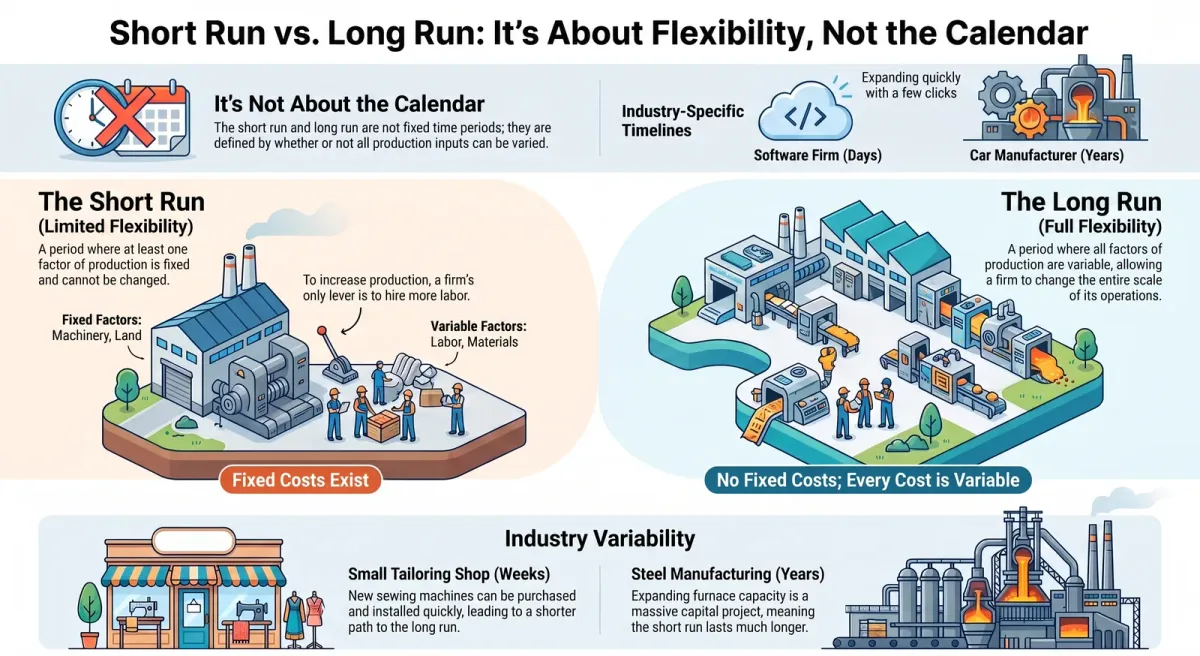
The most common misconception is worth clearing up first: short run and long run are not fixed time periods. It would be incorrect to say the short run always lasts six months or the long run always means five years. Economists instead define these terms based on a single question: can all the inputs used by a firm be varied, or not?
This distinction also varies across industries. Setting up a new factory for a car manufacturer might take years, making its “long run” quite lengthy, while a small tailoring unit might add a new sewing machine within weeks, making its “long run” comparatively short.
What Is the Short Run?
The short run is the period during which at least one factor of production cannot be varied — it remains fixed regardless of how much output the firm wants to produce. To change output in the short run, a firm can only adjust the other, variable, factor.
For example, if a firm’s capital (machinery) is fixed in the short run, it cannot suddenly install new machines to expand production. Its only option is to hire more or fewer workers, meaning output changes are driven entirely by changes in the variable factor.
What Is the Long Run?
The long run, by contrast, is the period during which all factors of production can be varied. There is no fixed factor at all. A firm operating in the long run can adjust both labour and capital simultaneously, and can even change the scale of its entire operation — building new factories, buying new machinery, and hiring accordingly.
This flexibility is what makes the long run important for understanding decisions like returns to scale, since scaling up all inputs together is only possible once every input becomes variable.
Fixed Factor vs Variable Factor
Within the short run, inputs fall into two categories:
-
Fixed factor: An input whose quantity cannot be changed in the short run, no matter how much output the firm wants. Capital, such as heavy machinery or factory buildings, often plays this role.
-
Variable factor: An input that can be adjusted freely even in the short run. Labour is the most common example, since firms can typically hire or release workers relatively quickly.
Example: A Firm Adjusting Only Labour
Suppose a firm’s capital is fixed at a certain level in the short run. If it wants to increase output, its only lever is labour — hiring more workers to raise production. This single-variable-input scenario is exactly what allows economists to study total product, average product, and marginal product of labour, covered in the next post of this series.
How the Time Period Differs Across Production Processes
Because the short run and long run are defined by whether inputs can be varied rather than by calendar time, the duration these periods represent differs dramatically between industries.
| Production Process | Typical Short Run Duration | Reason |
|---|---|---|
| Small tailoring shop | A few weeks | New sewing machines can be bought quickly |
| Car manufacturing plant | Several years | Building factories and installing heavy machinery takes time |
| Software development firm | Days to weeks | Hiring more developers or scaling servers happens fast |
| Steel manufacturing | Multiple years | Expanding furnace capacity is a major capital project |
This variation is precisely why NCERT and CBSE emphasise that the short run and long run should never be tied to a fixed number of days, months, or years in exam answers.
Why This Classification Matters for Cost Analysis
This distinction is not just definitional — it shapes how a firm’s costs behave. In the short run, because some factors are fixed, firms incur fixed costs regardless of output level, alongside variable costs that change with production. In the long run, since every input is variable, there is no fixed cost at all. This is why short run cost curves look different from long run cost curves — a distinction we explore fully in later posts in this series.
Quick Comparison: Short Run vs Long Run
| Feature | Short Run | Long Run |
|---|---|---|
| Fixed factor | Present (at least one) | None |
| Variable factor | Present | All factors are variable |
| Flexibility | Limited | Full flexibility |
| Fixed cost | Exists | Does not exist |
| Defined by | Whether inputs can vary | Whether inputs can vary |
| Duration | Varies by industry | Varies by industry |
Keep Learning with ChampionsPrep
Struggling to remember which examples count as fixed factors and which count as variable factors? Practice makes it click. On ChampionsPrep, you get topic-wise question banks and instant doubt resolution on Production and Costs for just ₹10 per use — perfect for quick, focused revision before your next test. Visit ChampionsPrep to keep building your Class 11 Economics foundation.
Catch up on the first post in this series: “Production Function Class 11 Economics: Meaning, Formula & Isoquants Explained.” Next up: “Total Product, Average Product and Marginal Product Explained with Formulas & Examples.”
Test Your Knowledge

Short Run vs Long Run in Economics: Fixed and Variable Factors Explained
Frequently Asked Questions
What is the difference between short run and long run in economics? +
In the short run, at least one factor of production remains fixed, and only the variable factor can be adjusted to change output. In the long run, all factors of production can be varied, so there is no fixed factor at all.
Is the short run always a fixed number of months? +
No. The short run and long run are not defined by a specific time duration. They are defined by whether all inputs can be varied, which differs across firms and industries.
What is a fixed factor of production? +
A fixed factor is an input that cannot be changed in the short run regardless of the desired output level, such as heavy machinery or factory infrastructure.
What is a variable factor of production? +
A variable factor is an input, most commonly labour, that a firm can adjust even in the short run to change its level of output.
Why is there no fixed cost in the long run? +
Because in the long run all factors of production are variable, there is no fixed factor and therefore no fixed cost — every cost incurred by the firm varies with the level of output.
Keep practising Economics
AI-powered feedback and structured revision for Economics — free to start, at your own pace.
AI-powered practice — free to start