
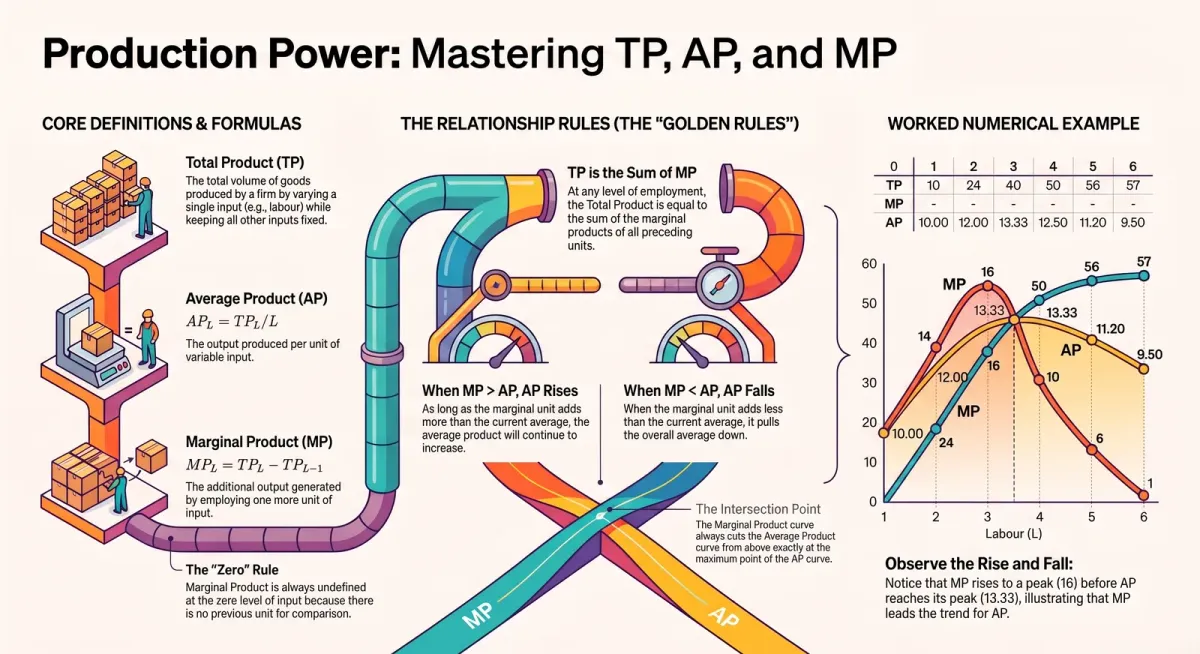
Once you understand what a production function is, the next essential step in Chapter 3, Production and Costs, is learning how to measure a firm’s output as it changes one input at a time. This is where Total Product (TP), Average Product (AP), and Marginal Product (MP) come in. These concepts appear repeatedly in CBSE board papers and CUET Economics questions, often together in a single numerical problem — so getting comfortable with their formulas and their relationship to each other pays off.
What Is Total Product (TP)?
Total Product is the output a firm gets from varying a single input, while keeping every other input constant. If a firm holds capital fixed and changes only labour employed, the resulting output at each level of labour forms the total product schedule of labour. TP is also sometimes called the total return or total physical product of the variable input.
What Is Average Product (AP)?
Average Product measures the output produced per unit of the variable input — on average, how much does each unit of labour contribute to production? The formula is:
AP_L = TP_L / L
To calculate AP at any level of labour, divide the total product at that level by the number of labour units employed. If 2 units of labour produce a total output of 24 units, the average product is 24 ÷ 2 = 12 units of output per worker.
What Is Marginal Product (MP)?
Marginal Product measures the additional output generated by employing one more unit of the variable input, while other inputs remain unchanged. The formula is:
MP_L = Change in TP_L / Change in L
In simpler terms, MP_L = (TP at L units) − (TP at L − 1 units). If total product rises from 10 units to 24 units when labour increases from 1 to 2, the marginal product of that second unit of labour is 24 − 10 = 14 units.
Remember for exams: marginal product is undefined at zero level of input employment, since there is no “previous unit” to compare against at that point.
The Relationship Between TP, AP and MP
These three measures are mathematically and logically connected, and understanding this connection is key to answering higher-order thinking questions.
How Marginal Product Relates to Total Product
For any level of employment of an input, total product equals the sum of the marginal products of every preceding unit of that input. TP is built up step by step as each additional unit of labour contributes its own marginal product to the running total.
How MP and AP Are Connected
-
For the very first unit of the variable input, MP and AP are always equal, since there is only one unit to average.
-
As long as MP is greater than AP, average product keeps rising, because each new unit pulls the average upward.
-
Once MP falls below AP, average product starts falling, because each new unit now drags the average down.
-
It follows that the marginal product curve cuts the average product curve exactly at the maximum point of the AP curve, and it does so from above.
This single rule — MP intersects AP at AP’s maximum — is one of the most frequently tested facts from this chapter, so it is worth memorising precisely.
Worked Numerical Example
Let’s apply these formulas to a sample total product schedule, with capital held fixed:
| Labour (L) | Total Product (TP) | Marginal Product (MP) | Average Product (AP) |
|---|---|---|---|
| 0 | 0 | — | — |
| 1 | 10 | 10 | 10.00 |
| 2 | 24 | 14 | 12.00 |
| 3 | 40 | 16 | 13.33 |
| 4 | 50 | 10 | 12.50 |
| 5 | 56 | 6 | 11.20 |
| 6 | 57 | 1 | 9.50 |
Notice a few important patterns in this table:
-
MP rises first (from 10 to 16) and then falls (16, 10, 6, 1). This rise-then-fall pattern is the essence of the law of variable proportions, explored fully in the next post.
-
AP also rises and then falls, consistent with the rule above: at L = 3, MP (16) still exceeds AP (13.33), so AP is still rising; by L = 4, MP (10) has fallen below AP (12.50), so AP turns down. With a discrete table, the crossover lies between these two rows rather than exactly on one row.
-
Once MP falls below AP (from L = 4 onwards), AP declines steadily, even though TP is still increasing.
This table is a classic format for CBSE numerical questions, and CUET often tests the same logic with slightly different starting numbers, so practising this calculation pattern pays off.
Why This Topic Matters Beyond the Exam
TP, AP, and MP explain real business decisions. A firm tracking the marginal product of its workers can decide exactly how many additional workers to hire before returns start diminishing. This same logic scales up to entire industries and is foundational to labour economics, wage determination, and, later in this chapter, the shapes of a firm’s cost curves.
Keep Learning with ChampionsPrep
TP, AP and MP numericals can look intimidating the first time you see them, but they follow a very consistent pattern once you have practised a few. On ChampionsPrep, you can attempt topic-wise practice questions on Production and Costs and clear your doubts instantly for just ₹10 per use. Visit ChampionsPrep to build speed and accuracy before your next Economics test.
Catch up on the previous post: “Short Run vs Long Run in Economics: Fixed and Variable Factors Explained.” Next up: “Law of Variable Proportions Explained: Why Marginal Product Rises and Falls.”
Test Your Knowledge

Total Product, Average Product and Marginal Product Explained with Formulas & Examples
Frequently Asked Questions
What is the formula for average product? +
Average Product (AP) is calculated as AP_L = TP_L / L, which is total product divided by the number of units of the variable input employed.
What is the formula for marginal product? +
Marginal Product (MP) is calculated as MP_L = Change in TP_L / Change in L, or equivalently, the total product at L units minus the total product at L−1 units.
Why is marginal product undefined at zero level of input? +
Because marginal product depends on comparing output to the previous unit of input, and at zero level of employment there is no preceding unit to compare against.
At what point does the MP curve cut the AP curve? +
The marginal product curve always cuts the average product curve from above, exactly at the maximum point of the average product curve.
How is total product related to marginal product? +
Total product at any level of input equals the sum of the marginal products of every preceding unit of that input, meaning TP is built cumulatively from successive marginal contributions.
Keep practising Economics
AI-powered feedback and structured revision for Economics — free to start, at your own pace.
AI-powered practice — free to start