
Ex-Ante vs Ex-Post in Economics: Planned vs Actual Values Explained
If you’ve just started Class 12 Macroeconomics, two terms will keep popping up in almost every chapter from here on: ex-ante and ex-post. They sound intimidating, but the idea behind them is refreshingly simple — one is about what you planned to do, and the other is about what you actually did.
Understanding this distinction early makes topics like the consumption function, investment demand, and the multiplier far easier to follow. Let’s break it down the way it is tested in CBSE board exams, CUET, and other Commerce entrance tests.
What Do Ex-Ante and Ex-Post Mean?
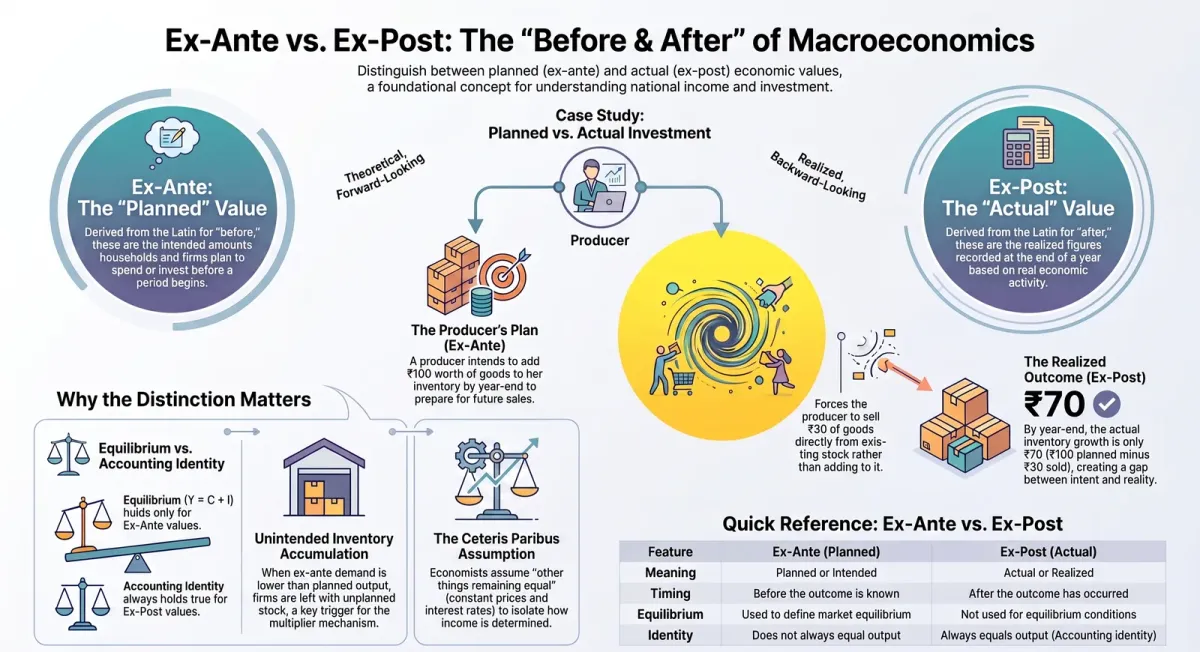
In everyday accounting, when we talk about consumption, investment, or output, we usually mean the actual values recorded at the end of a year — how much was really spent, produced, or invested. Economists call these ex-post measures, because they are calculated after the fact.
But before the year even begins, households and firms make plans. A household decides how much of its income it intends to spend. A firm decides how much stock it wants to add to its warehouse. These planned or intended values are called ex-ante measures.
-
Ex-ante = what was planned or intended
-
Ex-post = what actually happened, as measured by real economic activity
This distinction matters because planned values and actual values don’t always match — and understanding why they diverge is central to understanding how national income is determined in the short run.
Planned vs Actual Investment: A Simple Example
Investment is the easiest place to see this idea in action. Suppose a producer plans to add ₹100 worth of goods to her inventory by the end of the year. This ₹100 is her ex-ante (planned) investment.
Now suppose demand for her product suddenly rises during the year. To meet this extra demand, she has to sell ₹30 worth of goods straight out of her existing stock instead of adding fresh stock. By year-end, her inventory has grown by only ₹70 (₹100 minus ₹30).
That ₹70 is her ex-post (actual) investment — quite different from what she had originally planned.
This gap between planned and actual investment is not a mistake or an accounting error. It reflects real-world uncertainty: firms cannot always predict exactly how much they will sell, so their actual inventory changes often differ from their intentions.
Why the Ceteris Paribus Assumption Matters
Macroeconomic models rarely try to explain every variable at once — that would be nearly impossible, since income, prices, interest rates, and employment all influence one another simultaneously. Instead, economists rely on the assumption of ceteris paribus, meaning “other things remaining equal.”
When studying how income is determined, we temporarily hold the price level and the rate of interest constant — much like solving for one variable in a pair of simultaneous equations before substituting it into the other. This is precisely the approach used in the income-determination model built on the ideas of John Maynard Keynes, which forms the backbone of this chapter.
Why This Distinction Matters for the Rest of the Chapter
Once you’re comfortable with ex-ante versus ex-post, several ideas that initially seem confusing in macroeconomics start to click:
-
Equilibrium in the goods market is defined using ex-ante aggregate demand and ex-ante aggregate supply — not the actual, after-the-fact figures.
-
The accounting identity stating that “output equals consumption plus investment” always holds true for ex-post values, but the equilibrium condition Y = C + I only holds when we are talking about ex-ante (planned) values.
-
When ex-ante demand falls short of planned output, the shortfall shows up as unintended accumulation of inventories — a concept you will meet again while studying the multiplier mechanism.
Recognising these three points will help you avoid a very common mistake students make: assuming that the equilibrium equation and the accounting identity are the same thing. They look similar on paper but describe two different situations — one is a condition that may or may not hold (equilibrium), while the other always holds true by definition (the accounting identity).
Quick Recap Table
| Term | Meaning | Example |
|---|---|---|
| Ex-ante | Planned or intended value | Producer plans ₹100 of new inventory |
| Ex-post | Actual or realised value | Producer's inventory rises by only ₹70 |
Keep this table handy — nearly every conceptual and numerical question on national income determination in your CBSE board exam or CUET entrance test requires you to first identify whether a given figure is planned or actual before you can proceed.
Ready to Master Macroeconomics?
Concepts like ex-ante and ex-post form the foundation of nearly every numerical question in your board exams and entrance tests such as CUET, IPMAT, JIPMAT, NPAT, and SET. Don’t just memorise the definitions — practice applying them to real questions until they become second nature.
👉 Head to ChampionsPrep for AI-powered doubt resolution, topic-wise question banks, and personalised practice for Class 11 and 12 Commerce students — all at just ₹10 per use.
Interactive Simulation: Ex-Ante Investment & Keynesian Equilibrium
Use the simulator below to test how alterations in autonomous ex-ante investment affect equilibrium output through the Keynesian investment multiplier:
Keynesian Equilibrium & Ex-Ante Investment Multiplier
Adjust autonomous investment and the Marginal Propensity to Consume (MPC) to observe changes in total equilibrium income and demand gaps.
Keynesian cross: equilibrium income
Equilibrium
At full employment
Planned spending equals full-employment output.
A positive planned-spending gap at Yf signals excess demand; the income gap and the spending gap are different quantities.
Test Your Knowledge

Ex-Ante vs Ex-Post in Economics: Planned vs Actual Values Explained (Class 12)
Frequently Asked Questions
What is the simplest way to remember ex-ante and ex-post? +
Think of 'ante' as 'before' (planned) and 'post' as 'after' (actual or realised). Ex-ante decisions are made before the outcome is known; ex-post values are recorded once the outcome has already occurred.
Can ex-ante and ex-post values ever be equal? +
Yes. When the economy is in equilibrium, planned aggregate demand equals planned aggregate supply, and there is no unintended change in inventories, so ex-ante and ex-post values coincide.
Why do firms end up with unplanned inventory changes? +
Because actual demand in the market can turn out higher or lower than what firms expected when they drew up their production plans, leading to unplanned depletion or accumulation of stock.
Is the accounting identity Y = C + I always true? +
Yes, but only in the ex-post sense: actual output always equals actual consumption plus actual investment, with any mismatch between planned demand and output showing up as a change in inventories.
Why does this chapter assume ceteris paribus? +
Because holding other variables, such as the price level and the interest rate, constant allows economists to isolate and solve for the level of income one variable at a time, making an otherwise complex system manageable.
Keep practising Economics
AI-powered feedback and structured revision for Economics — free to start, at your own pace.
AI-powered practice — free to start