
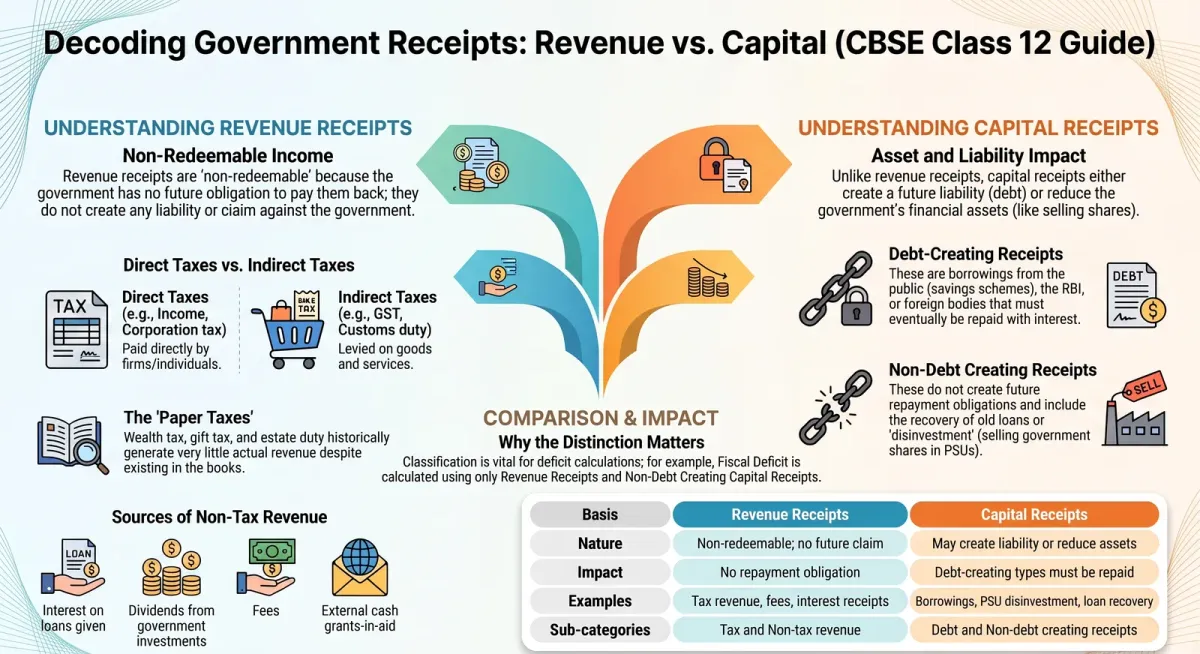
Every government budget question in your CBSE Class 12 exam eventually comes down to one core skill: correctly classifying receipts and expenditure. This post focuses on the receipts side of the government budget — the money coming in — and breaks down the difference between revenue receipts and capital receipts with clear examples you can use directly in your answers.
What Are Government Receipts?
The government budget is split into a revenue budget and a capital budget, and each has its own receipts and expenditure. On the receipts side, this gives us two categories:
-
Revenue Receipts — receipts that do not create any liability or claim on the government
-
Capital Receipts — receipts that either create a liability or reduce the government’s financial assets
Getting this classification right is essential, because it directly feeds into how fiscal deficit and revenue deficit are calculated later in the chapter.
Revenue Receipts: Meaning and Classification
Revenue receipts are called non-redeemable because the government has no future obligation attached to them — unlike a loan, they don’t need to be “paid back.” Revenue receipts are divided into two broad categories: tax revenue and non-tax revenue.
Tax Revenue: Direct vs Indirect Taxes
Tax revenue is split into:
-
Direct taxes — paid directly by individuals and firms on their income, such as personal income tax and corporation tax. Personal income tax is typically progressive (higher income, higher tax rate), while corporation tax is proportional to profits.
-
Indirect taxes — levied on goods and services rather than income, such as excise duty (on goods produced within the country), customs duty (on imports and exports), and service tax, most of which have now been subsumed under GST.
A special mention goes to wealth tax, gift tax, and estate duty — direct taxes that historically brought in very little revenue and are often called “paper taxes” for this reason.
Non-Tax Revenue Sources
Non-tax revenue includes:
-
Interest receipts on loans given by the government
-
Dividends and profits from government investments
-
Fees and other charges for services rendered
-
Cash grants-in-aid received from foreign countries and international organisations
Capital Receipts: Meaning and Classification
Capital receipts arise from borrowing or from selling government assets. Since loans must eventually be repaid, and asset sales mean giving up future income from those assets, capital receipts are classified based on whether they create debt.
Debt-Creating Capital Receipts
These are borrowings — money the government raises that must be repaid with interest. This includes:
-
Net borrowing at home (from the public through debt instruments like small savings schemes, and indirectly from commercial banks through the Statutory Liquidity Ratio)
-
Borrowing from the RBI
-
Borrowing from abroad
Non-Debt Creating Capital Receipts
These receipts do not create a future repayment obligation. The two main examples are:
-
Recovery of loans previously given out by the government
-
PSU disinvestment — proceeds from selling government shares in Public Sector Undertakings
This distinction between debt-creating and non-debt creating capital receipts becomes critical when you calculate the fiscal deficit, since fiscal deficit is defined using only non-debt creating capital receipts.
Revenue Receipts vs Capital Receipts: Quick Comparison
| Basis | Revenue Receipts | Capital Receipts |
|---|---|---|
| Nature | Non-redeemable, no future claim | May create liability or reduce assets |
| Examples | Tax revenue, interest receipts, fees | Borrowings, recovery of loans, disinvestment |
| Impact on government | No repayment obligation | Debt-creating receipts must be repaid |
| Sub-categories | Tax revenue, Non-tax revenue | Debt-creating, Non-debt creating |
Why This Distinction Matters for Deficit Calculations
Once you’re comfortable classifying receipts, the next logical step is understanding how they feed into the government’s deficit measures. The fiscal deficit, for instance, is calculated as total expenditure minus the sum of revenue receipts and non-debt creating capital receipts — which is exactly why this classification appears repeatedly across the chapter’s numerical and theory questions.
Related Reading
-
Government Budget Class 12: Meaning, Objectives & Functions Explained
-
Aggregate Demand and Equilibrium Income in the Two-Sector Model | Class 12 Macroeconomics
-
Consumption and Saving Functions Explained: MPC, MPS, APC, APS
Practice Makes the Difference
Classification questions like “is this a revenue receipt or a capital receipt?” show up constantly in board exams and CUET — and the only way to get consistently fast and accurate is repeated practice. On ChampionsPrep , you can access AI-powered, chapter-wise practice questions for CBSE Class XII Commerce at just ₹10 per use, so you can drill this exact skill until it’s second nature.
Test Your Knowledge
Revenue Receipts vs Capital Receipts: Class 12 Government Budget Guide
Frequently Asked Questions
Why are revenue receipts called "non-redeemable"? +
Because they do not create any future claim or liability on the government - unlike a loan, the government doesn't need to repay a tax collected or a fee received.
What is the difference between direct and indirect taxes? +
Direct taxes (like personal income tax and corporation tax) are levied directly on income or profits and paid by the individual or firm earning it. Indirect taxes (like excise duty, customs duty and GST) are levied on goods and services and are typically passed on to the consumer through prices.
Why are wealth tax, gift tax and estate duty called "paper taxes"? +
Because they have historically generated very little revenue for the government, despite existing on paper as part of the tax system.
What makes a capital receipt "debt-creating"? +
A capital receipt is debt-creating if it involves borrowing that must be repaid in the future, such as loans from the public, the RBI, or foreign lenders.
Is PSU disinvestment a revenue receipt or a capital receipt? +
PSU disinvestment is a capital receipt - specifically, a non-debt creating capital receipt - because it involves selling a government asset (shares in a public sector undertaking) rather than earning current income.
AI-powered practice — free to start