
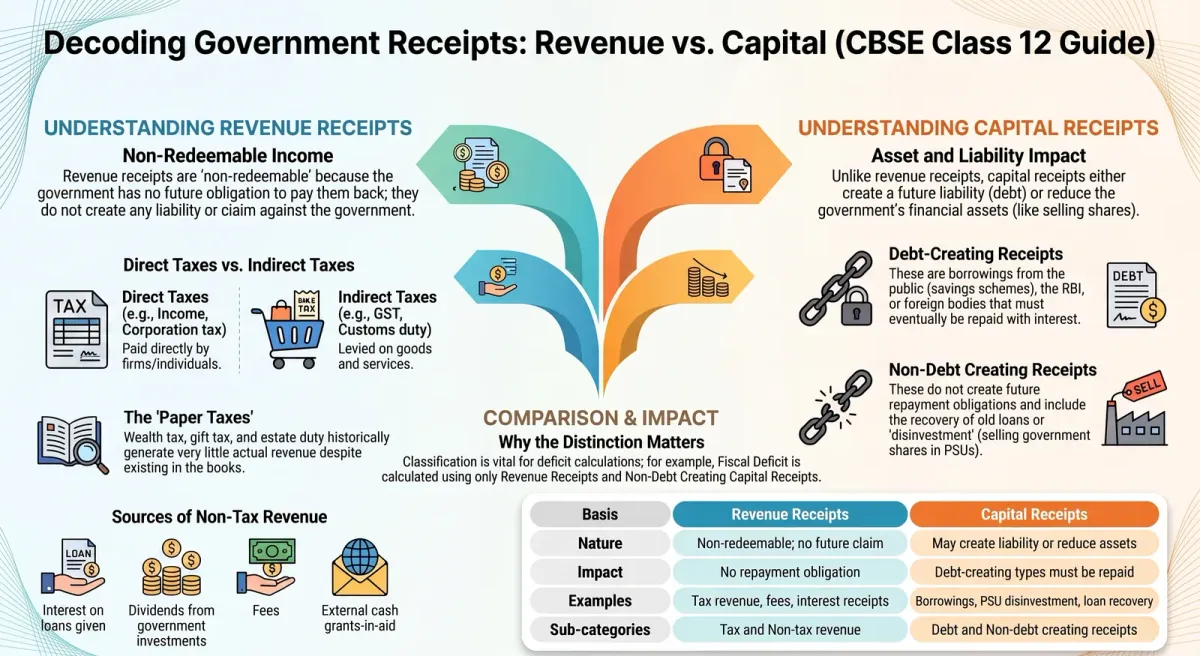
After receipts, the second half of every government budget question deals with expenditure — how the government spends the money it collects. This is one of the most commonly confused topics in CBSE Class 12 Economics, largely because older notes and past papers use a plan/non-plan classification that adds an extra layer on top of the revenue/capital split, a classification the Union Budget no longer uses. This guide clears up both distinctions with practical examples.
What Is Government Expenditure?
Just like receipts, government expenditure is split according to the two-part budget structure:
-
Revenue Expenditure — spending that does not create assets or reduce liabilities
-
Capital Expenditure — spending that creates physical or financial assets, or reduces liabilities
Until 2016–17, both categories were further divided into plan and non-plan expenditure. The Union Budget dropped that split from 2017–18 and now presents only the revenue and capital classification, but older notes and past papers still use the plan and non-plan terms, which is where many students get confused. Let’s untangle each piece.
Revenue Expenditure Explained
Revenue expenditure covers the government’s normal, recurring functioning — the costs of running departments and providing services, interest payments on accumulated debt, and grants given to state governments (even if the state eventually uses some of that grant to build an asset, from the central government’s perspective it’s still revenue expenditure).
Main Items of Revenue Expenditure
Under the older classification, non-plan revenue expenditure was the larger and more significant component of revenue expenditure. Its major items, which are still the main heads of revenue expenditure, are:
-
Interest payments — on market loans, external loans, and various reserve funds. This is the single largest item in this list.
-
Defence services — considered “committed expenditure,” since national security concerns leave little room for cuts.
-
Subsidies — an important welfare tool, covering food, fertilisers, exports, and loan interest, alongside implicit subsidies through under-pricing of services like education and health.
-
Salaries and pensions — the ongoing cost of running the government machinery.
Plan vs Non-Plan Expenditure — a Classification the Budget No Longer Uses
Until 2016–17, Budget documents further classified total expenditure (both revenue and capital) into:
-
Plan expenditure — related to the central Five-Year Plans and central assistance to State and Union Territory plans
-
Non-plan expenditure — the broader category covering general, economic, and social services outside specific Plan schemes
This classification drew criticism, and the Union Budget abolished it from 2017–18, keeping only the revenue and capital classification. It tended to encourage governments to launch new schemes (classified as “Plan,” and therefore seen as more desirable) while neglecting maintenance of existing infrastructure (classified as “Non-plan”). It also created a misleading impression that non-plan spending is wasteful, which could hurt allocation to essential sectors like education and health, where salaries — a non-plan item — form a large and necessary share of spending.
Capital Expenditure Explained
Capital expenditure results in the creation of physical or financial assets, or a reduction in the government’s financial liabilities. Unlike revenue expenditure, it adds to the government’s — and by extension, the country’s — productive capacity.
Examples of Capital Expenditure
-
Acquisition of land, buildings, machinery, and equipment
-
Investment in shares of public sector enterprises
-
Loans and advances given by the central government to state and Union Territory governments, PSUs, and other parties
Like revenue expenditure, capital expenditure is also split into plan capital expenditure (linked to central Plans and assistance to states/UTs) and non-plan capital expenditure (covering general, social, and economic services).
Revenue Expenditure vs Capital Expenditure: Quick Comparison
| Basis | Revenue Expenditure | Capital Expenditure |
|---|---|---|
| Effect on assets | Does not create assets | Creates physical/financial assets |
| Effect on liabilities | Does not reduce liabilities | May reduce liabilities |
| Nature | Recurring, day-to-day | One-time or long-term investment |
| Examples | Salaries, interest payments, subsidies | Land, machinery, loans to states/PSUs |
Why This Distinction Matters for Deficit Analysis
The revenue-capital classification of expenditure directly determines how the revenue deficit and fiscal deficit are calculated. A rising share of revenue expenditure funded through borrowing — rather than capital expenditure — signals that the government is using debt to finance consumption rather than investment, a red flag economists watch closely and a favourite theme in board exam long-answer questions.
Turn Theory Into Exam-Ready Answers
Knowing the definitions is one thing — being able to classify a fresh example correctly under exam pressure is another. On ChampionsPrep , you get AI-generated practice questions on government expenditure and every other Class XII Commerce topic, at just ₹10 per use, so you can build that exam instinct before the real test.
Test Your Knowledge
Revenue Expenditure vs Capital Expenditure: Class 12 Government Budget
Frequently Asked Questions
What is the basic difference between revenue and capital expenditure? +
Revenue expenditure does not create assets or reduce liabilities for the government, while capital expenditure creates physical or financial assets, or reduces the government's liabilities.
Why are interest payments classified as revenue expenditure and not capital expenditure? +
Interest payments are a recurring cost of servicing past borrowings and do not create any new asset for the government - they simply cover the cost of debt already taken, which is why they fall under revenue expenditure.
What is the difference between plan and non-plan expenditure? +
Under the classification used until 2016-17, plan expenditure related to spending under the central Five-Year Plans and central assistance to state/UT plans, while non-plan expenditure covered general, economic, and social services outside these Plan schemes, and typically included larger recurring costs like interest payments, defence, subsidies, and salaries. The Union Budget dropped the split from 2017-18.
Why was the plan/non-plan classification criticised? +
Because it encouraged new scheme launches over maintenance of existing infrastructure, and it fostered the misconception that non-plan spending is inherently wasteful, which risked under-funding essential sectors like education and health. It was abolished from 2017-18.
Are loans given by the government to state governments revenue or capital expenditure? +
They are capital expenditure, since they represent a financial asset (a loan receivable) for the central government, distinct from the recurring, non-asset-creating nature of revenue expenditure.
AI-powered practice — free to start