
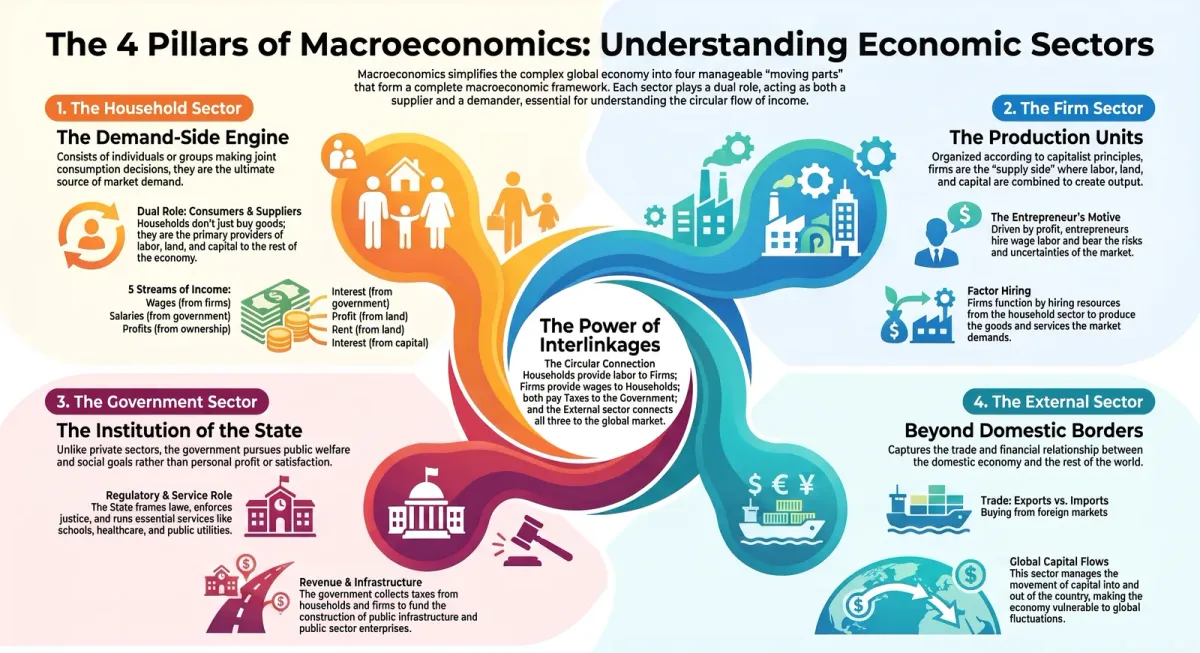
Macroeconomics often simplifies the entire economy into a handful of moving parts so that the interlinkages between them become easier to study. One of the most important frameworks you’ll encounter in Class 12 Macroeconomics is the idea that every economy can be understood as a combination of four major sectors: the household sector, the firm sector, the government sector, and the external sector. Let’s break each one down.
1. The Household Sector
A household refers to a single individual who takes decisions relating to their own consumption, or a group of individuals for whom consumption decisions are jointly determined. Households are the demand-side engine of the economy — without their spending, the market in which firms sell their products simply couldn’t function.
But households don’t just consume — they also save and pay taxes. Where does the money for all of this come from? Households consist of people who:
-
Work in firms as employees and earn wages.
-
Work in government departments and earn salaries.
-
Own firms and earn profits.
-
Lease out land and earn rent.
-
Lend capital and earn interest.
In short, the household sector is both the ultimate source of labour supply and the ultimate source of market demand in the economy — which is why it sits at the centre of most macroeconomic models.
2. The Firm Sector
Firms are production units organised according to capitalist principles. In a firm, one or more entrepreneurs are at the helm of affairs — they hire wage labour from the market, employ capital and land, and undertake the task of production. The entrepreneur’s motive is to sell the resulting output (goods and services) in the market and earn profit, while bearing the risks and uncertainties that come with it, such as not getting a high enough price for their goods.
Firms are where the “supply side” of the economy lives — they combine labour, capital, and land to produce the output that households ultimately consume.
3. The Government Sector
Apart from the private capitalist sector, every economy — developed or developing — has the institution of the State, which, for convenience, is simply referred to as the Government in macroeconomic analysis. The government’s role includes:
-
Framing laws, enforcing them, and delivering justice.
-
Undertaking production directly in many cases (public sector enterprises, utilities, etc.).
-
Imposing taxes and using that revenue to build public infrastructure.
-
Running schools, colleges, and providing healthcare services.
Unlike firms and households, which act in their own self-interest, the government pursues public goals — often defined by law or by the Constitution — aimed at the welfare of the country as a whole rather than private profit or personal satisfaction. This is a key distinction that separates macroeconomic decision-makers, like the government, from individual economic agents.
4. The External Sector
No country exists in isolation — every economy engages in trade with the rest of the world, and this is captured by the external sector, the fourth major piece of the macroeconomic puzzle. Trade with the external sector happens in two main ways:
-
Exports — when the domestic country sells goods to the rest of the world.
-
Imports — when the domestic economy buys goods from the rest of the world.
Beyond just goods, the external sector also affects the domestic economy through capital flows — capital from foreign countries may flow into the domestic economy, or the domestic country may export capital to foreign nations. This makes the external sector a crucial channel through which global economic events (like a slowdown in a major trading partner, or a currency fluctuation) can influence the domestic economy.
Why Studying These Four Sectors Together Matters
The real power of this framework isn’t in memorising four separate definitions — it’s in understanding how these sectors are interlinked. Household income depends on wages paid by firms and salaries paid by the government. Firms depend on household demand to sell their output. The government depends on taxes collected from households and firms to fund its spending. And the external sector connects the whole domestic system to the rest of the global economy.
This four-sector view is the foundation for topics you’ll study later in the year, including national income accounting, circular flow of income, and the balance of payments — so getting comfortable with it now will make those chapters significantly easier to grasp.
For board exams, a common and high-scoring question is: “Describe the four major sectors in an economy according to the macroeconomic point of view.” Structuring your answer sector-by-sector, with the key role and income source of each, is the most effective way to secure full marks.
Keep Learning with ChampionsPrep
The four-sector model is one of the most foundational frameworks in Class 12 Macroeconomics — once it clicks, everything from national income to fiscal policy becomes far easier to understand. For structured chapter-wise practice, question banks, and concept explainers built specifically for CBSE and Maharashtra Board Commerce students, visit https://app.championsprep.in and prepare smarter, one topic at a time.
Test Your Knowledge

The Four Sectors of an Economy: Households, Firms, Government & External Sector
Frequently Asked Questions
What are the four major sectors of an economy in macroeconomics? +
The four major sectors are the household sector, the firm sector, the government sector, and the external sector.
What is the household sector in economics? +
The household sector consists of individuals or groups who make joint consumption decisions. Households earn income through wages, salaries, profits, rent, and interest, and they save and pay taxes.
How do firms differ from households in the four-sector model? +
Firms are production units run by entrepreneurs who combine labour, capital, and land to produce goods and services for sale and profit, while households are primarily consumers who supply labour and demand goods.
What role does the government play as an economic sector? +
The government frames and enforces laws, delivers justice, undertakes production, collects taxes, and spends on public infrastructure, education, and healthcare, pursuing public welfare rather than private profit.
What is the external sector, and why is it important? +
The external sector represents a country's trade and financial relationship with the rest of the world through exports, imports, and capital flows. It's important because it links the domestic economy to global economic conditions.
AI-powered practice — free to start