
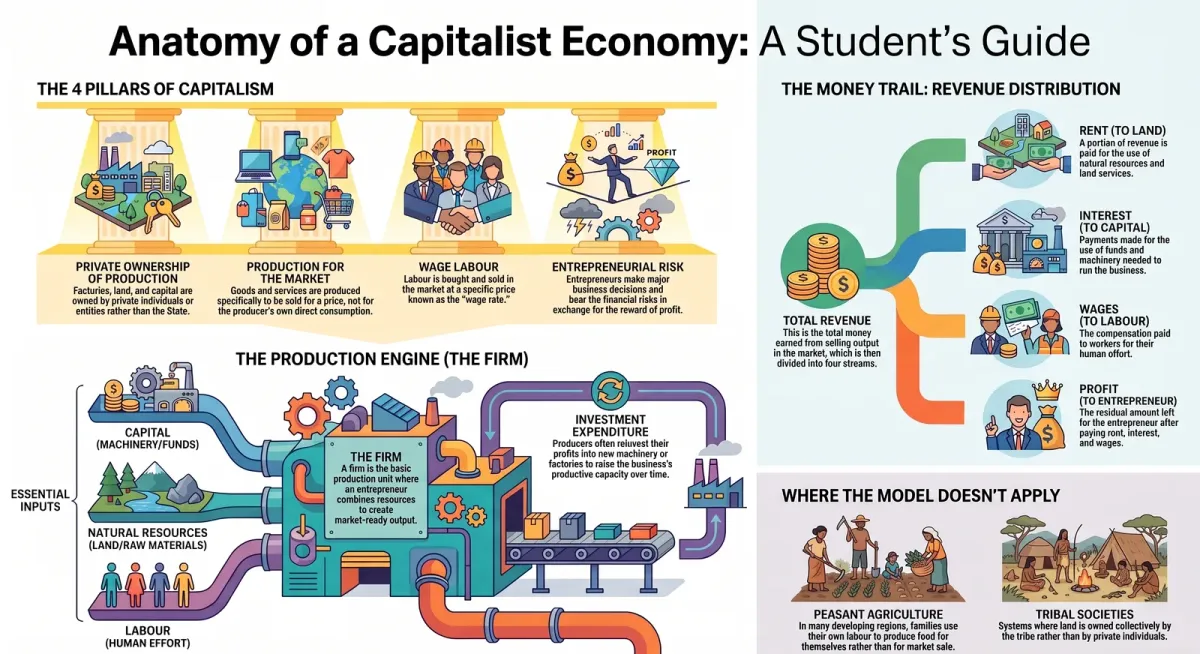
When your Class 12 Macroeconomics textbook talks about “the economy,” it isn’t describing just any economic system — it’s specifically analysing the working of a capitalist economy. Understanding what makes an economy “capitalist” is essential, because the entire logic of firms, wages, profits, and markets that you’ll study this year is built on this foundation.
Defining a Capitalist Economy
A capitalist economy is one in which most economic activities share four defining characteristics:
-
Private ownership of the means of production — factories, land, and capital are owned by private individuals or entities, not the State.
-
Production for the market — goods and services are produced with the intention of selling them, not for the producer’s own direct consumption.
-
Sale and purchase of labour services — labour is bought and sold at a price called the wage rate, and labour sold this way is referred to as wage labour.
-
Entrepreneurs bear risk and make major decisions, earning profit as their reward.
If we apply these four criteria across the world, we find that capitalist countries have only existed for the last three to four hundred years, and even today, strictly speaking, only a handful of countries in North America, Europe, and Asia fully qualify.
The Building Blocks: Entrepreneurs, Capital, Land, and Labour
At the centre of a capitalist enterprise is the entrepreneur — the person (or people) who exercises control over major business decisions and bears a large part of the associated risk. Entrepreneurs may supply their own capital to run the enterprise, or they may borrow it.
To carry out production, an enterprise needs:
-
Capital — funds and machinery needed to run the business.
-
Natural resources (land) — partly consumed in production (like raw materials) and partly fixed (like plots of land).
-
Labour — the human effort required to carry out production.
Once production is complete, the entrepreneur sells the output in the market and earns revenue. This revenue doesn’t all belong to the entrepreneur — it gets distributed:
-
A part is paid as rent for the services rendered by land.
-
A part is paid as interest to capital.
-
A part is paid as wages to labour.
-
Whatever remains is the entrepreneur’s profit.
Profits are often reinvested by producers to buy new machinery or build new factories — a process known as investment expenditure, which raises the productive capacity of the business over time.
Firms: Where Capitalist Production Actually Happens
In economics, production units organised according to capitalist principles are simply called firms. In a firm, the entrepreneur hires wage labour from the market, employs capital and land, and undertakes production with the goal of selling output and earning profit. This process isn’t risk-free — the entrepreneur might not get a high enough price for the goods produced, which can reduce or wipe out profits entirely. This uncertainty is a core feature of capitalist production.
Why the Capitalist Model Doesn’t Fully Apply Everywhere
It’s important to understand a nuance here: not every economy fits this capitalist model neatly, especially in developing countries. In many underdeveloped regions, agricultural production is carried out by peasant families using their own labour rather than hired wage labour. A large part of what’s produced is consumed by the family itself rather than sold in the market, and capital stock on these farms often doesn’t rise significantly over time.
Even more strikingly, in many tribal societies, individual land ownership doesn’t exist at all — land may belong to the entire tribe collectively. In such settings, the capitalist framework of analysis simply doesn’t apply. That said, many developing countries — including India — do have a significant presence of production units organised along capitalist lines, which is why this framework remains highly relevant for understanding modern economies.
Why This Matters for Your Studies
Understanding the capitalist economy framework isn’t just background reading — it’s the conceptual base for nearly everything else in your macroeconomics syllabus. Concepts like national income, factor payments, and investment all depend on understanding how capital, labour, and land combine within firms to generate revenue and profit. Board exams frequently test this directly, asking students to “describe the important features of a capitalist economy” or explain how revenue gets distributed among rent, interest, wages, and profit.
Keep Learning with ChampionsPrep
Mastering the concept of a capitalist economy sets you up for success in every macroeconomics chapter that follows. For chapter-wise question banks, concept summaries, and exam-oriented practice built for CBSE and Maharashtra Board Commerce students, head over to https://app.championsprep.in and get exactly the help you need, exactly when you need it.
Test Your Knowledge

What Is a Capitalist Economy? Features Explained for Class 12
Frequently Asked Questions
What are the four key features of a capitalist economy? +
Private ownership of means of production, production for sale in the market, sale and purchase of labour at a wage rate (wage labour), and entrepreneurs bearing risk to earn profit.
What is wage labour? +
Wage labour refers to labour that is sold and purchased against wages in the market, at a price known as the wage rate, a defining feature of capitalist economies.
How does an entrepreneur's revenue get distributed? +
Revenue earned by selling output is distributed as rent to land, interest to capital, wages to labour, with the remaining amount kept as profit by the entrepreneur.
What is investment expenditure? +
Investment expenditure refers to expenses producers make, often using their profits, to buy new machinery or build new factories, which raises their productive capacity.
Does the capitalist economy model apply to all countries equally? +
No. In many underdeveloped countries, production is carried out by peasant families for family consumption rather than wage labour and market sale, and in some tribal societies land is not individually owned at all, meaning the capitalist framework doesn't fully apply there.
AI-powered practice — free to start