
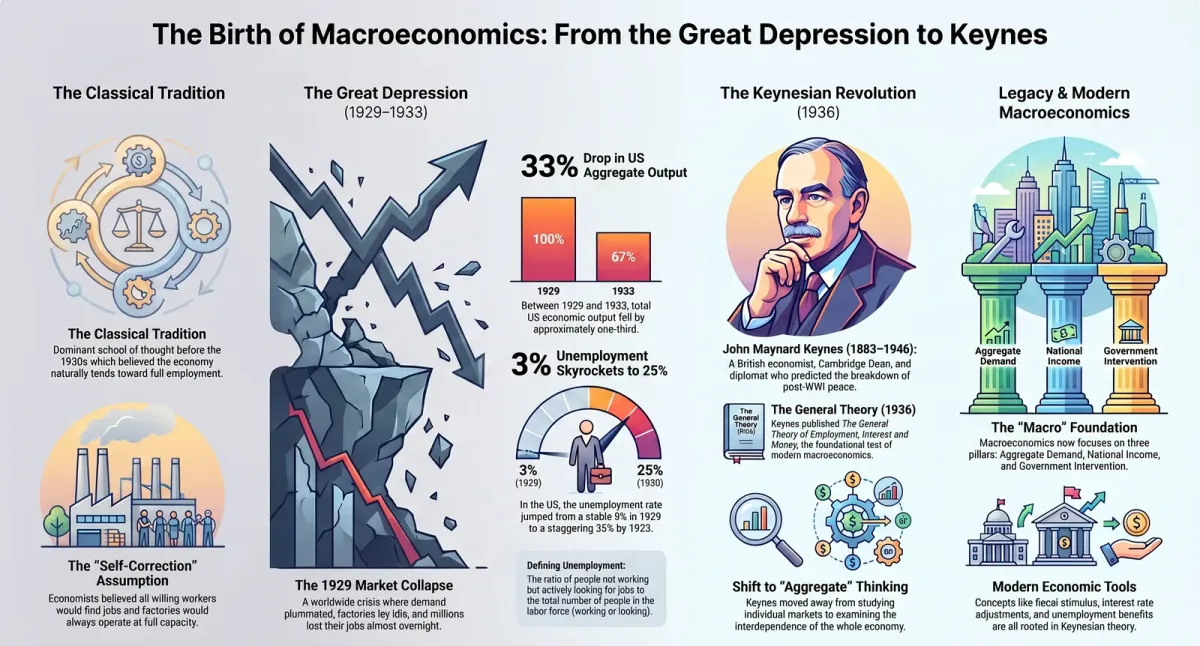
Every subject has an origin story, and macroeconomics has one of the most dramatic ones in the history of ideas. It wasn’t invented in a classroom — it was born out of one of the worst economic crises the world has ever seen. Here’s how the Great Depression of 1929 and the work of John Maynard Keynes gave rise to macroeconomics as we study it today.
The World Before Keynes: The Classical Tradition
Before the 1930s, the dominant way of thinking about economics was known as the classical tradition. Classical economists believed that all labourers who were ready and willing to work would eventually find employment, and that all factories would operate at their full capacity. In other words, the economy was assumed to naturally correct itself towards full employment over time.
This belief worked reasonably well as a theory — until reality proved otherwise in the most brutal way possible.
The Great Depression: When the Classical View Collapsed
The Great Depression of 1929 shattered the classical assumption. Output and employment levels in Europe and North America fell by enormous amounts, and the crisis spread to other parts of the world as well. Demand for goods in the market dropped sharply, factories across industries lay idle, and millions of workers were thrown out of jobs almost overnight.
The numbers tell the story clearly. In the United States, between 1929 and 1933:
-
The unemployment rate rose from just 3 per cent to 25 per cent.
-
Aggregate output in the country fell by about 33 per cent.
To put this in perspective, the unemployment rate is defined as the number of people who are not working and are actively looking for jobs, divided by the total number of people who are working or looking for jobs. A jump from 3% to 25% meant that roughly one in every four people who wanted to work simply could not find a job. This wasn’t a temporary blip — it was a prolonged, structural collapse that classical economics had no good explanation for.
Enter John Maynard Keynes
John Maynard Keynes, a British economist born in 1883, was educated at King’s College, Cambridge, where he was later appointed Dean. Keynes was not just an academic — he was actively involved in international diplomacy following the First World War, and in his 1919 book The Economic Consequences of the Peace, he even predicted the eventual breakdown of the post-war peace agreement. He was also, somewhat unusually for an economist, a shrewd foreign currency speculator.
But Keynes’ most influential contribution came in 1936, when he published The General Theory of Employment, Interest and Money. This book is widely regarded as one of the most influential economics texts of the twentieth century — and it’s the reason macroeconomics exists as a separate branch of the subject today.
What Made Keynes’ Approach Different
Unlike his predecessors, Keynes chose to examine the working of the economy in its entirety, studying the interdependence between different sectors rather than focusing only on individual markets. This was a radical shift. Instead of assuming the economy would automatically return to full employment, Keynes argued that an economy could get stuck with long-lasting unemployment — exactly what the Great Depression had demonstrated in real life.
This new way of thinking — studying aggregate output, aggregate employment, and the general price level across the whole economy — became the foundation of macroeconomics as a distinct subject.
Why This History Still Matters Today
Understanding this backstory isn’t just trivia for your exam — it explains why macroeconomics asks the questions it does. Every time your textbook discusses aggregate demand, national income, or government intervention in the economy, it’s building on the framework Keynes developed in direct response to the Great Depression. Modern policy tools like fiscal stimulus, interest rate adjustments by central banks, and unemployment benefits all trace their intellectual roots back to this moment in economic history.
For board exams, this topic frequently appears as a direct question: “Describe the Great Depression of 1929” or “How did macroeconomics emerge as a separate subject?” Being able to connect the classical tradition → Great Depression → Keynes → General Theory (1936) sequence clearly will help you score full marks on both short-answer and long-answer questions.
Keep Learning with ChampionsPrep
The story of Keynes and the Great Depression is one of the most exam-relevant narratives in Class 12 Macroeconomics — make sure you can explain it in your own words, with the correct dates and figures. For structured practice questions, topic-wise question banks, and exam-focused explainers for CBSE and Maharashtra Board Commerce students, visit https://app.championsprep.in and study smarter with our pay-per-use learning model.
Test Your Knowledge
The Great Depression & The Birth of Macroeconomics: Keynes Explained
Frequently Asked Questions
What was the classical tradition in economics? +
The classical tradition was the dominant economic thinking before Keynes, which held that all willing labourers would find employment and factories would operate at full capacity, implying the economy naturally tends towards full employment.
By how much did the unemployment rate rise during the Great Depression in the USA? +
The US unemployment rate rose from 3 per cent in 1929 to 25 per cent in 1933.
How much did aggregate output fall during the Great Depression in the USA? +
US aggregate output fell by about 33 per cent between 1929 and 1933.
Which book by Keynes is credited with founding macroeconomics? +
The General Theory of Employment, Interest and Money, published in 1936, is credited with giving birth to macroeconomics as a separate branch of economics.
What was Keynes' educational and professional background? +
Keynes was educated at King's College, Cambridge, where he later became Dean. He was involved in international diplomacy after World War I and was also known as a skilled foreign currency speculator.
AI-powered practice — free to start