
Circular Flow of Income and the Three Methods of Calculating National Income (Class 12 Economics Explained)
One of the most important — and frequently tested — ideas in CBSE Class 12 Macroeconomics is the circular flow of income. It’s the mental model that explains why an economy’s total production, total income, and total expenditure must all be equal, and why we have three different methods of calculating the same number: national income. If you’re preparing for your board exam, the Maharashtra State Board exam, or CUET, mastering this concept will help you solve numericals faster and understand later chapters on income determination with far greater ease.
What Is the Circular Flow of Income?
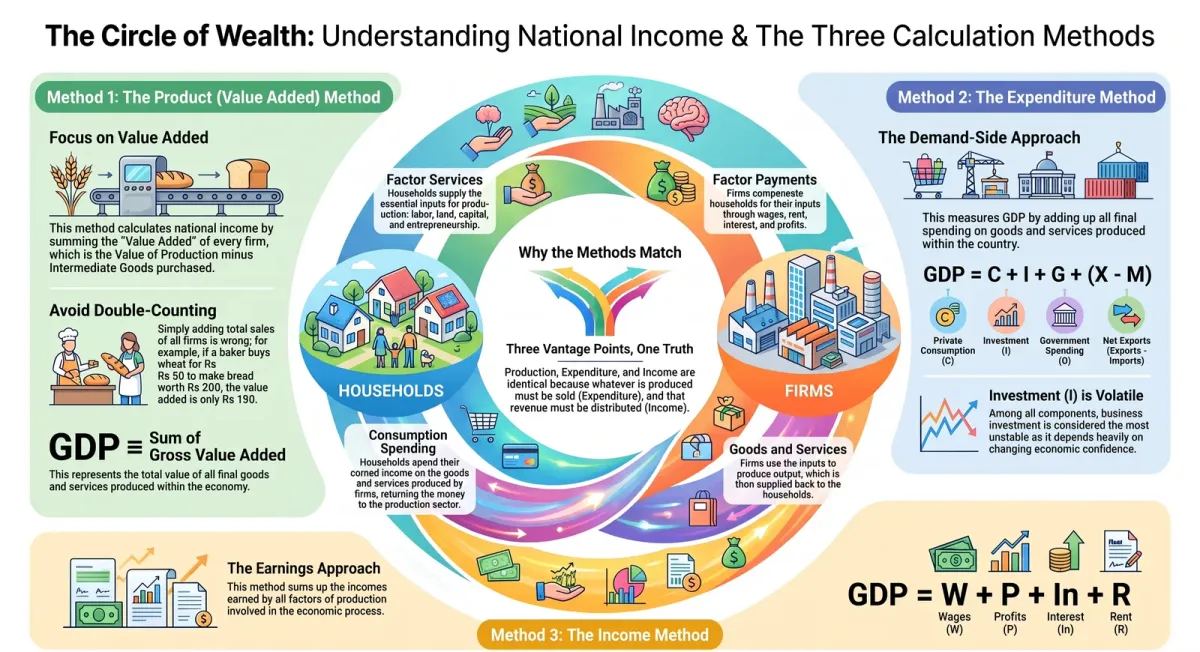
Imagine the simplest possible economy: just two sectors, firms and households, with no government, no external trade, and no savings. In this simplified economy, households own all the factors of production — labour, capital, entrepreneurship, and land — and supply these to firms. In exchange, firms make factor payments to households in the form of wages, interest, profit, and rent.
Since households in this simple model don’t save, pay taxes, or buy imports, they spend their entire income on goods and services produced by domestic firms. This spending returns to firms as sales revenue, which firms then redistribute as factor payments in the next round of production. Income thus moves continuously between firms and households — hence the term “circular flow.”
The Four Flows in the Circular Flow Diagram
The standard circular flow diagram captures four distinct flows:
-
Spending — households pay firms for goods and services (households to firms)
-
Goods and services — firms supply output to households (firms to households)
-
Factor payments — firms pay wages, rent, interest, and profit to households (firms to households)
-
Factor services — households supply labour, land, capital, and entrepreneurship to firms (households to firms)
Because there’s no leakage from this system — no savings, taxes, or imports — the total amount firms distribute as factor payments exactly equals the total amount households spend as consumption expenditure. This equality is the key insight behind all three methods of calculating national income.
The Three Methods of Calculating National Income
Since the same aggregate value of money is moving in a circle, we can measure it at any point in that circle and get the same answer. This gives us three separate — but mathematically equivalent — approaches.
1. Product Method (Value Added Method)
The product method calculates national income by adding up the value added by every firm in the economy. Value added equals a firm’s value of production minus the value of intermediate goods it purchased and used up.
Why not simply add up total production of every firm? Because that would double-count intermediate goods. Consider a farmer who produces wheat worth Rs 100 and sells Rs 50 worth to a baker, who uses it entirely to bake bread worth Rs 200. Simply adding Rs 100 + Rs 200 gives Rs 300 — but this counts the Rs 50 of wheat twice. Using value added instead: the farmer’s value added is Rs 100 (no inputs used), and the baker’s value added is Rs 200 − Rs 50 = Rs 150. The correct aggregate output is Rs 250.
GDP ≡ Sum of Gross Value Added of all firms in the economy
2. Expenditure Method
The expenditure method looks at the demand side — how much was spent buying the final goods and services produced. It adds up:
-
C — final consumption expenditure by households
-
I — final investment expenditure (including change in inventories, fixed business investment, and residential investment)
-
G — government’s final consumption and investment expenditure
-
X — export revenue earned from foreign buyers
-
M — import expenditure, which must be subtracted since it represents spending on goods not produced domestically
GDP ≡ C + I + G + X − M
Of these five components, investment (I) is generally described as the most volatile or unstable, since business investment decisions can change sharply with economic conditions.
3. Income Method
The income method sums up the incomes earned by all factors of production:
-
W — wages and salaries earned by labour
-
P — profits earned by entrepreneurs
-
In — interest earned by owners of capital
-
R — rent earned by owners of land
GDP ≡ W + P + In + R
Why Do All Three Methods Give the Same Value?
Because of the circular flow: whatever firms produce (product method) must be sold to someone, so it becomes expenditure (expenditure method); and whatever firms earn from that expenditure must be distributed back to the factors of production that helped create it (income method). Production, expenditure, and income are simply three vantage points on the same underlying activity — so, in principle, they must yield an identical GDP figure.
This equivalence is often tested through short numericals where students are given sales, wages, and profit data for two firms and asked to verify that all three methods match — exactly the kind of question you should practise until it’s second nature.
Practise Until It Clicks — With ChampionsPrep
Numerical problems on the three methods of national income calculation are a guaranteed part of your board exam and entrance test syllabus. ChampionsPrep offers pay-per-use, AI-powered practice sets built specifically for CBSE and Maharashtra Board Class 11–12 Commerce students, with instant feedback on product, expenditure, and income method problems. Head to https://app.championsprep.in and start solving targeted practice questions today.
Test Your Knowledge

Circular Flow of Income & 3 Methods to Calculate National Income | Class 12 Economics
Frequently Asked Questions
What are the three methods of calculating national income? +
The three methods are the product (value added) method, the expenditure method, and the income method. All three measure the same underlying national income from different vantage points — production, spending, and earning.
Why must all three methods give the same GDP value? +
Because income flows circularly through the economy: what firms produce is sold as expenditure, and the revenue from that expenditure is distributed back as factor income. Production, spending, and income are three views of one continuous flow.
What is value added and why does it matter? +
Value added is a firm's production value minus the value of intermediate goods it used. It matters because summing value added avoids double-counting intermediate goods when calculating national income.
Which component of the expenditure method is considered the most unstable? +
Investment expenditure (I) is generally the most volatile component, since it depends on business confidence and can change sharply from year to year.
Does the circular flow model apply to real economies with government and foreign trade? +
The chapter's basic model excludes government and foreign trade for simplicity, but the core conclusion — that all three methods yield the same national income — continues to hold even in more complex, realistic economies.
AI-powered practice — free to start