
If you’re preparing for CBSE Class 12 Economics, the Maharashtra State Board, or CUET, Chapter 2 of Introductory Macroeconomics — National Income Accounting — is where your foundation gets built. Before you can calculate GDP or understand the circular flow of income, you need to be clear about a few basic ideas: final goods, intermediate goods, consumption goods, capital goods, stocks, flows, and depreciation. Get these wrong, and every numerical problem on national income will trip you up. Get them right, and the rest of macroeconomics becomes far easier to follow. This post breaks down these foundational concepts with simple, exam-ready examples.
What Is a Final Good in Economics?
A final good is any good or service that is meant for final use and will not pass through any further stage of production or transformation. Once a final good is sold, it exits the active economic production process — even though the buyer may still use or even physically alter it (like brewing tea leaves at home).
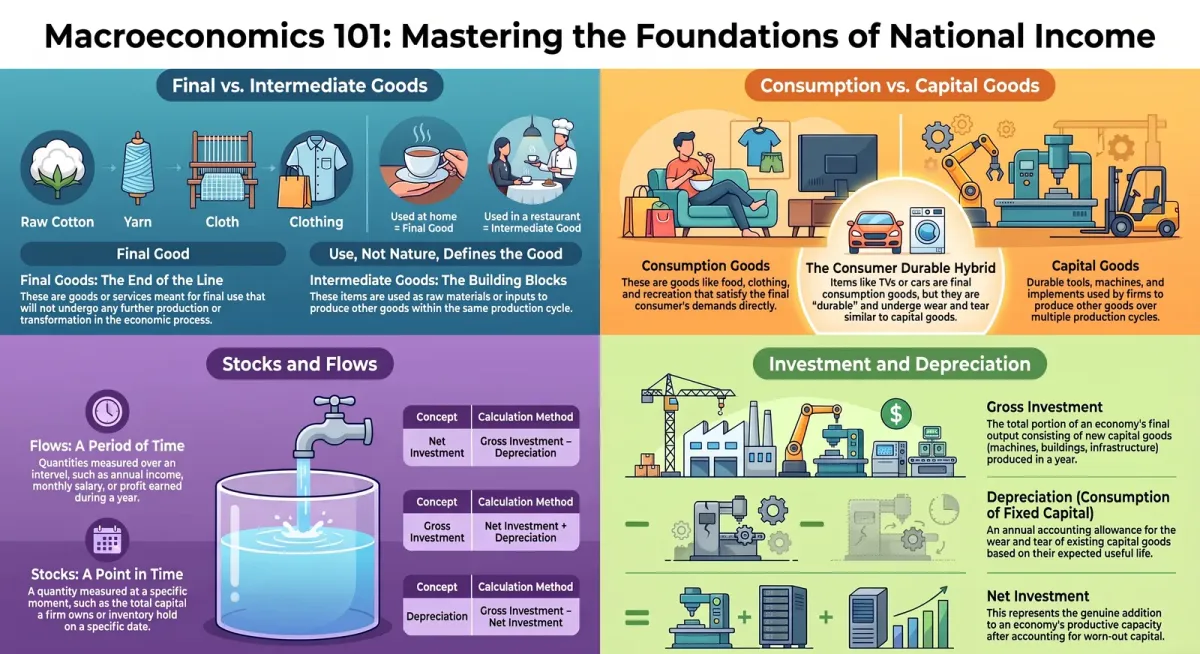
Think of the classic chain: a farmer grows raw cotton and sells it to a spinning mill. The mill turns it into yarn and sells that to a textile mill, which weaves it into cloth. The cloth is then made into an article of clothing and sold to a consumer. At every stage before the final sale to the consumer, the good is being transformed further — so raw cotton, yarn, and cloth are all intermediate goods. Only the finished clothing, once sold for final use, is a final good.
Why the Same Good Can Be Both Final and Intermediate
Here’s a detail that trips up many students: whether a good is “final” or “intermediate” depends on its economic use, not its physical nature. Tea leaves bought by a household to make tea at home are a final good, since home consumption isn’t an economic activity. But the same tea leaves, bought by a restaurant to brew and sell to customers, become an intermediate good — they’re now inputs into a saleable service. This is a favourite in CBSE board short-answer questions, so remember it well.
Consumption Goods vs Capital Goods
Among final goods, economists distinguish between two broad categories:
-
Consumption goods (or consumer goods): Goods and services like food, clothing, and recreation that are consumed directly by their ultimate users.
-
Capital goods: Durable goods such as machines, tools, and implements that are used in the production process itself. They don’t get transformed or used up immediately; instead, they help produce other goods over many production cycles.
A special category worth remembering is consumer durables — items like televisions, home computers, and automobiles. These are final goods meant for consumption, but like capital goods, they are durable and undergo wear and tear, requiring maintenance and replacement.
Understanding Stocks and Flows
Macroeconomics deals heavily with quantities measured over time (flows) and quantities measured at a point in time (stocks). This distinction is essential for understanding concepts like income, investment, and capital.
-
A flow is defined over a period of time — annual income, monthly salary, or profit earned during a year are all flows.
-
A stock is defined at a point in time — the capital owned by a firm, or inventory held on a specific date, are stocks.
Imagine water flowing from a tap into a tank. The rate at which water enters per minute is a flow. The total water sitting in the tank at any moment is a stock. Capital is a stock; investment (addition to capital during a year) is a flow.
Depreciation, Gross Investment and Net Investment
Every year, a portion of an economy’s final output consists of capital goods — machines, buildings, and infrastructure. This is called gross investment. However, capital goods already in use wear out over time due to regular use, and part of each year’s new capital goods production simply replaces this worn-out capital rather than adding to it.
This wear-and-tear allowance is called depreciation — an accounting concept: even if a firm doesn’t spend money on replacement every year, an amount is set aside annually based on the asset’s expected useful life.
The genuine addition to an economy’s productive capacity is called net investment:
Net Investment = Gross Investment − Depreciation
This formula appears repeatedly in board exam numericals, so practise applying it in both directions — solving for any one of the three values when the other two are given.
Quick Revision Checklist
-
Final good → no further transformation; ready for final use
-
Intermediate good → used as input for further production
-
Consumption goods → satisfy final consumer demand directly
-
Capital goods → durable, aid production, not consumed directly
-
Stock → measured at a point in time (e.g., capital)
-
Flow → measured over a period of time (e.g., income, investment)
-
Net Investment = Gross Investment − Depreciation.
Master These Concepts with ChampionsPrep
Struggling to apply these definitions to numerical problems? ChampionsPrep’s AI-powered practice platform gives Class 12 Commerce students instant, pay-per-use access to chapter-wise question banks, previous-year style problems, and step-by-step solutions for CBSE, Maharashtra Board, and CUET preparation. Visit https://app.championsprep.in to start practising National Income Accounting questions today — no subscriptions, just focused, affordable practice exactly when you need it.
Test Your Knowledge

Final Goods, Intermediate Goods, Stocks & Flows | Class 12 Macroeconomics Basics
Frequently Asked Questions
What is the difference between a final good and an intermediate good? +
A final good is meant for final use and does not undergo any further transformation in the production process, while an intermediate good is used as a raw material or input to produce another good.
Are consumer durables the same as capital goods? +
No. Consumer durables (like TVs or cars) are final goods purchased for household consumption, while capital goods (like machines) are used by firms to produce other goods. Both are durable, but their economic purpose differs.
Why is depreciation called an accounting concept? +
Because it represents an annual allowance for wear and tear based on an asset's expected life, even though a firm may not actually spend money on replacement in every single year.
Can the same good be both a final good and an intermediate good? +
Yes. Classification depends on economic use. For example, tea leaves used at home are a final good, but the same tea leaves used by a restaurant to prepare tea for sale are an intermediate good.
How do I remember the difference between stock and flow? +
Think of a water tank: water flowing in per minute is a flow, while the total water in the tank at any moment is a stock. Income, investment, and production are flows; capital and inventory levels are stocks.
AI-powered practice — free to start