
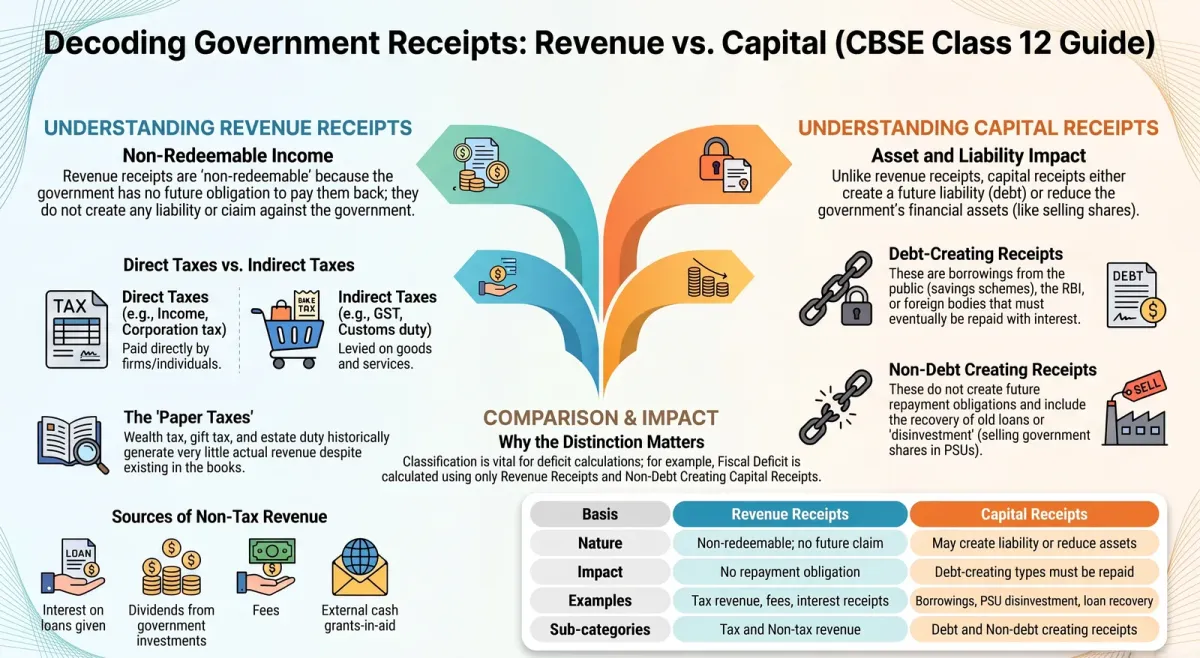
Deficit questions are almost guaranteed to appear on your CBSE Class 12 board exam, and they’re just as common in CUET Commerce. The challenge isn’t memorising formulas — it’s understanding what each deficit measure actually tells you, and how they relate to one another. This guide walks through all three deficit measures with formulas, meaning, and real numbers you can quote in your answers.
Balanced, Surplus and Deficit Budget: The Basics
Before diving into the technical measures, recall the three broad states a budget can be in:
-
Balanced budget — government expenditure equals government revenue
-
Surplus budget — tax collection exceeds required expenditure
-
Deficit budget — expenditure exceeds revenue (the most common situation in practice)
When a government runs a deficit, economists use three specific measures to understand exactly how large that deficit is and what it implies: revenue deficit, fiscal deficit, and primary deficit.
Revenue Deficit: Formula, Meaning and Implications
Revenue Deficit = Revenue Expenditure − Revenue Receipts
Revenue deficit captures only the transactions affecting the government’s current income and expenditure. When a government runs a revenue deficit, it is effectively dissaving — spending more on consumption than it earns, and using up savings from other sectors of the economy to plug the gap.
This has serious implications: the government must borrow not just to fund investment, but also to cover its regular consumption needs. Over time, this builds up debt and interest liabilities, eventually forcing the government to cut expenditure — often capital or welfare expenditure, since revenue expenditure like salaries and interest payments is largely “committed” and hard to reduce. This can hurt both growth and welfare outcomes.
Fiscal Deficit: Formula and What It Really Measures
Gross Fiscal Deficit = Total Expenditure − (Revenue Receipts + Non-Debt Creating Capital Receipts)
Non-debt creating capital receipts — like recovery of loans and PSU disinvestment proceeds — are receipts that don’t create future liabilities. By excluding them (along with revenue receipts) from total expenditure, the fiscal deficit isolates exactly how much the government needs to borrow.
How Fiscal Deficit Is Financed
From the financing side, the same figure can be expressed as:
Gross Fiscal Deficit = Net Borrowing at Home + Borrowing from RBI + Borrowing from Abroad
This makes fiscal deficit the key indicator of the government’s total borrowing requirement and a widely watched signal of the financial health of the public sector.
Primary Deficit: Isolating Today’s Fiscal Imbalance
Gross Primary Deficit = Gross Fiscal Deficit − Net Interest Liabilities
The government’s total borrowing requirement includes interest obligations on debt accumulated in the past — money that has nothing to do with this year’s spending decisions. Primary deficit strips out these old interest payments to show how much of the current borrowing is driven purely by this year’s expenditure exceeding this year’s revenue. Net interest liabilities themselves equal interest payments minus interest receipts on the government’s net domestic lending.
The Relationship Between Revenue, Fiscal and Primary Deficit
These three measures aren’t independent — they connect through a clear chain:
Fiscal Deficit = Revenue Deficit + Capital Expenditure − Non-Debt Creating Capital Receipts
Primary Deficit = Fiscal Deficit − Net Interest Liabilities
A high share of revenue deficit within the fiscal deficit is a warning sign: it means a large chunk of borrowing is financing consumption rather than investment — a point examiners love to test in “elucidate” and “explain the relationship” type questions.
India’s Deficit Numbers: A Real-World Snapshot
For 2024–25 (P.A.), India’s central government deficit figures as a percentage of GDP were:
-
Revenue Deficit: 1.71%
-
Fiscal Deficit: 4.76%
The primary deficit is the fiscal deficit less net interest liabilities, so take its latest value from the Budget at a Glance.
Quoting current figures like these in your long-answer responses demonstrates applied understanding, not just rote formula recall — something examiners consistently reward.
Why This Matters Beyond the Exam
Deficit measures aren’t just academic — they shape real decisions about taxation, borrowing costs, inflation, and the government’s ability to fund welfare and infrastructure. Understanding these numbers helps you follow Budget Day news, Economic Survey reports, and broader macroeconomic debates with genuine comprehension.
Practice Deficit Numericals Until They’re Second Nature
Deficit questions often combine formulas with numerical calculations — the kind of thing that only becomes fast and accurate with repeated practice. On ChampionsPrep , get AI-powered, chapter-specific practice questions for CBSE Class XII Commerce at just ₹10 per use, and build the speed and accuracy you need for exam day.
Test Your Knowledge

Fiscal Deficit vs Revenue Deficit vs Primary Deficit: Class 12 Guide
Frequently Asked Questions
What is the simplest way to remember the difference between revenue deficit and fiscal deficit? +
Revenue deficit only looks at current income vs. current (revenue) expenditure. Fiscal deficit looks at the government's entire borrowing requirement - it accounts for capital expenditure too and excludes only non-debt creating receipts from total expenditure.
Why is a high revenue deficit considered worse than a high fiscal deficit funded mostly by capital expenditure? +
Because a high revenue deficit means the government is borrowing to fund consumption (like salaries and subsidies) rather than investment, which builds up debt without building future productive capacity, unlike borrowing for capital expenditure, which can generate future returns.
Does a larger fiscal deficit always mean more expansionary fiscal policy? +
No. The same fiscal measures can produce a larger or smaller deficit depending on the state of the economy - for example, deficits automatically widen during a recession (as tax revenues fall) and shrink during a boom, even without any change in fiscal policy.
What is the purpose of calculating the primary deficit separately from the fiscal deficit? +
Primary deficit removes the effect of interest payments on past debt, isolating how much of the current year's borrowing is due to this year's expenditure exceeding this year's revenue - a cleaner measure of the government's present fiscal stance.
What was India's fiscal deficit as a percentage of GDP in 2024-25 (P.A.)? +
India's fiscal deficit for 2024-25 (P.A.) stood at 4.76% of GDP, compared to a revenue deficit of 1.71% of GDP.
AI-powered practice — free to start