
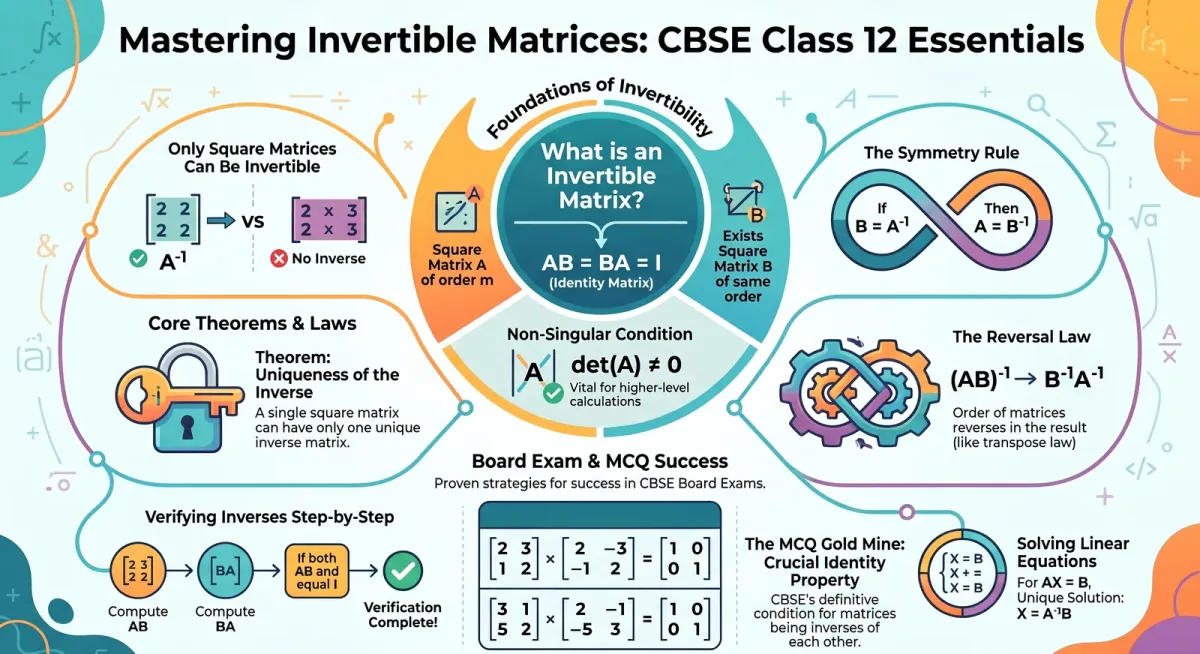
The final major topic in NCERT Chapter 3 is invertible matrices — square matrices that possess a multiplicative inverse. Understanding invertibility is essential not only for the Matrices chapter itself but also for Chapter 4 (Determinants), where you will learn a practical method to compute inverses using cofactors. This guide gives you the complete theoretical foundation needed for both.
Definition of Invertible Matrices
A square matrix A of order m is called invertible (or non-singular) if there exists another square matrix B of the same order m such that:
AB = BA = Iwhere I is the identity matrix of order m. When this condition holds, B is called the inverse of A and is denoted by A⁻¹.
Equivalently, A is the inverse of B, so A = B⁻¹.
A Concrete Example
Let A = [[2, 3], [1, 2]] and B = [[2, −3], [−1, 2]]. Are they inverses of each other?
Check AB:
AB = | 2×2 + 3×(−1)   2×(−3) + 3×2 |   =   | 4−3   −6+6 |   =   | 1  0 |   = I ✓
     | 1×2 + 2×(−1)   1×(−3) + 2×2 |        | 2−2   −3+4 |       | 0  1 |
Check BA:
BA = | 2×2 + (−3)×1   2×3 + (−3)×2 |   =   | 4−3   6−6 |   =   | 1  0 |   = I ✓
     |(−1)×2 + 2×1   (−1)×3 + 2×2  |        |−2+2  −3+4 |       | 0  1 |
Both AB = I and BA = I hold, so B = A⁻¹ (and A = B⁻¹).
Important Notes on Invertible Matrices
Only Square Matrices Can Be Invertible
A rectangular matrix does not possess an inverse. For products AB and BA to both be defined and equal, matrices A and B must be square matrices of the same order.
If B is the Inverse of A, then A is the Inverse of B
Invertibility is symmetric: A⁻¹ = B if and only if B⁻¹ = A.
Theorem 3: Uniqueness of the Inverse
Theorem: The inverse of a square matrix, if it exists, is unique.
Proof
Let A be a square matrix of order m, and suppose B and C are both inverses of A. We want to show B = C.
Since B is the inverse of A: AB = BA = I …(1) Since C is the inverse of A: AC = CA = I …(2)
Now:
B = BI = B(AC) = (BA)C = IC = CTherefore B = C. The inverse is unique. ✓
This elegant proof uses only the associative law of matrix multiplication and the definition of the identity matrix.
Theorem 4: (AB)⁻¹ = B⁻¹A⁻¹ — The Reversal Law for Inverses
Theorem: If A and B are invertible matrices of the same order, then their product AB is also invertible, and:
(AB)⁻¹ = B⁻¹A⁻¹Just like the reversal law for transpose, the inverse of a product reverses the order.
Proof
Starting from (AB)(AB)⁻¹ = I:
(AB)(AB)⁻¹ = I
A⁻¹(AB)(AB)⁻¹ = A⁻¹I          [pre-multiply by A⁻¹]
(A⁻¹A)B(AB)⁻¹ = A⁻¹           [associativity]
IB(AB)⁻¹ = A⁻¹                [A⁻¹A = I]
B(AB)⁻¹ = A⁻¹
B⁻¹B(AB)⁻¹ = B⁻¹A⁻¹           [pre-multiply by B⁻¹]
I(AB)⁻¹ = B⁻¹A⁻¹
(AB)⁻¹ = B⁻¹A⁻¹   ✓
This proof appears as a theorem in NCERT and the derivation itself is a standard 5-mark board question.
Matrices A and B are Inverses if and Only if AB = BA = I
The condition for two matrices to be inverses of each other is this two-way requirement: both AB = I and BA = I must hold. It is not sufficient for only one of these to be true.
This is directly tested as an MCQ:
Question: Matrices A and B are inverses of each other only if: (A) AB = BA (B) AB = BA = 0 (C) AB = 0, BA = I (D) AB = BA = I Answer: D
Verifying that Two Matrices Are Inverses
To confirm that B = A⁻¹, you must compute both AB and BA and verify that each equals the identity matrix. If even one product differs from I, the matrices are not inverses.
Step-by-Step Verification
Given: A = [[3, 1], [5, 2]] and B = [[2, −1], [−5, 3]]. Verify B = A⁻¹.
Check AB:
AB = | 3×2 + 1×(−5)   3×(−1) + 1×3 |   =   | 6−5   −3+3 |   =   | 1  0 |   = I ✓
     | 5×2 + 2×(−5)   5×(−1) + 2×3 |        | 10−10  −5+6 |       | 0  1 |
Check BA:
BA = | 2×3 + (−1)×5   2×1 + (−1)×2 |   =   | 6−5   2−2 |   =   | 1  0 |   = I ✓
     |(−5)×3 + 3×5   (−5)×1 + 3×2  |        |−15+15 −5+6 |       | 0  1 |
Both products equal I, so B = A⁻¹ confirmed. ✓
This type of question — verify that two given matrices are inverses — is a reliable 3-mark problem in CBSE boards.
The Connection Between Invertibility and Linear Equations
When a system of linear equations is written in matrix form AX = B, the system has a unique solution X = A⁻¹B if and only if A is invertible. This connects Chapter 3 to Chapter 4 (Determinants), where matrices are applied to solve systems of linear equations — making invertibility one of the most consequential concepts in the entire unit.
Relationship to Determinants
A square matrix A is invertible if and only if its determinant is non-zero (det(A) ≠ 0). This connection is fully developed in Chapter 4, where you will learn:
A⁻¹ = (1 / det(A)) × adj(A)where adj(A) is the adjugate (adjoint) of A. Understanding invertibility now prepares you to compute inverses explicitly in the next chapter.
CBSE Board Exam Tips for Invertible Matrices
-
Verify both ways: To confirm B = A⁻¹, always check both AB = I and BA = I.
-
Uniqueness: If a matrix has an inverse, it has exactly one — you do not need to worry about multiple inverses.
-
Reversal law: (AB)⁻¹ = B⁻¹A⁻¹ — the order reverses, exactly like (AB)’ = B’A’.
-
No inverse for rectangles: Only square matrices of matching order can be inverses.
-
MCQ alert: “AB = BA = I” is the definition of inverses — this exact statement appears as an MCQ option every year.
Suggested Reading on ChampionsPrep
-
Matrix Multiplication: Non-Commutativity and Key Properties
-
Transpose of a Matrix: Properties and the Reversal Law
-
What is a Matrix? Introduction, Notation, and CBSE Exam Tips
Test Your Knowledge
Complete Your Matrices Preparation
Invertible matrices complete the theoretical foundation of Chapter 3 and directly connect to Chapter 4 (Determinants), where you will compute inverses using cofactors. Master this chapter fully before moving on.
Practice every concept from Matrices with 100+ CBSE-aligned questions at ChampionsPrep . Start at just ₹10 — MCQs, long-form, and instant explanations.
Invertible Matrices: Definition, Theorems and Examples | Class 12 CBSE Maths
Frequently Asked Questions
What is an invertible matrix? +
A square matrix A of order m is invertible if there exists a square matrix B of the same order such that AB = BA = I, where I is the identity matrix. B is called the inverse of A and is written A⁻¹.
Is the inverse of a matrix unique? +
Yes. If a square matrix has an inverse, that inverse is unique. This is proved by assuming two inverses B and C and showing that B = BI = B(AC) = (BA)C = IC = C.
What is the reversal law for the inverse of a product? +
If A and B are invertible matrices of the same order, then (AB)⁻¹ = B⁻¹A⁻¹. The order is reversed, similar to the reversal law for the transpose: (AB)' = B'A'.
Can a rectangular matrix be invertible? +
No. Only square matrices can be invertible. For AB and BA to both be defined and equal to the identity matrix, A and B must be square matrices of the same order.
What is the condition for matrices A and B to be inverses of each other? +
Matrices A and B are inverses of each other if and only if AB = BA = I, where I is the identity matrix of the appropriate order.
AI-powered practice — free to start