
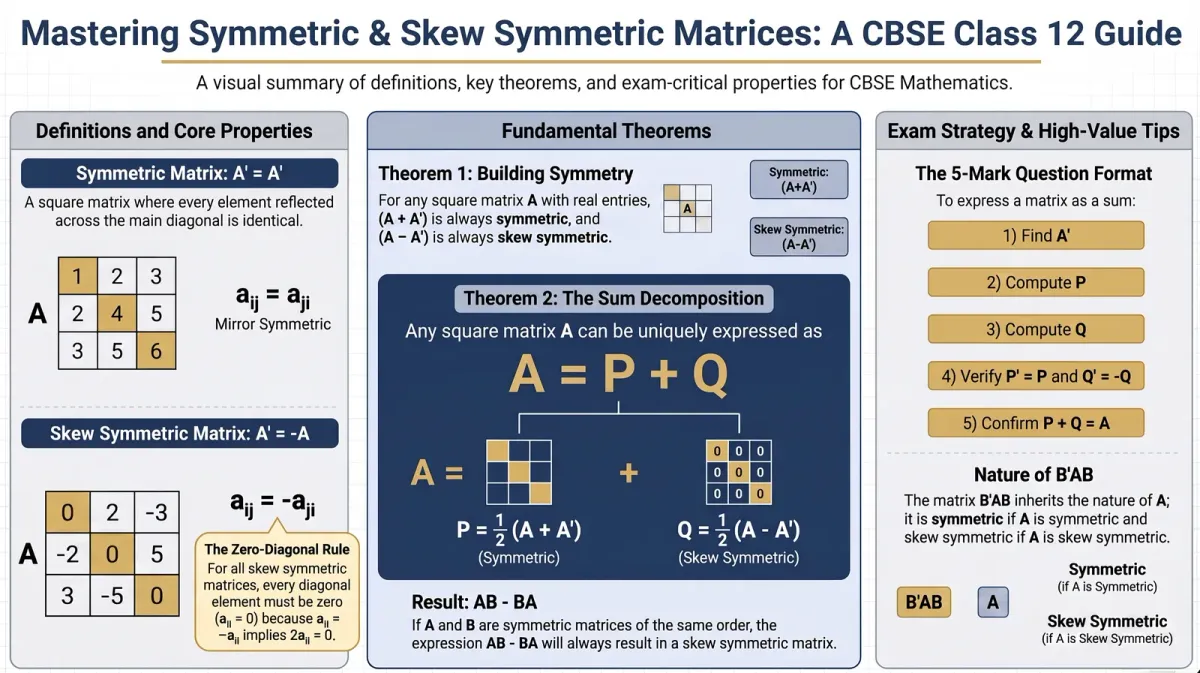
After mastering the transpose, the next major concept in NCERT Chapter 3 is symmetric and skew symmetric matrices. These are special types of square matrices defined entirely by their relationship to their own transpose. Understanding them unlocks two important theorems — and a standard 5-mark board question type where you express any square matrix as the sum of a symmetric and a skew symmetric matrix.
This guide covers both definitions, key properties of diagonal elements, two fundamental theorems, and a full worked example.
Definition of Symmetric Matrices
A square matrix A = [aij] is called symmetric if its transpose equals itself:
A' = A, equivalently aij = aji for all i and jIn a symmetric matrix, every element reflected across the main diagonal has the same value. The matrix is “mirror symmetric” about its diagonal.
Example of a Symmetric Matrix
A = | √3    2    3  |
    |  2   -1.5 -1  |
    |  3   -1    1  |
Here, a₁₂ = a₂₁ = 2, a₁₃ = a₃₁ = 3, and a₂₃ = a₃₂ = −1. Taking A’ gives exactly A, confirming it is symmetric.
Quick Check for Symmetry
For a 2 × 2 matrix [[a, b], [c, d]], symmetry requires b = c. For a 3 × 3 matrix, the three pairs of off-diagonal elements must match across the diagonal.
A' = -A, equivalently aji = -aij for all i and jEvery element reflected across the diagonal is the negative of its mirror element.
Critical Property: Diagonal Elements Are Always Zero
Setting i = j in the skew symmetric condition: aii = −aii, which means 2aii = 0, so aii = 0 for all i.
Every diagonal element of a skew symmetric matrix is zero. This is a key fact tested directly in CBSE exams.
Example of a Skew Symmetric Matrix
B = |  0    e    f |
    | -e    0    g |
    | -f   -g    0 |
Here B’ = −B, and all diagonal elements are 0.
Theorem 1: A + A’ is Symmetric and A − A’ is Skew Symmetric
For any square matrix A with real entries:
-
A + A’ is always symmetric
-
A − A’ is always skew symmetric
Proof for A + A’
Let B = A + A’. Then:
B' = (A + A')' = A' + (A')' = A' + A = A + A' = BSince B’ = B, the matrix A + A’ is symmetric. ✓
Proof for A − A’
Let C = A − A’. Then:
C' = (A - A')' = A' - (A')' = A' - A = -(A - A') = -CSince C’ = −C, the matrix A − A’ is skew symmetric. ✓
This theorem is proved step by step in NCERT and is a standard 4-mark proof question in CBSE boards.
Theorem 2: Every Square Matrix is a Sum of Symmetric and Skew Symmetric Matrices
Any square matrix A can be written as:
A = (1/2)(A + A') + (1/2)(A - A')The first part, P = ½(A + A’), is symmetric (by Theorem 1 and the scalar property of transpose). The second part, Q = ½(A − A’), is skew symmetric.
This means every square matrix can be uniquely expressed as the sum of a symmetric and a skew symmetric matrix — a beautifully elegant result.
Worked Example: Expressing a Matrix as a Sum
Example (NCERT Example 22): Express B = [[2, −2, −4], [−1, 3, 4], [1, −2, −3]] as the sum of a symmetric and a skew symmetric matrix.
Step 1: Find B’
B' = |  2  -1   1 |
     | -2   3  -2 |
     | -4   4  -3 |
Step 2: Compute P = ½(B + B’)
B + B' = |  4  -3  -3 |     P = |  2    -3/2  -3/2 |
         | -3   6   2 |         | -3/2   3     1   |
         | -3   2  -6 |         | -3/2   1    -3   |
Verify P’ = P ✓ (symmetric)
Step 3: Compute Q = ½(B − B’)
B - B' = |  0  -1  -5 |     Q = |  0    -1/2  -5/2 |
         |  1   0   6 |         |  1/2   0     3   |
         |  5  -6   0 |         |  5/2  -3     0   |
Verify Q’ = −Q ✓ (skew symmetric, note all diagonal elements are 0)
Step 4: Confirm P + Q = B ✓
Additional Results Involving Symmetric and Skew Symmetric Matrices
Beyond the two main theorems, NCERT presents several additional results that are tested in CBSE board exams:
Result 1: If A and B are symmetric matrices of the same order, then AB − BA is skew symmetric.
Proof: (AB − BA)’ = (AB)’ − (BA)’ = B’A’ − A’B’ = BA − AB = −(AB − BA). Since the transpose equals the negative, AB − BA is skew symmetric. ✓
Result 2: The matrix B’AB is symmetric if A is symmetric, and skew symmetric if A is skew symmetric.
Proof: (B’AB)’ = B’A’(B’)’ = B’A’B. If A’ = A (symmetric), this equals B’AB — symmetric. If A’ = −A (skew symmetric), this equals −B’AB — skew symmetric.
These results carry 4 marks each in CBSE boards and the proof structure is always the same: compute the transpose, apply the given condition on A, and show the result equals ±the original.
Key Results to Memorise
-
AB − BA is skew symmetric whenever A and B are symmetric matrices of the same order.
-
If A is symmetric: (A + A’) = 2A (already symmetric) and A − A’ = O.
-
If A + A’ = I, the value of α in [[cosα, −sinα], [sinα, cosα]] satisfies a specific condition — a standard MCQ in CBSE.
CBSE Board Exam Tips
-
Diagonal zero: In any skew symmetric matrix, ALL diagonal elements must be 0. If a question gives a skew symmetric matrix with a diagonal entry that isn’t 0, something is wrong.
-
Symmetric check: For A to be symmetric, verify A’ = A by inspection — compare elements across the diagonal.
-
5-mark question format: Express a 3 × 3 matrix as sum → compute P and Q separately → verify each → state P + Q = original matrix.
-
Theorem proofs: Be able to prove both Theorem 1 cases using transpose properties.
Suggested Reading on ChampionsPrep
-
Transpose of a Matrix: Properties, Reversal Law and Class 12 Examples
-
Types of Matrices: All Seven Types — Definitions and Examples
-
Invertible Matrices: Definition and Theorems for CBSE Class 12
Test Your Knowledge
Achieve Full Marks on These Theorems
Symmetric and skew symmetric matrices generate some of the highest-value questions in CBSE boards — proofs, verifications, and the sum-decomposition method. Master these with targeted practice.
Work through 100+ symmetric matrix questions at ChampionsPrep . CBSE board-ready, just ₹10 per session.
Symmetric and Skew Symmetric Matrices: Full Class 12 CBSE Guide
Frequently Asked Questions
What is a symmetric matrix? +
A square matrix A is symmetric if A' = A, meaning every element aij equals aji. The matrix appears identical when its rows and columns are interchanged.
What is a skew symmetric matrix? +
A square matrix A is skew symmetric if A' = -A, meaning aji = -aij for all i and j. All diagonal elements of a skew symmetric matrix are necessarily zero.
Why are all diagonal elements of a skew symmetric matrix zero? +
Setting i = j in the skew symmetric condition aji = -aij gives aii = -aii, which means 2aii = 0 and therefore aii = 0 for every diagonal position.
What does Theorem 2 on matrices state? +
Theorem 2 states that any square matrix A can be expressed as A = P + Q, where P = (1/2)(A + A') is symmetric and Q = (1/2)(A - A') is skew symmetric.
If A and B are symmetric matrices, is AB - BA symmetric or skew symmetric? +
If A and B are symmetric matrices of the same order, then AB - BA is always skew symmetric. This follows because (AB - BA)' = B'A' - A'B' = BA - AB = -(AB - BA).
AI-powered practice — free to start