
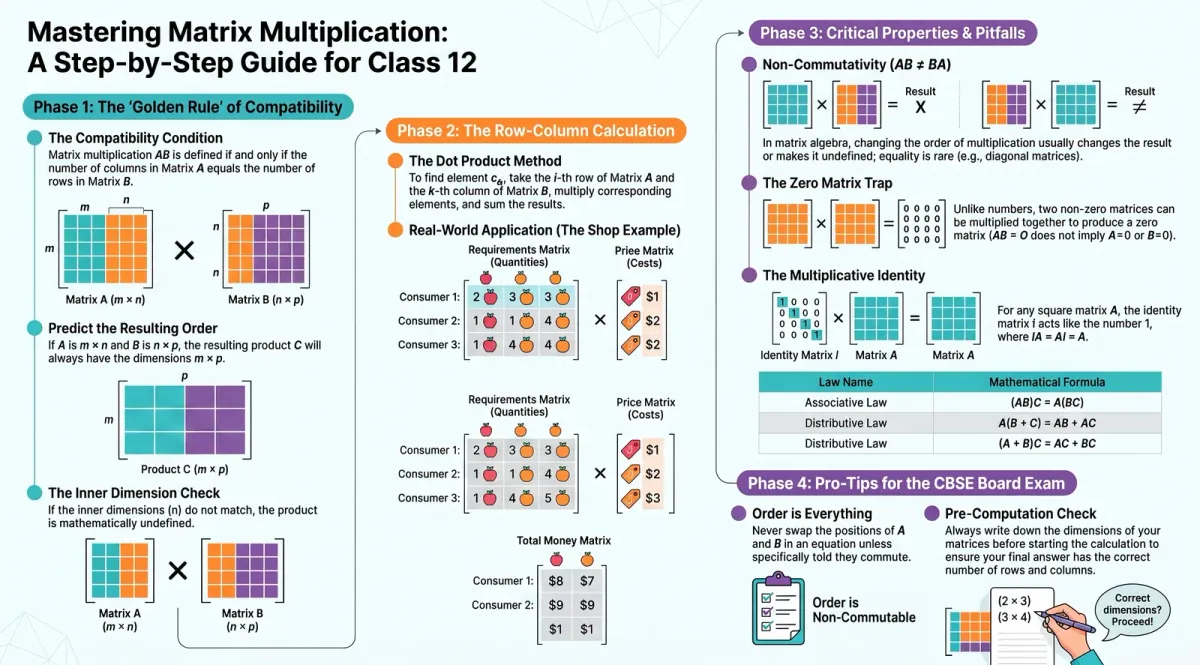
Matrix multiplication is one of the most important — and initially surprising — operations in Chapter 3. Unlike addition, where you simply add corresponding elements, multiplication requires a specific condition to hold and follows a very different process. It also breaks the familiar rule of commutativity that applies to numbers.
This guide explains matrix multiplication from the ground up: the condition for it to be defined, the step-by-step method, the properties you must know, and the key non-commutativity insight that separates matrix algebra from ordinary arithmetic.
What is Matrix Multiplication?
Matrix multiplication is the process of combining two matrices to produce a third, where each entry of the result is computed as the dot product of a row from the first matrix and a column from the second.
The Real-World Motivation
Imagine Meera wants to buy 2 pens and 5 story books, while Nadeem wants 8 pens and 10 story books. A shop quotes: pen = ₹5, story book = ₹50.
-
Meera spends: 5×2 + 50×5 = ₹260
-
Nadeem spends: 5×8 + 50×10 = ₹540
In matrix form:
Requirements:   | 2   5  |      Prices:  |  5 |
                | 8  10  |               | 50 |

Money needed:   | 5×2 + 50×5  |   =   | 260 |
                | 5×8 + 50×10 |         | 540 |
This is matrix multiplication: the requirements matrix times the price matrix gives the money needed.
Condition for Matrix Multiplication
The product AB is defined if and only if the number of columns in A equals the number of rows in B.
If A is m × n and B is n × p, then the product AB is a matrix of order m × p.
A       ×      B       =      AB
m × n       n × p          m × p
      ↑         ↑
   must match
If this inner dimension doesn’t match, the product is undefined.
How to Multiply Two Matrices: Step-by-Step
The element cᵢₖ of the product matrix C = AB is computed by:
cik = ai1·b1k + ai2·b2k + ... + ain·bnk = Σ aij · bjkThat is: take the i-th row of A and the k-th column of B, multiply corresponding elements, and sum the results.
Worked Example (NCERT Example 12)
Let A = [[6, 9], [2, 3]] and B = [[2, 6, 0], [7, 9, 8]]
A is 2 × 2, B is 2 × 3 → AB will be 2 × 3.
AB = | 6×2 + 9×7   6×6 + 9×9   6×0 + 9×8 |
     | 2×2 + 3×7   2×6 + 3×9   2×0 + 3×8 |

   = | 12+63   36+81   0+72 |   =  | 75   117   72 |
     |  4+21   12+27   0+24 |      | 25    39   24 |
Always confirm the order of the result before you compute: if A is m × n and B is n × p, your result must have exactly m rows and p columns.
Non-Commutativity of Matrix Multiplication
Here is the key difference from ordinary arithmetic: AB ≠ BA in general, even when both products are defined.
Example Demonstrating AB ≠ BA
Let A = [[1, -2, 3], [-4, 2, 5]] and B = [[2, 3], [4, 5], [2, 1]]
A is 2 × 3, B is 3 × 2. AB is 2 × 2 but BA is 3 × 3. Since AB and BA have different orders, they cannot be equal.
Even when both products have the same order, equality is not guaranteed. For example, with A = [[1, 0], [0, -1]] and B = [[0, 1], [1, 0]]:
AB = | 0   1 |    but    BA = |  0  -1 |
     | -1  0 |               |  1   0 |
AB ≠ BA. Matrix multiplication is not commutative — this is a fundamental and frequently tested fact.
When Is AB = BA?
AB = BA when A and B are diagonal matrices of the same order (the special case). In general, do not assume commutativity.
Zero Matrix as a Product of Non-Zero Matrices
In ordinary arithmetic, if ab = 0 then either a = 0 or b = 0. This is NOT true for matrices.
Example: Let A = [[0, -1], [0, 2]] and B = [[3, 5], [0, 0]]
AB = | 0×3 + (-1)×0   0×5 + (-1)×0 |   =   | 0  0 |   = O
     | 0×3 +  2×0     0×5 +  2×0   |        | 0  0 |
Neither A nor B is the zero matrix, yet AB = O. Remember this when evaluating matrix equations.
Properties of Matrix Multiplication
1. Associative Law
(AB)C = A(BC) whenever both sides are defined.
2. Distributive Law
A(B + C) = AB + AC and (A + B)C = AC + BC
3. Multiplicative Identity
For every square matrix A of order n: IₙA = AIₙ = A
The identity matrix acts as the “1” of matrix multiplication.
Using Matrix Multiplication to Solve Real Problems
Matrix multiplication is not an abstract exercise. In NCERT Example 19, a political group contacts voters in two cities using telephone, house calls, and letters. The cost per contact (in paise) forms a column matrix, and the number of contacts in each city forms a row matrix. Their product gives the total cost per city — a compact, elegant calculation.
Similarly, a school bookshop with three book types at three prices uses a row matrix of quantities and a column matrix of prices. One matrix product gives the total revenue — replacing the need for three separate multiplications and an addition. This is the power of matrix multiplication: it bundles multiple simultaneous calculations into one clean operation.
CBSE Board Exam Tips
-
Check dimensions first: Write A(m×n) × B(n×p) → AB(m×p) before computing.
-
Non-commutativity: Never swap the order of A and B. AB and BA are generally different.
-
Row-column method: For each element cᵢₖ, dot product row i of A with column k of B.
-
Zero product: The fact that AB = O does not mean A = O or B = O.
-
Identity: Multiplying any matrix by the identity matrix of the right order returns the original.
Suggested Reading on ChampionsPrep
-
Matrix Addition and Scalar Multiplication: Operations and Properties
-
Transpose of a Matrix: Properties and the Reversal Law for Class 12
-
Invertible Matrices: Definition, Uniqueness and (AB)⁻¹ Theorem
Test Your Knowledge
Test Your Matrix Multiplication Skills
Multiplication is the trickiest operation in this chapter — and the most frequently tested. Speed and accuracy come with practice.
Solve 100+ matrix multiplication MCQs and step-by-step questions at ChampionsPrep . ₹10 per session, CBSE board-aligned, instant explanations.
Matrix Multiplication Explained: Rules, Steps and Examples | Class 12 CBSE
Frequently Asked Questions
What is the condition for matrix multiplication to be defined? +
Matrix multiplication AB is defined only when the number of columns in A equals the number of rows in B. If A is m × n and B is n × p, then AB has order m × p.
Is matrix multiplication commutative? +
No. Matrix multiplication is not commutative in general. AB and BA may not be equal even when both products are defined. Only in special cases such as diagonal matrices of the same order does AB = BA.
How do you find the product of two matrices? +
The element cik of the product C = AB is found by taking the dot product of the i-th row of A with the k-th column of B: cik = ai1·b1k + ai2·b2k + ... + ain·bnk.
Can the product of two non-zero matrices be a zero matrix? +
Yes. Unlike real numbers, it is possible for AB = O even when neither A nor B is a zero matrix. This is an important difference between matrix algebra and ordinary arithmetic.
What is the multiplicative identity for matrices? +
The identity matrix In of order n is the multiplicative identity. For any square matrix A of order n, InA = AIn = A.
AI-powered practice — free to start