
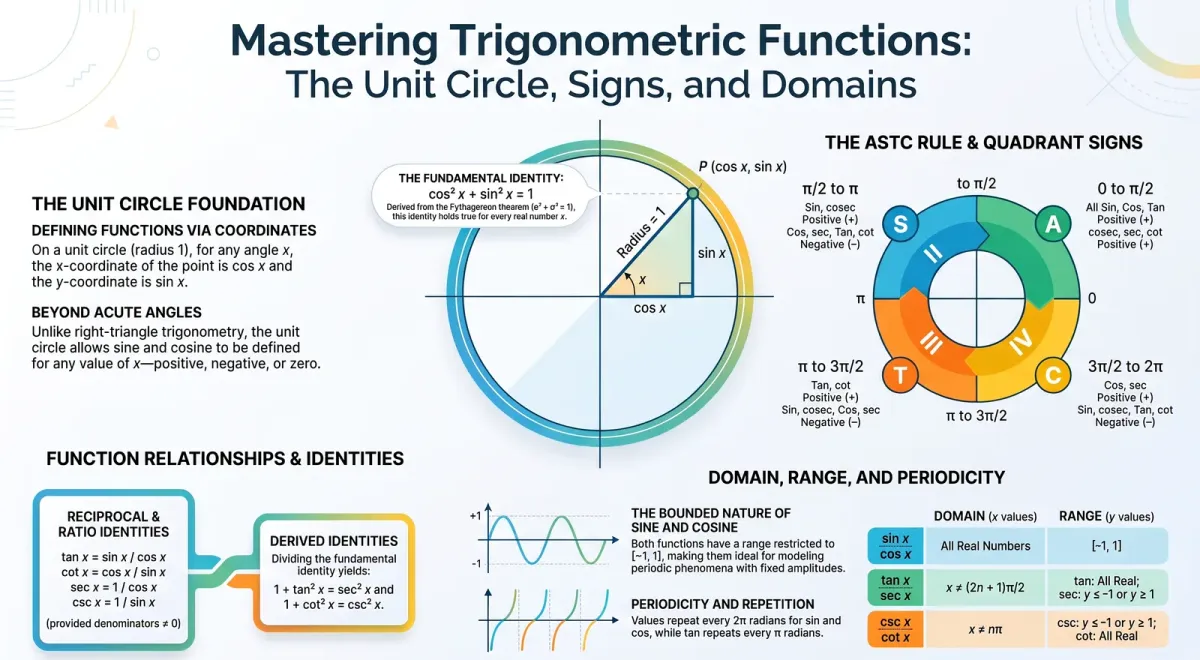
In earlier classes, sine, cosine, and tangent were defined only for acute angles using the sides of a right triangle. CBSE Class 11 Maths Chapter 3 extends this idea to any angle whatsoever, using the unit circle. This generalisation is what turns “trigonometric ratios” into “trigonometric functions,” and it is the foundation for everything from graphing sine waves to solving trigonometric equations in Class 12.
Defining Trigonometric Functions Using the Unit Circle
Consider a unit circle (radius 1) centred at the origin of the coordinate axes. Let P(a, b) be any point on the circle such that the angle AOP = x radians, meaning the arc AP has length x.
We define:
cos x = a and sin x = b
Since triangle OMP is right-angled, OM² + MP² = OP², which gives a² + b² = 1. This directly proves the most important identity in trigonometry:
cos²x + sin²x = 1, for every real number x
Because a and b are simply coordinates of a point on the unit circle, sin x and cos x are defined for every real value of x, positive, negative, or zero — not just acute angles.
Values at Quadrantal Angles
Angles that are integral multiples of π/2 are called quadrantal angles. Since one complete revolution subtends 2π radians, the points A(1,0), B(0,1), C(−1,0), and D(0,−1) correspond to angles 0, π/2, π, and 3π/2. This gives:
-
cos 0° = 1, sin 0° = 0
-
cos(π/2) = 0, sin(π/2) = 1
-
cos π = −1, sin π = 0
-
cos(3π/2) = 0, sin(3π/2) = −1
-
cos 2π = 1, sin 2π = 0
An important consequence: sin x = 0 whenever x = nπ, and cos x = 0 whenever x = (2n+1)π/2, where n is any integer.
The Other Four Trigonometric Functions
Once sine and cosine are defined, the remaining four functions follow as ratios:
-
cosec x = 1/sin x, x ≠ nπ
-
sec x = 1/cos x, x ≠ (2n+1)π/2
-
tan x = sin x / cos x, x ≠ (2n+1)π/2
-
cot x = cos x / sin x, x ≠ nπ
From cos²x + sin²x = 1, dividing through by cos²x and sin²x respectively gives two more identities you will use constantly:
1 + tan²x = sec²x and 1 + cot²x = cosec²x
Sign of Trigonometric Functions in Each Quadrant
Since cos x = a and sin x = b are just coordinates of a point on the unit circle, their signs follow the sign of the coordinates in each quadrant. Using ∠AOQ = −x to show cos(−x) = cos x and sin(−x) = −sin x, we get the complete ASTC-style sign table:
| Quadrant | sin x | cos x | tan x | cosec x | sec x | cot x |
|---|---|---|---|---|---|---|
| I | + | + | + | + | + | + |
| II | + | − | − | + | − | − |
| III | − | − | + | − | − | + |
| IV | − | + | − | − | + | − |
A handy way to remember this is the phrase “All Sin Tan Cos” (ASTC), read quadrant by quadrant — in quadrant I, All functions are positive; in II, only Sin (and cosec); in III, only Tan (and cot); in IV, only Cos (and sec).
Domain and Range of Each Function
-
y = sin x and y = cos x: domain is all real numbers; range is the interval [−1, 1].
-
y = cosec x: domain excludes x = nπ; range is y ≤ −1 or y ≥ 1.
-
y = sec x: domain excludes x = (2n+1)π/2; range is y ≤ −1 or y ≥ 1.
-
y = tan x: domain excludes x = (2n+1)π/2; range is all real numbers.
-
y = cot x: domain excludes x = nπ; range is all real numbers.
Notice that sine and cosine are the only two functions with a bounded range — this is why they are the natural choice for modelling periodic phenomena like tides or sound waves, which never exceed a fixed amplitude.
Periodicity: Why Values Repeat After 2π (or π)
Since one full revolution returns point P to the same position, sin(2nπ + x) = sin x and cos(2nπ + x) = cos x for any integer n. Because tan x is a ratio of sin and cos, its values repeat over a shorter interval — every π radians, not 2π. This is exactly why tan x has vertical asymptotes wherever cos x = 0, and it is essential for later chapters on solving general trigonometric equations.
Master the Unit Circle with Guided Practice
Understanding domains, ranges, and quadrant signs is far easier when you can test yourself right after reading. ChampionsPrep’s AI-powered platform offers structured practice sets and instant, step-by-step explanations mapped to CBSE and Maharashtra State Board syllabi, along with prep for CUET, IPMAT, JIPMAT, NPAT, and SET. It’s free to register, and you only pay as you use — so there’s no reason to wait. Head to https://app.championsprep.in and start reinforcing Chapter 3 today.
Test Your Knowledge
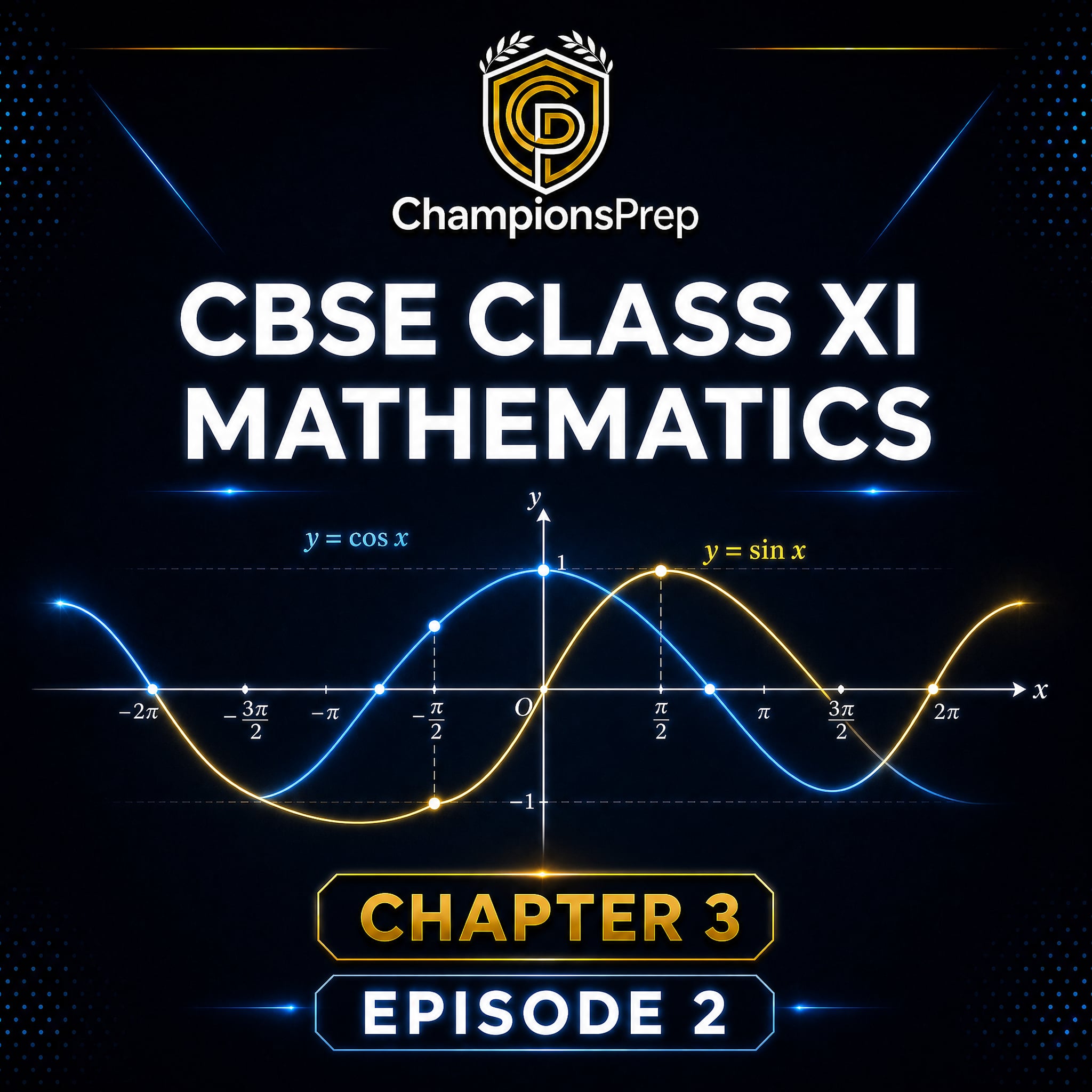
Trigonometric Functions: Definition, Domain, Range and Quadrant Signs
Frequently Asked Questions
How are trigonometric functions defined for angles greater than 90°? +
Using the unit circle: for any real number x, sin x and cos x are the y- and x-coordinates of the point on the unit circle reached after rotating by angle x radians from the positive x-axis, regardless of how large or negative x is.
What is the domain and range of sin x and cos x? +
Both sin x and cos x have domain equal to all real numbers, and range equal to the closed interval [−1, 1].
How do you remember the sign of trigonometric functions in each quadrant? +
Use the ASTC rule: All functions are positive in Quadrant I, only Sin (and cosec) in Quadrant II, only Tan (and cot) in Quadrant III, and only Cos (and sec) in Quadrant IV.
Why is tan x not defined at 90°? +
Because tan x = sin x / cos x, and cos(90°) = 0. Division by zero is undefined, so tan x (and sec x) are undefined at every odd multiple of 90° (π/2 radians).
What is the fundamental trigonometric identity? +
cos²x + sin²x = 1 for every real number x. This follows directly from the Pythagorean theorem applied to a point on the unit circle, and it is the basis for deriving 1 + tan²x = sec²x and 1 + cot²x = cosec²x.
AI-powered practice — free to start