
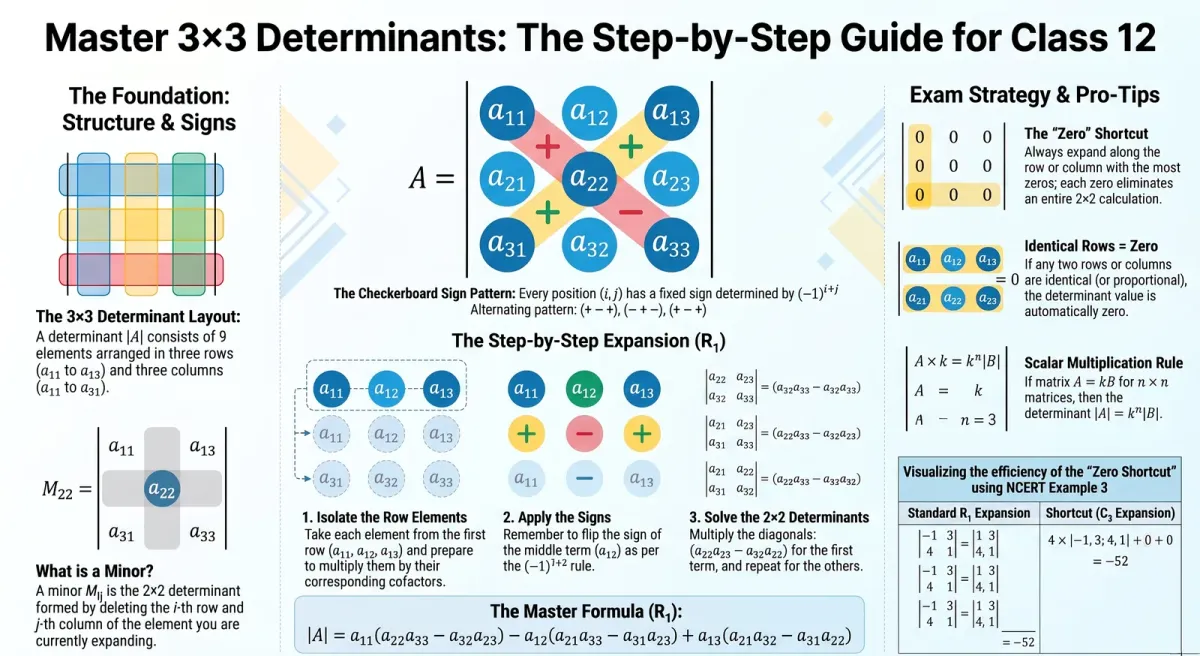
Evaluating a 3 × 3 determinant is one of the most commonly tested skills in the CBSE Class 12 Maths board exam. Once you understand the underlying method — cofactor expansion along a row or column — the calculations become systematic and reliable. This guide walks you through the complete process, explains every step, highlights smart shortcuts, and includes NCERT-aligned worked examples to strengthen your exam readiness.
Setting Up the 3 × 3 Determinant
A 3 × 3 determinant looks like this:
      | a₁₁  a₁₂  a₁₃ |
|A| = | a₂₁  a₂₂  a₂₃ |
      | a₃₁  a₃₂  a₃₃ |
The core idea is to reduce this 3 × 3 determinant into a combination of 2 × 2 determinants. This process is known as expansion along a row (or column).
A crucial fact from NCERT: expanding along any row or column always gives the same value. You do not need to expand along R₁ every time — in fact, choosing wisely can save significant calculation time.
Expansion Along the First Row (R₁)
The standard method taught in NCERT is expansion along the first row. Each element of R₁ is multiplied by its cofactor — a signed 2 × 2 determinant formed by deleting that element’s row and column.
The formula is:
|A| = a₁₁ × (−1)^(1+1) × M₁₁ + a₁₂ × (−1)^(1+2) × M₁₂ + a₁₃ × (−1)^(1+3) × M₁₃
which simplifies to:
|A| = a₁₁(a₂₂a₃₃ − a₃₂a₂₃) − a₁₂(a₂₁a₃₃ − a₃₁a₂₃) + a₁₃(a₂₁a₃₂ − a₃₁a₂₂)
Understanding the Sign Pattern
The signs follow a fixed checkerboard pattern:
+  −  +
−  +  −
+  −  +
The sign for the element in position (i, j) is (−1)^(i+j). So position (1,1) gives +1, position (1,2) gives −1, and position (1,3) gives +1.
Smart Strategy: Expand Along the Row With Most Zeros
Here is the most important exam shortcut: if any row or column contains zeros, expand along it. Each zero eliminates one 2 × 2 sub-determinant from your calculation, reducing the work significantly.
Worked Example 1 (NCERT Example 3)
Evaluate: |1 2 4; −1 3 0; 4 1 0|
The third column has two zeros. Expand along column C₃:
|A| = 4 × (−1)^(1+3) × |−1 3; 4 1| + 0 + 0
= 4 × (+1) × (−1 − 12) = 4 × (−13) = −52
Only one 2 × 2 determinant needed — from 9 multiplications down to 2.
Expansion Along the Second Row and First Column
Understanding expansion along other rows and columns builds flexibility for exam problems.
Expanding Along R₂
|A| = −a₂₁(a₁₂a₃₃ − a₃₂a₁₃) + a₂₂(a₁₁a₃₃ − a₃₁a₁₃) − a₂₃(a₁₁a₃₂ − a₃₁a₁₂)
Expanding Along C₁
|A| = a₁₁(a₂₂a₃₃ − a₂₃a₃₂) − a₂₁(a₁₂a₃₃ − a₁₃a₃₂) + a₃₁(a₁₂a₂₃ − a₁₃a₂₂)
All three methods — R₁, R₂, and C₁ — produce the same final answer, confirming the consistency property of determinants.
Worked Example 2: Expansion Along R₁
Evaluate: |3 −1 −2; 0 0 −1; 3 −5 0|
Expanding along R₁:
= 3 × |0 −1; −5 0| − (−1) × |0 −1; 3 0| + (−2) × |0 0; 3 −5|
= 3(0 − 5) + 1(0 + 3) − 2(0 − 0)
= 3(−5) + 1(3) − 0 = −15 + 3 = −12
Key Rules to Remember for the Board Exam
Rule 1 — Sign depends on position: Always apply (−1)^(i+j) to get the cofactor. A common error is forgetting the sign flip.
Rule 2 — Zeros save time: Always scan all rows and columns before expanding. Pick the one with the most zeros.
Rule 3 — Scalar multiplication: If A = kB for n × n matrices, then |A| = kⁿ|B|. This appears regularly in Class 12 MCQs.
Rule 4 — Identical rows mean zero: If any two rows (or columns) of a determinant are identical, its value is zero. This is a quick shortcut for checking special determinants.
Clear Your Doubts Instantly
Confused about which row to expand along or why your sign is wrong? ChampionsPrep offers AI-powered doubt resolution for Class 12 Maths at just ₹10 per session. No subscription needed — just instant, accurate answers when you need them.
👉 Get help at https://app.championsprep.in and never get stuck on a determinant problem again.
Test Your Knowledge

How to Evaluate a 3×3 Determinant: Step-by-Step NCERT Class 12 Guide
Frequently Asked Questions
Is there only one way to expand a 3×3 determinant? +
No. You can expand along any of the three rows or any of the three columns — all six expansions give the same result. Choose the row or column with the most zeros for the easiest calculation.
Why do we use the sign (−1)^(i+j) in the expansion? +
The sign ensures the cofactor expansion is consistent with the formal algebraic definition of a determinant. It follows a fixed alternating + − + pattern across rows and columns.
What is the minor of an element in a 3×3 matrix? +
The minor Mᵢⱼ is the 2×2 determinant formed by deleting the i-th row and j-th column of the 3×3 matrix.
Can a 3×3 determinant be zero even when no element is zero? +
Yes. If two rows (or columns) are proportional to each other, the determinant equals zero regardless of the actual element values.
Does the order of expansion affect the final value of the determinant? +
No. As long as you apply the correct sign (−1)^(i+j) for each element, expanding along any row or column gives the same final determinant value.
AI-powered practice — free to start