
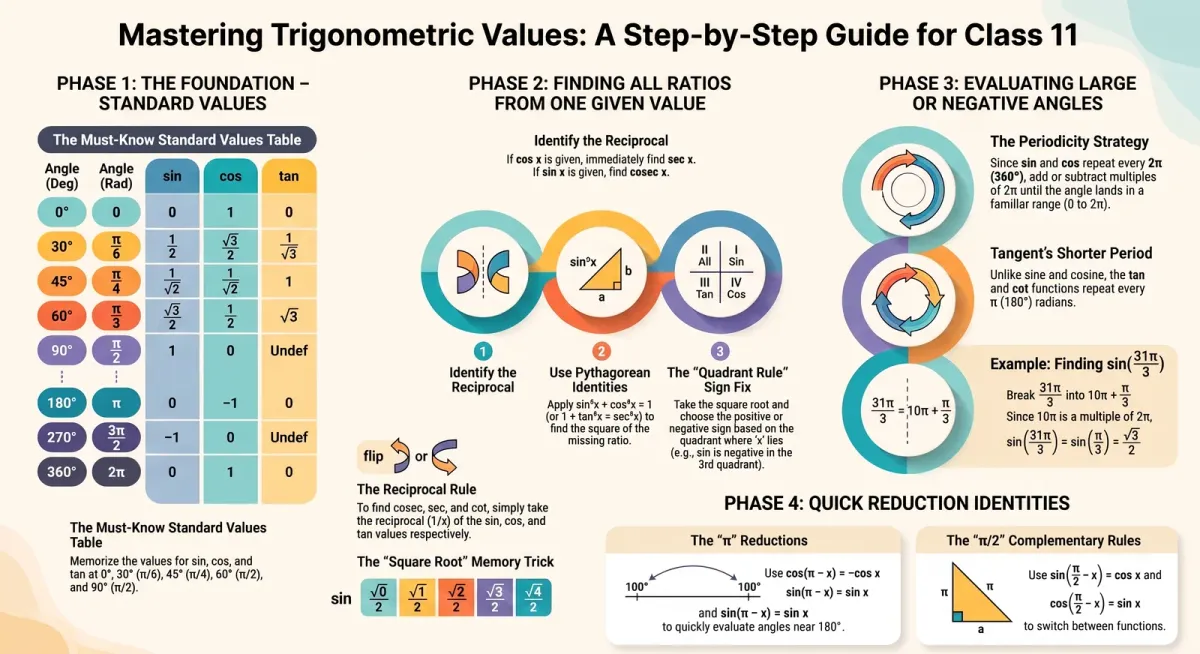
Once you know how trigonometric functions are defined and how their signs behave across quadrants, the next practical skill is actually computing values — both for standard angles like 30°, 45°, and 60°, and for large or negative angles that first need to be reduced using periodicity. This post walks through the standard values table, the technique for finding the remaining five ratios when one is given, and worked examples using periodicity, exactly as they appear in CBSE Class 11 Maths Chapter 3.
The Standard Values Table
For the commonly tested angles 0°, 30°, 45°, 60°, and 90° (and their radian equivalents), the trigonometric ratios are:
| Angle | 0° | π/6 | π/4 | π/3 | π/2 | π | 3π/2 | 2π |
|---|---|---|---|---|---|---|---|---|
| sin | 0 | 1/2 | 1/√2 | √3/2 | 1 | 0 | −1 | 0 |
| cos | 1 | √3/2 | 1/√2 | 1/2 | 0 | −1 | 0 | 1 |
| tan | 0 | 1/√3 | 1 | √3 | not defined | 0 | not defined | 0 |
The values of cosec x, sec x, and cot x are simply the reciprocals of sin x, cos x, and tan x respectively at each of these angles.
Finding the Other Five Ratios When One Is Given
A very common CBSE question type gives you one trigonometric ratio plus the quadrant in which the angle lies, and asks for the other five. The method is always the same: use the Pythagorean identities to find the missing ratio’s square, take the square root, and then fix the sign using the quadrant.
Example: If cos x = −3/5, and x lies in the third quadrant, find the other five trigonometric functions.
Since cos x = −3/5, immediately sec x = −5/3.
Using sin²x + cos²x = 1: sin²x = 1 − 9/25 = 16/25, so sin x = ±4/5.
Since x lies in the third quadrant, sin x is negative, so sin x = −4/5, giving cosec x = −5/4.
Then tan x = sin x / cos x = (−4/5)/(−3/5) = 4/3, and cot x = cos x / sin x = 3/4.
Example: If cot x = −5/12, and x lies in the second quadrant, find the other five functions.
tan x = −12/5. Using sec²x = 1 + tan²x = 1 + 144/25 = 169/25, sec x = ±13/5.
Since x is in the second quadrant, sec x is negative, so sec x = −13/5, giving cos x = −5/13.
Then sin x = tan x · cos x = (−12/5)(−5/13) = 12/13, and cosec x = 13/12.
Notice the pattern in both examples: identify the given ratio’s reciprocal first, apply the correct Pythagorean identity, and only decide the sign at the very last step, using the quadrant rule.
Using Periodicity to Evaluate Large or Negative Angles
Because sin(2nπ + x) = sin x and cos(2nπ + x) = cos x for any integer n, you can always reduce a large angle to an equivalent angle between 0 and 2π before reading off its value.
Example: Find sin(31π/3).
31π/3 = 10π + π/3 = 5(2π) + π/3. Since sin repeats every 2π, sin(31π/3) = sin(π/3) = √3/2.
Example: Find cos(−1710°).
cos repeats every 360°, so cos(−1710°) = cos(−1710° + 5 × 360°) = cos(−1710° + 1800°) = cos(90°) = 0.
This “add or subtract multiples of the period until the angle lands in a familiar range” strategy handles almost every large-angle evaluation question CBSE sets.
Useful Reduction Identities
Alongside periodicity, a set of standard reduction formulas (derived from the sum-difference identities covered separately) let you convert angles like π − x, π + x, and 2π − x into expressions of x alone:
-
cos(π − x) = −cos x, sin(π − x) = sin x
-
cos(π + x) = −cos x, sin(π + x) = −sin x
-
cos(2π − x) = cos x, sin(2π − x) = −sin x
-
cos(π/2 − x) = sin x, sin(π/2 − x) = cos x
-
cos(π/2 + x) = −sin x, sin(π/2 + x) = cos x
These identities are the quickest route to evaluating angles that are “standard angle plus or minus a small adjustment,” without needing a calculator.
A Quick Worked Practice Problem
Find the value of tan(19π/3).
19π/3 = 6π + π/3 = 3(2π) + π/3. Since tan has a period of π (not 2π), it’s simplest to reduce modulo π here too: 19π/3 = 6π + π/3, and since 6π is a multiple of π, tan(19π/3) = tan(π/3) = √3.
A quick reminder worth keeping in mind: always finalise the sign last, using the quadrant, rather than guessing it up front — and remember that tan and cot repeat every π radians, not 2π like sine and cosine.
Turn This Into Exam-Ready Practice
Memorising the standard values table is one thing — applying it quickly under exam pressure is another. ChampionsPrep’s AI-powered practice questions and instant explanations help you build that speed, mapped directly to the CBSE and Maharashtra State Board syllabus, plus dedicated tracks for CUET, IPMAT, JIPMAT, NPAT, and SET. Registration is free, and you only pay as you use — so you can start solving Chapter 3 problems today. Visit https://app.championsprep.in to begin.
Test Your Knowledge
How to Find Trigonometric Function Values Using Standard Angles and Quadrant Rules
Frequently Asked Questions
How do you find the value of tan 15° or tan 75° without a calculator? +
Express the angle as a sum or difference of standard angles (e.g., 15° = 45° − 30°) and apply the sum-difference formula for tangent. This technique is covered in detail in the sum and difference formulas guide.
What is the trick to remember the standard trigonometric values table? +
A common method is to write sin values for 0°, 30°, 45°, 60°, 90° as √0/2, √1/2, √2/2, √3/2, √4/2, which simplifies to 0, 1/2, 1/√2, √3/2, 1. Cosine values are the same list in reverse order.
If sin x is given, how do you find cos x? +
Use the identity cos²x = 1 − sin²x, take the square root, and then choose the correct sign (positive or negative) based on which quadrant the angle x lies in.
Why does tan x repeat every π radians while sin x repeats every 2π radians? +
Because tan x = sin x / cos x, and both sin(x + π) = −sin x and cos(x + π) = −cos x. The two negative signs cancel in the ratio, so tan(x + π) = tan x — a shorter period than sin or cos individually.
What is the value of sin 0°, cos 0°, and tan 0°? +
sin 0° = 0, cos 0° = 1, and tan 0° = 0, since at 0° the point on the unit circle is (1, 0).
AI-powered practice — free to start