
Before you can work with sine, cosine, or tangent, you need a solid grip on how angles are actually measured. CBSE Class 11 Maths Chapter 3, Trigonometric Functions, opens with exactly this idea — degree measure and radian measure — and almost every later formula in the chapter, and in Class 12 calculus, depends on being comfortable switching between the two. This guide walks through the definitions, the conversion formulas, the arc length relationship, and a few worked examples so you can move on to the rest of trigonometry with confidence.
What Is an Angle? Initial Side, Terminal Side and Vertex
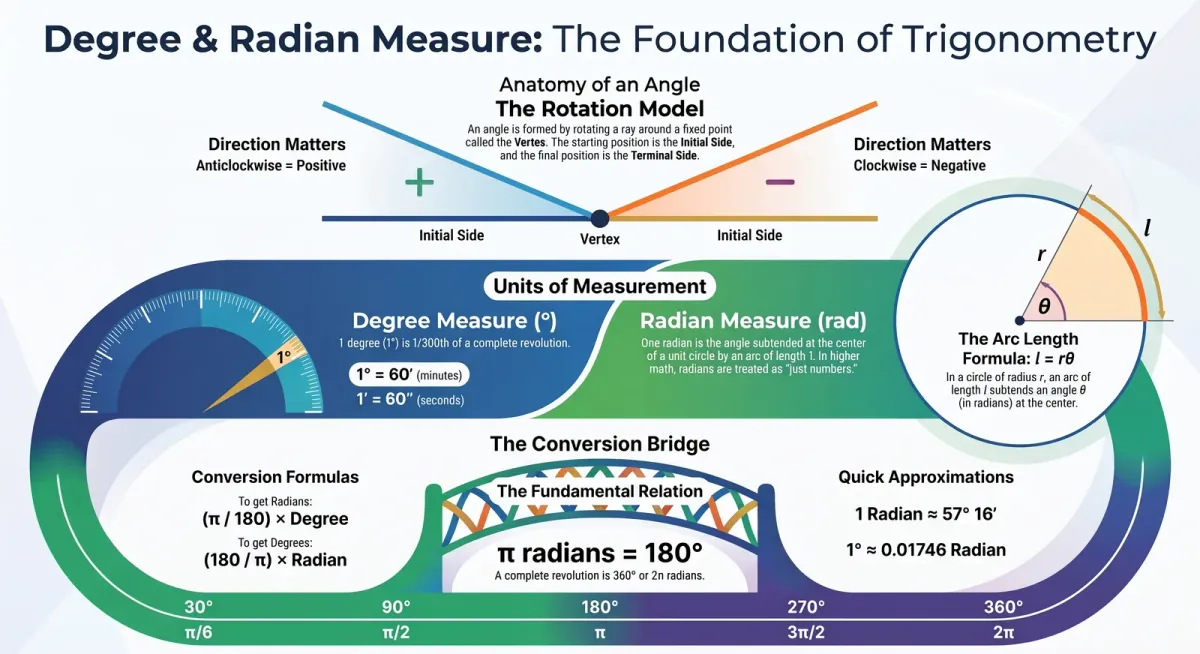
An angle is formed by the rotation of a ray about its starting point. The original position of the ray is called the initial side, and the position it reaches after rotating is called the terminal side. The fixed point around which the ray rotates is the vertex.
This rotation-based definition is more general than the “opening between two lines” idea you may recall from earlier classes, and it is exactly what lets an angle be larger than 360° or even negative.
Positive and Negative Angles
The direction of rotation decides the sign of the angle:
-
If the ray rotates anticlockwise, the angle is positive.
-
If the ray rotates clockwise, the angle is negative.
So an angle of −45° and an angle of 45° have the same “size” but opposite directions of rotation. This convention becomes important later when you study the signs of trigonometric functions in different quadrants.
Units for Measuring Angles
There are two units used throughout this chapter and the rest of the course: degree measure and radian measure.
Degree Measure
If a rotation from the initial side to the terminal side is (1/360)th of a complete revolution, the angle is said to measure one degree, written 1°.
A degree is further divided as:
-
1° = 60 minutes (60′)
-
1′ = 60 seconds (60″)
Degree measure is the unit you have used since school — angles like 30°, 45°, 90°, and 180° are all degree measures.
Radian Measure
The radian is defined using a unit circle (a circle of radius 1 unit). The angle subtended at the centre by an arc of length exactly 1 unit is said to measure 1 radian.
More generally, in a circle of radius r, an arc of length r subtends an angle of 1 radian at the centre. Since equal arcs subtend equal angles, an arc of length l subtends an angle θ (in radians) given by:
θ = l / r, or equivalently, l = r θ
This single relationship — arc length equals radius times angle in radians — is one of the most frequently tested formulas in this chapter, and it reappears in physics (angular velocity, circular motion) throughout Class 11 and 12.
Relation Between Radian and Real Numbers
Every real number corresponds to a unique radian measure, and vice versa. Picture a unit circle with a tangent line at the point representing zero; wrapping the positive real numbers anticlockwise and the negative real numbers clockwise around the circle sets up a one-to-one correspondence between real numbers and radian measures. This is why, in higher mathematics, angles are almost always expressed in radians rather than degrees — radians are “just numbers,” which makes calculus formulas far cleaner.
Relation Between Degree and Radian
Since one complete revolution equals 360° and also equals 2π radians:
2π radian = 360°, or π radian = 180°
From this, the two conversion formulas follow directly:
-
Radian measure = (π / 180) × Degree measure
-
Degree measure = (180 / π) × Radian measure
Using π ≈ 22/7, you also get the useful approximations 1 radian ≈ 57°16′ and 1° ≈ 0.01746 radian.
Here is the standard conversion table you should memorise, since it appears throughout the chapter:
| Degree | 30° | 45° | 60° | 90° | 180° | 270° | 360° |
|---|---|---|---|---|---|---|---|
| Radian | π/6 | π/4 | π/3 | π/2 | π | 3π/2 | 2π |
Solved Examples
Example 1: Convert 40°20′ into radian measure.
40°20′ = 40(1/3)° = (121/3)°. Using radian = (π/180) × degree, this gives (121π)/540 radian.
Example 2: Convert 6 radians into degree measure.
Degree = (180/π) × 6 = (1080 × 7)/22 = 343(7/11)° ≈ 343°38′11″.
Example 3: Find the radius of a circle in which a central angle of 60° subtends an arc of length 37.4 cm (use π = 22/7).
θ = 60° = π/3 radian. Using r = l/θ: r = (37.4 × 3 × 7)/22 = 35.7 cm.
These examples cover the main question types CBSE sets from this section — unit conversion both ways and finding radius from a given arc length.
Why This Topic Matters for CUET, IPMAT and Board Exams
Degree-radian conversion resurfaces in CUET’s quantitative section and indirectly in every later trigonometry chapter, since those chapters assume instant conversion without pausing. Getting this section solid now saves time throughout the rest of the syllabus.
Ready to Practice What You’ve Learned?
Reading the theory is only half the job — degree-radian conversion sticks only after you have solved a range of problems on your own. ChampionsPrep gives you AI-powered practice questions, instant explanations, and topic-wise question banks built directly from the NCERT syllabus for CBSE and Maharashtra State Board Class 11–12 Commerce students, plus CUET, IPMAT, JIPMAT, NPAT, and SET aspirants. Registration is free, and you only pay as you use — so you can start practicing Chapter 3 right away with zero upfront cost. Visit https://app.championsprep.in to get started.
Test Your Knowledge
Degree and Radian Measure of Angles: Complete Guide for CBSE Class 11 Maths
Frequently Asked Questions
What is the difference between degree measure and radian measure? +
Degree measure divides one full revolution into 360 equal parts, while radian measure is based on arc length — one radian is the angle subtended by an arc equal in length to the radius of the circle. Both measure the same angle, just using different scales.
What is the formula to convert degrees to radians? +
Radian measure = (π / 180) × Degree measure. For example, 90° in radians is (π/180) × 90 = π/2.
What is the arc length formula in trigonometry? +
The arc length formula is l = rθ, where l is the arc length, r is the radius of the circle, and θ is the angle in radians (not degrees) subtended at the centre.
Why are radians preferred over degrees in higher mathematics? +
Radians express angles as real numbers rather than an arbitrary 360-part scale, which is why every real number corresponds to exactly one radian measure. This makes formulas in calculus and advanced trigonometry significantly simpler.
How many radians make one complete revolution? +
One complete revolution equals 360°, which is equal to 2π radians (approximately 6.283 radians).
AI-powered practice — free to start