
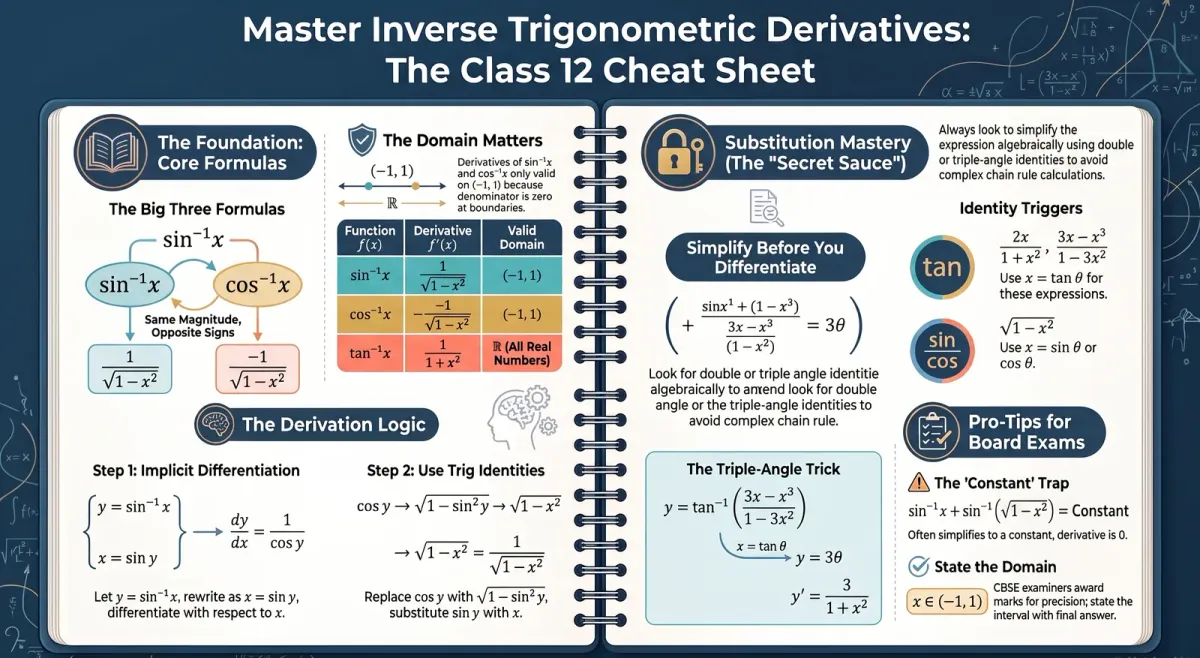
Inverse trigonometric functions — sin⁻¹x, cos⁻¹x, tan⁻¹x and their counterparts — look intimidating at first, but their derivatives follow a small, memorable set of formulas. This topic is a guaranteed scorer in CBSE board exams and CUET Maths papers, especially when combined with clever trigonometric substitutions. Here’s everything you need, from derivation to solved problems.
The Standard Derivative Formulas
Before diving into derivations, memorize this table — it’s the foundation for every question in this topic:
| f(x) | f′(x) | Domain |
|---|---|---|
| sin⁻¹x | 1 / √(1 − x²) | (−1, 1) |
| cos⁻¹x | −1 / √(1 − x²) | (−1, 1) |
| tan⁻¹x | 1 / (1 + x²) | R (all real numbers) |
Notice the pattern: sin⁻¹x and cos⁻¹x have the same magnitude of derivative but opposite signs, while tan⁻¹x has a completely different structure with no square root and a domain of all real numbers.
Deriving the Formula for sin⁻¹x
Step-by-Step Derivation
Let y = sin⁻¹x, so by definition, x = sin y.
Differentiating both sides with respect to x:
1 = cos y × (dy/dx)
dy/dx = 1 / cos y
Now, since y ∈ (−π/2, π/2), cos y is always positive, so we can write cos y = √(1 − sin²y) = √(1 − x²) (using sin y = x).
dy/dx = 1 / √(1 − x²), valid for x ∈ (−1, 1)
This derivation pattern — differentiate implicitly, then rewrite in terms of x using the appropriate identity — is exactly how all inverse trig derivatives are derived, so understanding this one example unlocks the rest.
Solved Example 1: Basic Application
Differentiate f(x) = sin⁻¹x + sin⁻¹(√(1−x²)), for 0 < x < 1.
Using the standard formulas: d/dx[sin⁻¹x] = 1/√(1−x²)
For the second term, let g(x) = √(1−x²). By the chain rule, d/dx[sin⁻¹(g(x))] = [1/√(1−g²)] × g′(x). Since g² = 1−x², this simplifies to 1/√(x²) = 1/x (for the relevant domain), and g′(x) = −x/√(1−x²).
Combining terms and simplifying (a standard CBSE technique) shows this expression is actually constant over the given domain — differentiating it gives 0. This is a classic trick question: always simplify before you differentiate blindly!
Solved Example 2: Using Trigonometric Substitution
Find dy/dx if y = tan⁻¹((3x − x³)/(1 − 3x²)), for −1/√3 < x < 1/√3.
This expression matches the triple-angle identity for tangent: tan(3θ) = (3tanθ − tan³θ)/(1 − 3tan²θ).
Substitute x = tan θ, so θ = tan⁻¹x. Then:
y = tan⁻¹(tan 3θ) = 3θ = 3 tan⁻¹x
dy/dx = 3 / (1 + x²)
This substitution technique — recognizing double-angle or triple-angle identities hidden inside inverse trig expressions — is one of the most tested skills in this section. Common substitutions to remember: x = sin θ or x = cos θ for expressions with √(1−x²), x = tan θ for expressions with (1+x²), and x = sec θ for expressions with √(x²−1).
Solved Example 3: A Compound Expression
Find dy/dx if y = sin⁻¹(2x/(1+x²)), for −1 < x < 1.
Substitute x = tan θ:
2x/(1+x²) = 2tanθ/(1+tan²θ) = sin(2θ) [using the double angle identity]
So y = sin⁻¹(sin 2θ) = 2θ = 2 tan⁻¹x, because for −1 < x < 1 we have 2θ ∈ (−π/2, π/2), which is inside the principal range of sin⁻¹.
dy/dx = 2 / (1 + x²), for −1 < x < 1
Why the domain matters: for x > 1, 2θ lies in (π/2, π), so sin⁻¹(sin 2θ) = π − 2θ and the derivative becomes −2 / (1 + x²). For x < −1 it is also −2 / (1 + x²), and the function is not differentiable at x = ±1.
Notice how the same substitution trick (x = tan θ) simplifies a scary-looking inverse trig expression into something you can differentiate in one line.
Why These Substitutions Work
The substitutions x = sinθ, x = tanθ, or x = secθ are chosen specifically to match a known trigonometric identity buried in the expression — usually a double-angle or triple-angle formula. Once substituted, the inverse trig function often collapses to a simple multiple of θ (like 2θ or 3θ), and since θ = (the corresponding inverse trig function of x), differentiating becomes trivial. Recognizing which substitution to use comes with practice — look for structures like 2x/(1+x²), (1−x²)/(1+x²), or (3x−x³)/(1−3x²) as strong hints.
A Note on Domain Restrictions
CBSE examiners frequently test whether you remember that these derivative formulas only hold within specific domains. sin⁻¹x and cos⁻¹x are defined for x ∈ [−1, 1], but their derivatives are only valid on the open interval (−1, 1) — at the endpoints x = 1 and x = −1, the derivative formula involves division by zero (since √(1−x²) = 0 there), so the function is not differentiable at those boundary points, even though it is continuous. tan⁻¹x, by contrast, is defined and differentiable across all real numbers, since 1 + x² can never be zero. Always state the domain alongside your final derivative in board answers — examiners award marks for this precision.
Tips for Scoring Full Marks in This Topic
-
Memorize the three core formulas — everything else builds on sin⁻¹x, cos⁻¹x, and tan⁻¹x.
-
Always check the domain before differentiating — the formulas only hold within specific ranges.
-
Look for hidden identities before applying the chain rule directly — many “hard” problems become one-line answers after the right substitution.
-
Simplify algebraically first whenever you see combinations like sin⁻¹x + sin⁻¹(√(1−x²)), which equals π/2 for 0 ≤ x ≤ 1 — they’re often disguised constants.
-
Practice both derivation and application — CBSE tests both “find the derivative of sin⁻¹x” (recall) and complex substitution problems (application) in the same paper.
Master Inverse Trig Derivatives With Targeted Practice
Substitution-based inverse trig problems are where most students lose marks under time pressure. Build pattern recognition with topic-wise practice sets and instant doubt-solving at ChampionsPrep for just ₹10 per use. Practice today and turn this into one of your strongest scoring topics.
Test Your Knowledge
Derivatives of Inverse Trigonometric Functions Class 12: Formulas & Solved Problems
Frequently Asked Questions
What is the derivative of sin inverse x? +
The derivative of sin inverse x is 1 divided by the square root of (1 minus x squared), valid for x in the open interval between minus one and one.
What is the derivative of tan inverse x, and what is its domain? +
The derivative of tan inverse x is 1 divided by (1 plus x squared), and it is valid for all real numbers since the denominator is never zero or negative.
How do you differentiate complicated inverse trigonometric expressions? +
Use trigonometric substitution, commonly x equals sine theta, tangent theta, or secant theta, to convert the expression into a recognizable double or triple angle identity, which usually simplifies the function to a simple multiple of theta.
Why is the derivative of cos inverse x negative while sin inverse x is positive? +
Because sin inverse x plus cos inverse x equals a constant, pi over two. Differentiating both sides shows their derivatives must be exact negatives of each other.
Are inverse trigonometric functions continuous and differentiable everywhere? +
Inverse trigonometric functions are continuous throughout their domains, but they are only differentiable within the open interval of that domain, not at the endpoints.
AI-powered practice — free to start